


Most teams don't have a work problem. They have a decision problem wearing a work costume.
You can see it in the standup where nothing actually moves. Three engineers are technically "blocked," but not on code — they're waiting on someone to confirm whether the pricing tier logic should round up or down. The PM says it's a product call. The product lead says it's a business policy question. Finance thinks it's obvious and doesn't understand why anyone is asking. Two weeks pass. The ticket sits in "in progress" the whole time, which makes your dashboards lie to you.
Decisions in a growing org don't announce themselves. They hide inside tasks. And because nobody owns deciding, the work stalls in a way that's almost invisible until you go looking for it. A real decision architecture for teams isn't about adding process for its own sake. It's about making decisions something you can actually see, assign, time, and measure — the same way you already treat code, tickets, and releases.
Why decisions rot in the middle of teams
There's a pattern that shows up almost everywhere once a team crosses roughly 15–20 people: the number of people who can have an opinion grows faster than the number of people who are actually allowed to decide. Early on, five people in a room settle everything in ten minutes. Nobody writes down who owns what because they don't need to. The founder or lead makes the tough calls, everyone else fills gaps naturally.
Then you hire. You add a second squad. You bring on a design lead, a data person, maybe a compliance contact. Suddenly every decision has more stakeholders and no clearer owner. What used to be a hallway conversation becomes a Slack thread with 14 people, three of whom weren't invited but showed up anyway.
A few things reliably break at this stage:
-
Ownership gets fuzzy. Everyone assumes someone senior will "handle it," so nobody does.
-
Decisions get re-litigated. Something gets decided Tuesday, then a stakeholder who missed the thread reopens it Thursday. No record exists, so there's nothing to point to.
-
The default becomes "escalate." When people aren't sure they're allowed to decide, they kick it upstairs. Leadership becomes a bottleneck for choices that never should have reached them.
-
Speed and quality both drop. Slow and sloppy, because rushed calls get made under pressure once the delay becomes painful.
Scaling teams keep investing in delivery process — better sprints, cleaner backlogs, tighter definition of ready — while the actual bottleneck is upstream, in the murky space where nobody knows who gets to say yes. You can optimize the assembly line all you want. If the person approving the blueprint takes nine days, the line just idles faster.
Step one: classify the decision before you try to make it
Not all decisions deserve the same weight, and treating them equally is where most teams waste their energy. A reversible technical choice does not need a committee. A pricing policy change should never be made by one engineer at 6pm because they were tired of waiting.
Eliminate team chaos and missed deadlines.
Temsly helps you assign, track & complete projects efficiently with full visibility.
- Centralized task management
- Real-time team communication
- Resource and deadline tracking
No credit card required
The cleanest split that tends to work uses four buckets:
| Decision Type | What it covers | Reversibility | Who should own it | Typical target speed |
|---|---|---|---|---|
| Tactical | Day-to-day execution: task sequencing, small scope tradeoffs, minor UX tweaks | Easy to reverse | The person doing the work | Same day |
| Technical | Architecture, tooling, data models, integration patterns | Medium — costly but recoverable | Tech lead / senior eng | 1–3 days |
| Product | Feature scope, prioritization, user-facing behavior | Medium | Product owner, with input | 2–5 days |
| Policy | Pricing, compliance, data handling, anything with legal or financial exposure | Hard to reverse | Named exec or cross-functional group | Explicit deadline, no default |
The insight that actually changes behavior: reversibility should drive how much process you attach. Jeff Bezos's "one-way vs two-way door" framing is useful, but teams misapply it constantly — they treat easily reversible calls like they're permanent, and permanent ones like they're throwaway. Tactical decisions get strangled in review while genuine policy decisions get made informally in a DM. Flip that and you've already recovered a lot of lost time.
One mistake to watch for: people misclassify on purpose. An engineer who wants to avoid a hard conversation will label a product decision "technical" so they can just decide it alone. A stakeholder who wants control will label something tactical as "policy" to force it up to a committee they sit on. Classification isn't neutral, so it helps to have the type visible and challengeable rather than just assumed.
Step two: map decision rights, not just responsibilities
RACI charts are where good intentions go to die. They're too heavy, nobody updates them, and half the org can't remember whether they're "consulted" or "informed" on any given thing.
What actually works is lighter — a decision-rights map that answers one question per decision type: who has the D? Who is the single person or defined group that gets to make the final call, even when there's disagreement?
-
List your recurring decision types. Not every possible decision — the 8 to 12 that keep coming up and keep stalling. Deployment approvals, scope cuts, vendor selection, pricing exceptions, and so on.
-
Assign one decider per type. One name, or one clearly defined group with a chair who breaks ties.
-
Name the required input-givers. These are people who must be consulted but do not get a vote. Keep this list short. Three is fine, seven is a meeting.
-
State the fallback. If the decider is out, who acts? This single line prevents the "we couldn't decide because Priya was on PTO" week.
Worth noting: separate the right to decide from the right to be heard. Most conflict inside teams isn't really about the outcome — it's about people feeling steamrolled. If someone knows they'll genuinely be consulted, they'll usually accept a decision they disagree with. If they feel the process ignored them, they'll relitigate it forever. Clear decision rights actually reduce interpersonal friction, which is the opposite of what people expect when you start formalizing things.
This is also where good governance patterns matter. If you want to go deeper on how committees and escalation ladders create predictable delivery instead of bureaucracy, that's covered in Why Governance Patterns (Committees, Escalation Ladders, Gates) Produce Predictable Cross‑Functional Delivery.
Step three: require a decision artifact (a small one)
This is the part that feels like overhead and isn't. Every non-trivial decision should leave a trace. Not a document. A trace.
The failure mode without it is brutal. A choice gets made in a thread, the thread scrolls away, and six weeks later someone asks "why did we build it this way?" Nobody remembers. So you rebuild the debate from scratch, usually reaching a different conclusion, which then contradicts the original code, and now you've got two half-built approaches fighting each other in production.
-
What we decided (one sentence)
-
Why (the two or three real reasons, including what's being deliberately traded away)
-
Who decided and who was consulted
-
When we'll revisit it, if ever
That's it. The goal isn't documentation completeness — it's stopping the same argument from happening twice. Teams that adopt even this minimal version stop re-litigating old choices, and onboarding gets dramatically easier because new people can read why instead of guessing.
The common mistake: making the artifact too heavy. The moment it becomes a formatted doc with a template and mandatory reviewers, people stop writing them. A pinned message in the right channel counts. A one-line entry in a decision log counts. Friction is the enemy — the artifact has to be faster to write than the confusion it prevents.
Step four: set SLAs and escalation gates on decisions
You already put SLAs on requests and tickets. Decisions deserve the same treatment, because an un-timed decision defaults to "whenever," and "whenever" is where velocity dies.
The mechanic is simple: each decision type gets a maximum time-to-decide. Tactical, same day. Technical, up to three days. Product, up to a week. Policy gets an explicit deadline tied to whatever it's blocking. When the clock runs out, an escalation gate triggers — the decision moves up a level, or a pre-named backstop decider makes the call.
Here's a simple visual of the escalation flow so teams can see how SLAs, reminders, and backstops interact.
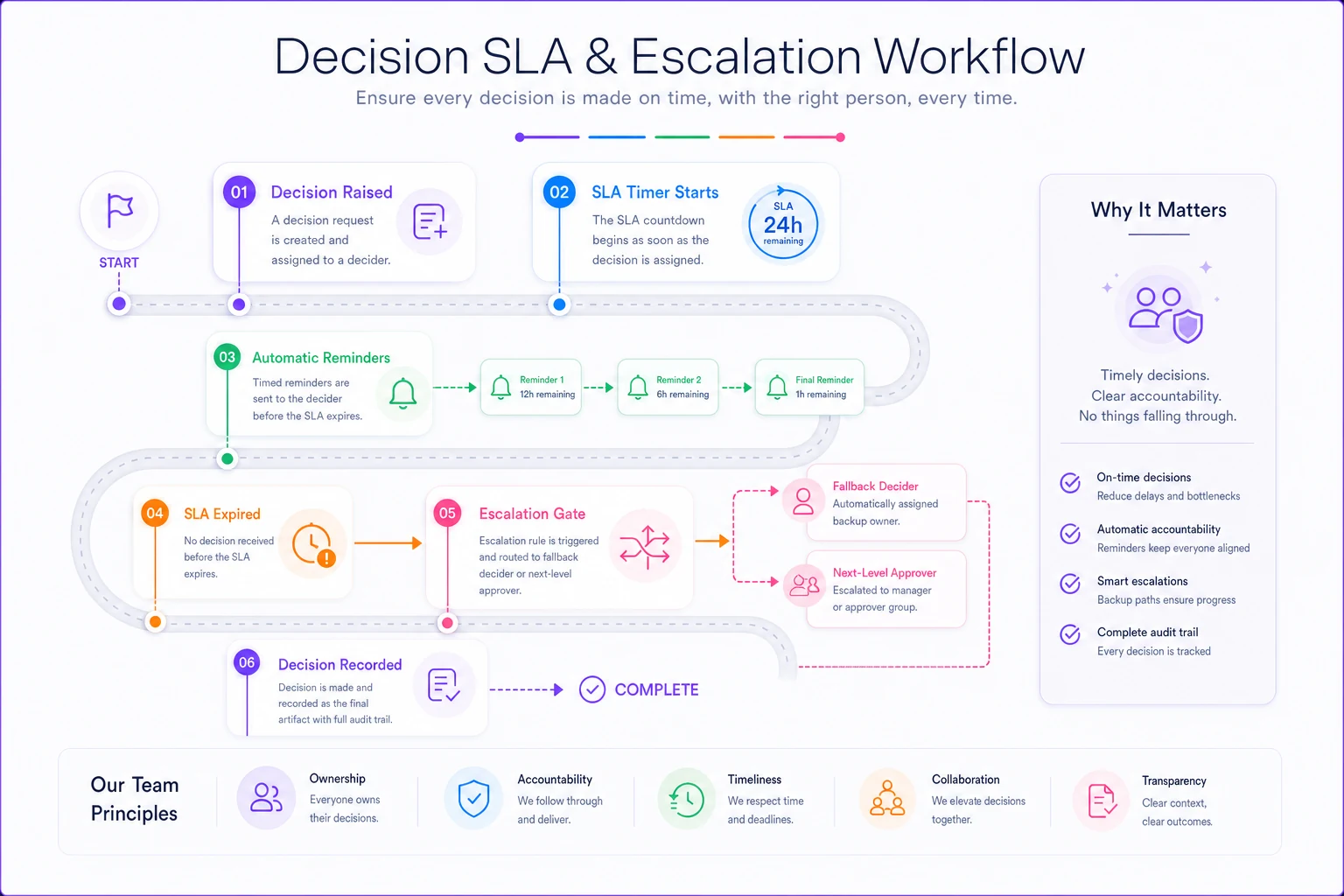
The reason this works is a bit subtle. It's not really about the deadline itself. It's about removing the guilt tax on chasing people. Right now, when a decision is stuck, someone has to be the annoying person who keeps pinging leadership. Most people won't do that, so things rot. When there's a defined SLA and an automatic escalation, nobody has to be the villain — the system nudges, not a person.
This pairs closely with how you handle competing priorities. When five people all insist their decision is the urgent one, you need a way to arbitrate rather than just reward whoever is loudest. The scoring and arbitration approach in Prioritize When Everyone Says It's Urgent: A Scoring Rubric, Arbitration Flow and Negotiation Scripts fits directly on top of decision SLAs.
One caution: don't set SLAs so tight that people just rubber-stamp to beat the clock. The deadline should force a decision, not force a bad one. If a policy call genuinely needs more information, the right move is to extend the gate with a reason logged — not to blow past it silently.
Step five: measure decision velocity with a few honest metrics
You can't improve what you refuse to look at, and most teams have zero visibility into how long their decisions actually take. The work is tracked to the hour; the decisions blocking the work are tracked nowhere.
-
Time-to-decide — from when a decision is raised to when it's resolved, by type. This is your headline number.
-
Escalation rate — what percentage of decisions blow past their SLA and get escalated. A rising rate means either your deciders are overloaded or your rights map is wrong.
-
Reopen rate — how often a "decided" thing gets reopened. High reopen rates almost always trace back to missing artifacts or people who felt unheard.
-
Decisions in flight — how many open decisions exist right now. This is your early-warning gauge; it spikes before delivery slows.
A dashboard for this doesn't need to be fancy. A single view showing open decisions by type, days-in-flight, and owner tells you more about next month's velocity than your burndown chart does.
The pattern worth paying attention to: decision backlog leads delivery backlog by a couple of weeks. When decisions-in-flight climbs, delivery slows shortly after. Catch it early and you can shift decider capacity before it becomes a delivery miss. Most teams only notice the delivery slowdown — by which point you're already two weeks behind where you could've intervened.
Where lightweight tooling genuinely helps is the tracking itself. Nobody wants to hand-maintain a decision log, so it dies. Workflow platforms with some automation can timestamp when a decision is raised, ping the owner, trigger the escalation gate at the SLA line, and roll the numbers into a dashboard without anyone babysitting it. The value isn't clever software — it's that the boring, easy-to-drop steps happen on their own, so the system survives contact with a busy week.
A real scenario: a 30-person B2B software team
A mid-stage B2B software company, around 30 people across three squads, kept missing release dates that had nothing to do with engineering effort. When they actually traced their stalled tickets, roughly a third of the delay was decision wait time — tickets sitting idle because a scope, pricing, or integration call hadn't been made.
Their average time-to-decide on product and policy calls was hovering somewhere around 8–9 days. Not because the decisions were hard, but because nobody knew who owned them, so most got informally escalated to two overloaded leads.
They did three things: classified their recurring decisions into the four buckets, named one decider per type with a fallback, and put a 3-day SLA on technical and product calls with an auto-escalation gate. They also started logging one-line decision artifacts in a shared channel.
Within about two months, average time-to-decide on those calls dropped to under three days. Reopen rate fell off noticeably once artifacts existed — people stopped reopening settled questions because there was finally something to point to. Delivery predictability improved more than any sprint-process change had managed in the previous year. The engineers didn't work faster. They just stopped waiting.
When this makes sense — and when it doesn't
When it's worth building: teams past roughly 15 people, multiple squads or functions that depend on each other, or any org where leadership has quietly become the bottleneck for routine choices. If your standups are full of "still blocked on a decision," you're the target case.
When it's overkill: a tight team of five or six who genuinely fit in one room. Formalizing decision rights there just adds ceremony to something that already works. Keep it informal until the pain shows up — and it will announce itself as re-litigated choices and decisions nobody owns.
Who should not do this: anyone hoping process will fix a trust problem. If leadership won't actually delegate the D — if they say engineers own technical calls but then override them routinely — no architecture will save you. The map only works if people respect it. Decision rights without the willingness to honor them just creates a paper trail of ignored authority, which is worse than no map at all.
A rollout checklist
Before going through the checklist, it's worth being honest about sequencing. Most teams try to implement everything at once and end up with a half-finished system that nobody trusts. Pick the two or three recurring decisions that cause the most pain, run the full model on those first, and expand from there once it's working.
-
[ ] List the 8–12 recurring decisions that keep stalling your team
-
[ ] Classify each as tactical, technical, product, or policy
-
[ ] Assign one decider (or one group with a chair) per type
-
[ ] Name a fallback decider for each, for coverage gaps
-
[ ] Set a max time-to-decide per type
-
[ ] Define what happens when the SLA is breached (escalation gate)
-
[ ] Create a dead-simple decision artifact format (four lines max)
-
[ ] Pick one place decisions get logged — and only one
-
[ ] Track time-to-decide, escalation rate, reopen rate, decisions-in-flight
-
[ ] Review the numbers monthly and adjust rights where escalation rates run high
Getting through even the first five items on that list puts you ahead of most teams at this size. The rest can follow once the basics are holding.
Where this connects to the rest of your operating model
Decision architecture isn't a standalone fix. It sits underneath everything else you've built. Your SLAs on incoming requests mean nothing if the decisions those requests trigger have no owner. Your dependency planning falls apart if the cross-team calls it depends on take nine days. Even your meeting load is downstream of this — a huge share of recurring meetings exist purely because nobody trusts a decision to get made async. Fix the decision rights and a lot of those meetings quietly become unnecessary, which is exactly the shift explored in Why Enforceable Async Rules Cut Meeting Load: Templates to Replace Common Status and Coordination Meetings.
The teams that move fast aren't the ones with the most talented people or the cleanest backlog. They're the ones where a decision, once raised, actually gets made — by a known owner, within a known window, with a trace left behind. Everything else in your delivery pipeline is downstream of that. Start by making your decisions visible, and you'll be surprised how much of your "capacity problem" was a decision problem the whole time.
The teams that move fast aren't the ones with the most talented people or the cleanest backlog. They're the ones where a decision, once raised, actually gets made — by a known owner, within a known window, with a trace left behind. Everything else in your delivery pipeline is downstream of that. Start by making your decisions visible, and you'll be surprised how much of your "capacity problem" was a decision problem the whole time.
Ready to elevate your team's performance?
Join 2,000+ teams using Temsly to streamline workflows, boost productivity, and deliver projects on time.