


Walk into any operations meeting where marketing promised a 6-week product launch, engineering heard 16 weeks, and sales already told three enterprise clients it ships Monday. The project manager stares at a spreadsheet showing 47 approval chains across 11 departments, wondering how a feature update became organizational chaos.
This happens constantly. Not because teams are bad at their jobs, but because most companies build governance backwards—starting from crisis management instead of operational design.
Companies add steering committees after marketing and engineering clash over priorities. They create escalation paths after discovering critical projects stalled in legal for weeks. They implement stage gates after shipping something customer success can't support.
You get a patchwork of reactive controls that slow everything without improving outcomes.
The Three Patterns That Actually Work
Three governance patterns separate predictable delivery from firefighting: decision committees, escalation ladders, and stage gates. They work because they create clarity where confusion normally lives.
Decision Committees That Decide (Not Just Meet)
Most cross-functional committees become status update theater. Everyone talks, nobody commits. Real decision committees work differently.
Bounded authority. The committee approves budgets up to $75,000, timeline extensions up to 2 weeks, scope changes affecting 3 departments max. Beyond that? Automatic escalation. No debate.
Rotating ownership. Each decision gets assigned to one committee member who owns the outcome for 90 days. Not the discussion—the actual result. When the mobile app integration fails because they approved insufficient QA resources, everyone knows who made that call.
Decision velocity tracking. Every committee decision gets timestamped from request to resolution. Product feature requests sitting in queue for 72 hours? Measurable. Customer escalations taking 11 days? Fixable.
A logistics company restructured their committees after their "steering committee" discussed the same warehouse system upgrade for 14 months without deciding anything. They created three decision layers: operational (daily decisions under $10k), tactical (weekly under $100k), strategic (monthly over $100k).
The operational committee—warehouse ops, IT, finance—could approve day-to-day operations without waiting for executive alignment. Tactical handled vendor selection and resources. Strategic dealt with platform decisions and multi-year investments.
Average decision time dropped from 23 days to 6 days. Not through better meetings, but clearer boundaries about who decides what.
Escalation Ladders That Skip Levels
Traditional escalation follows org charts. Problem starts with developer, goes to tech lead, engineering manager, director, VP. Three weeks later it reaches someone who can actually solve it, but the customer already left.
Functional escalation maps problems to decision-makers, not reporting structures.
Technical blockers skip to the technical architect, regardless of org level. API integration failing? You need the person who designed the integration framework, not six management layers.
Resource conflicts jump to the resource planning committee. When QA and customer success both need the same technical writer, middle management politics won't solve it. The resource committee sees all projects and makes trade-offs.
Customer impact escalates immediately to a cross-functional rapid response team. Not executives or account managers—a standing team with support, engineering, and operations who can actually fix things.
A healthcare software company built this after losing a major hospital because a critical bug sat in normal escalation for 8 days. They mapped every project blocker to specific paths:
-
Integration failures → Technical architecture team (2-hour SLA)
-
Compliance questions → Legal/security team (24-hour SLA)
-
Resource conflicts → Planning committee (48-hour SLA)
-
Customer escalations → Rapid response team (4-hour SLA)
-
Budget overruns → Finance/project sponsor (72-hour SLA)
They didn't reduce problems. They reduced how long problems stayed hidden in management layers.
Stage Gates With Teeth
Most stage gates are ceremonial checkpoints where projects get waved through because nobody wants to delay timelines. Real gates make binary decisions: proceed or stop.
Not "proceed with concerns" or "conditionally approve pending review." Either the project meets criteria or it doesn't.
This needs three elements most gates lack:
Measurable exit criteria defined upfront. Not "customer success comfortable with rollout" but "customer success has training materials for 80% of features and scheduled training for 50% of tier-1 accounts."
Independent gatekeepers. The engineering lead who pushed for this feature for two years shouldn't decide if it's production-ready. An independent technical reviewer with no timeline stake makes that call.
Consequences for failure. When projects fail gates, something specific happens: resources reallocate, timelines reset, sponsors change. Without consequences, gates become suggestions.
When projects fail gates, something specific happens: resources reallocate, timelines reset, sponsors change. Without consequences, gates become suggestions.
Decision-to-Pattern Mapping
The trick isn't having all three patterns—it's knowing when to use each. Map decision types to governance patterns based on impact and urgency.
Eliminate team chaos and missed deadlines.
Temsly helps you assign, track & complete projects efficiently with full visibility.
- Centralized task management
- Real-time team communication
- Resource and deadline tracking
No credit card required
| Decision Type | Governance Pattern | Trigger Criteria | Typical Timeline |
|---|---|---|---|
| Resource allocation across teams | Decision Committee | >3 departments affected or >$50k budget impact | 3-5 business days |
| Technical architecture choices | Escalation Ladder | Blocked progress or integration failure | 2-4 hours |
| Scope changes mid-project | Decision Committee | >20% timeline impact or feature addition/removal | 48-72 hours |
| Quality/compliance approval | Stage Gate | Pre-defined phase completion | 1-2 business days |
| Vendor selection | Decision Committee | >$25k annual spend or critical system | 5-10 business days |
| Production incidents | Escalation Ladder | Customer-facing impact or data risk | 15-60 minutes |
| Release readiness | Stage Gate | Code complete, QA complete, documentation complete | 24 hours |
| Priority conflicts | Escalation Ladder | Two teams need same resource | 4-24 hours |
| Budget overruns | Decision Committee | >10% over approved budget | 24-48 hours |
| Launch go/no-go | Stage Gate | All launch criteria met/not met | 4 hours |
The mapping matters less than having one. When everyone knows resource conflicts go to planning committee within 24 hours, people stop having three-week email threads about who gets the senior designer's time.
How Patterns Break
Even good patterns fail predictably.
Committee capture happens when one personality or department dominates decisions. 80% of decisions favor one team, or the same person always wins. Fix this by rotating decision ownership and requiring written justifications.
Escalation fatigue occurs when teams escalate everything because it's faster than normal channels. Real emergencies get lost in noise. Track escalation frequency by team and type. When mundane issues repeatedly escalate, fix the underlying process.
Gate gaming emerges when teams learn to pass gates without meeting intent. They produce unread documentation, run tests that don't reflect real usage, get sign-offs from people who haven't reviewed work.
A financial services company discovered their stage gates were pure theater after three consecutive projects passed all gates but failed immediately in production. Gatekeepers were approving based on PowerPoints, not deliverables.
They instituted one rule: no gate review without hands-on validation. Gatekeepers had to actually use the software, review documentation, test integrations. Gate failure rate jumped to 30% initially, but production failures dropped to nearly zero.
Building Your Governance Stack
Creating working patterns means avoiding extremes: the free-for-all where nothing has process, and bureaucracy where everything needs twelve approvals.
Map current decision flows first. Track for two weeks:
-
What decisions actually get made
-
Who makes them
-
How long they take
-
What happens when they're wrong
You'll spot the patterns. Decisions bouncing between departments for weeks. Escalations dying in middle management. Gates that never reject anything.
Week 1-2: One decision committee for resource conflicts only. Give it bounded authority ($X budget, Y timeline impact) and track every decision.
Week 3-4: Escalation paths for your top three blockers. Usually technical problems, resource conflicts, customer issues. Skip management layers—go to people who can act.
Week 5-6: One meaningful stage gate. Pick where most projects fail—usually between development and deployment, or pilot and rollout. Define specific, measurable criteria.
Week 7-8: Measure decision velocity. How long from problem identified to problem resolved? Not discussion started or committee convened—actual resolution.
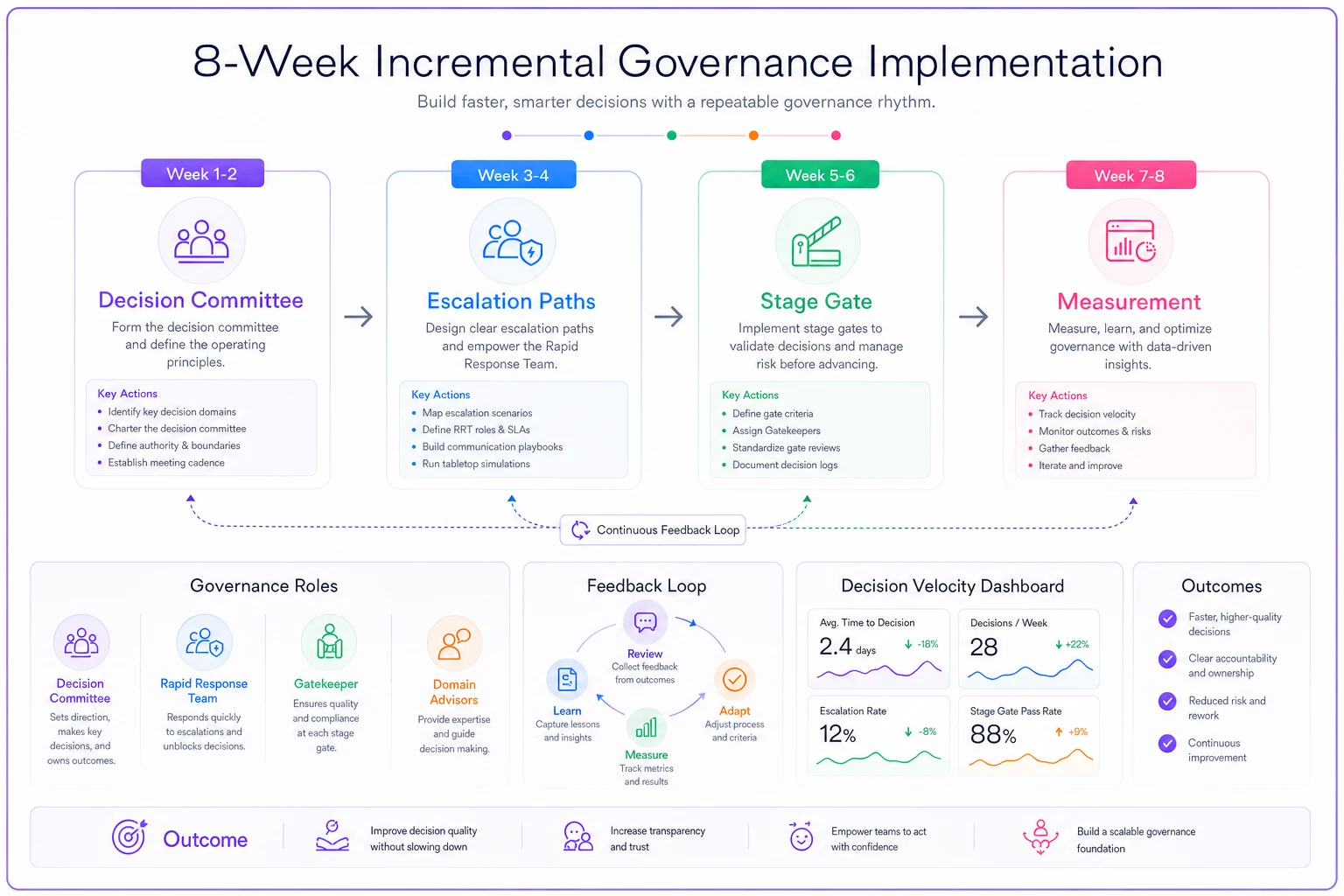
This visual summarizes the incremental rollout described above.
Track decision velocity from day one to see where cycles stall.
This incremental approach lets you debug each pattern before adding complexity. Most organizations implement all governance simultaneously and create a mess nobody follows.
The Real Work
Cross-functional governance isn't about control—it's coordination. Working patterns don't create more meetings or documentation. They create clarity about who decides what, when decisions happen, what standards must be met.
Companies that ship predictably don't have perfect processes. They have clear patterns everyone understands and mostly follows. Their committees make decisions. Their escalations reach people who can act. Their gates prevent bad releases, not all releases.
You already have governance patterns—they're just implicit and inconsistent. The question is whether you'll design them intentionally or let them evolve crisis to crisis.
Start with one pattern. Make it work. Add another.
Build governance like any operational system: incrementally, with measurement, constant adjustment based on what happens. Predictable delivery isn't about the best teams or newest tools. It's about clear patterns for the thousand small decisions that determine whether projects ship or stall.
Ready to elevate your team's performance?
Join 2,000+ teams using Temsly to streamline workflows, boost productivity, and deliver projects on time.