
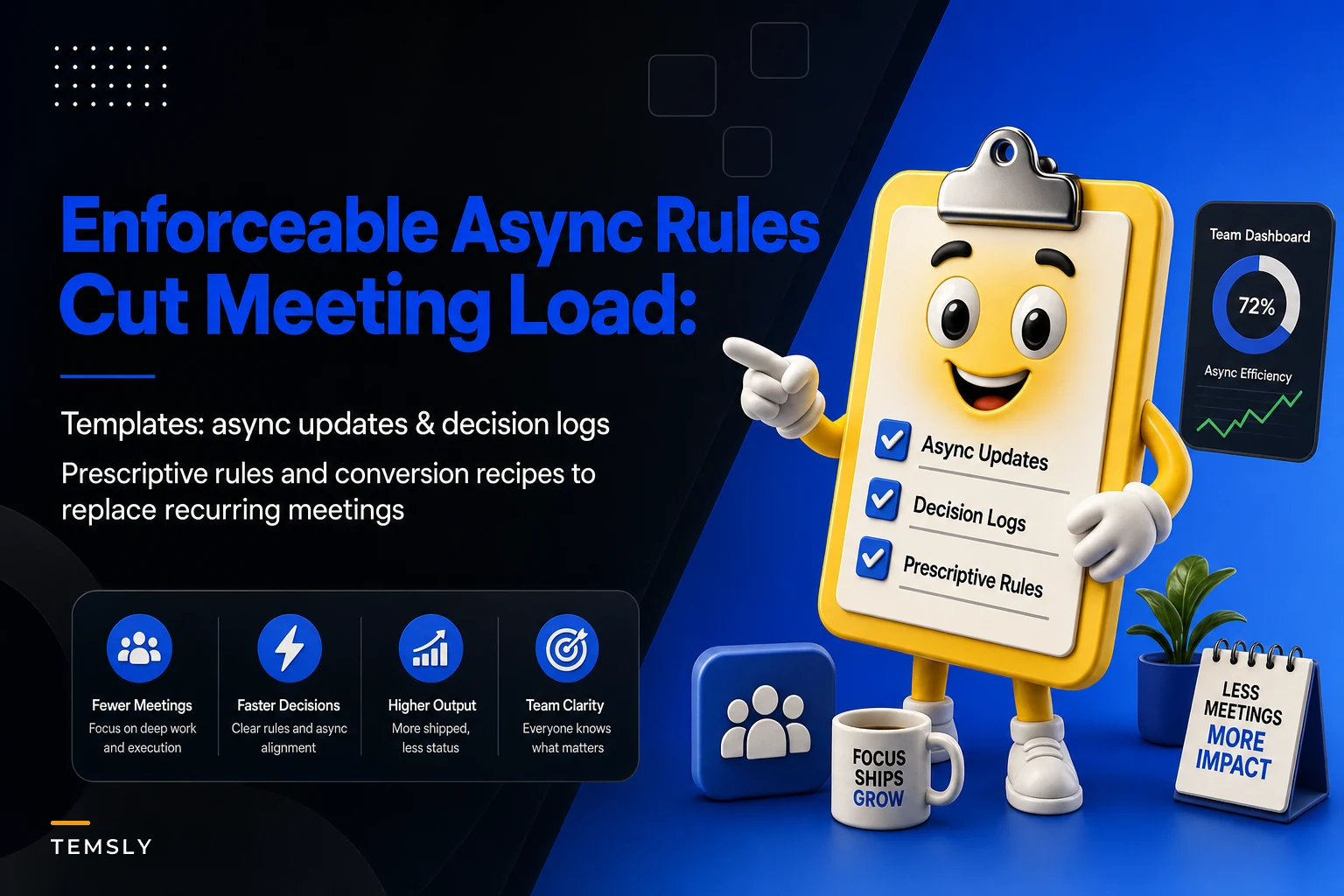

Picture Monday morning engineering sync. Twenty minutes scheduled, always runs thirty-five. Eight developers sitting through updates that matter to maybe two of them. Product manager juggling tabs while someone explains a database migration nobody else understands. That's 280 minutes of collective time every Monday. At $85/hour average developer cost, you're burning $396 per meeting. Times fifty weeks equals nearly $20,000 on one recurring meeting that could be a Slack thread.
Now count your status meetings, coordination syncs, review sessions. The math gets uncomfortable fast.
Most teams never calculate the coordination tax
Teams running 12-15 hours of recurring meetings think they're being collaborative. They're fragmenting deep work into useless 23-minute chunks between calendar blocks.
Typical product designer trying to finish a feature spec: 9:00 AM - Opens Figma, starts mapping user flow 9:23 AM - Notification for 9:30 standup 9:30 AM - Sits through backend deployment updates 10:05 AM - Meeting runs over, grabs coffee 10:15 AM - Tries remembering the Figma work 10:40 AM - Finally back in flow 11:00 AM - Design review starts
Two attempts at meaningful work, zero completed outcomes. More time context-switching than designing. The coordination tax isn't just meeting time. It's fifteen minutes before when you stop working because why start something new? Twenty minutes after while your brain refocuses. Checking your calendar six times to figure out when you can actually work.
Async rules without enforcement are wishful thinking
Every team wants fewer meetings. They create Slack channels for updates. Build Notion databases for tracking. Buy Loom licenses for video updates. Six weeks later, meetings are back.
Eliminate team chaos and missed deadlines.
Temsly helps you assign, track & complete projects efficiently with full visibility.
- Centralized task management
- Real-time team communication
- Resource and deadline tracking
No credit card required
Marketing team tried going async for weekly reviews. Created shared doc for updates. Week one: three people posted. Week two: one person posted at 11:58 PM Sunday. Week three: CMO scheduled "emergency sync" because project status was unclear. Week four: meeting returned to everyone's calendar.
What went wrong? No enforcement. No clear format. No accountability. Most importantly, no recipe for converting that meeting type into an async workflow that delivers the same outcomes.
Four meeting types you can eliminate immediately
Not every meeting can go async. Quarterly planning needs real-time debate. Customer escalations require immediate problem-solving. But many recurring meetings exist purely for information transfer, not decision-making.
Status Updates and Progress Reviews
These meetings pretend to be about alignment but they're really about manager anxiety over visibility. The information exchange takes three minutes. The remaining twenty-seven is theatrical reassurance that work is happening.
Coordination and Handoff Meetings
The classic "let's sync on next steps" where six people discuss work affecting two of them. These happen because nobody trusts handoffs will work without verbal confirmation.
FYI and Announcement Meetings
All-hands where leadership reads slides that could've been an email. Team meetings where someone walks through a deck already shared. These exist because presenters want to feel heard, not because listeners need synchronous delivery.
Review and Feedback Sessions
Design reviews where seven stakeholders give conflicting real-time feedback. Code reviews where developers explain approaches while others half-listen. These create more confusion than clarity because synchronous feedback is rarely thoughtful.
The async update template that actually gets filled out
Most async templates fail because they ask for essays when people barely have time for bullet points. Here's what works:
The Three-Line Status Update
Line 1: What shipped/completed this week (specific deliverables only) Line 2: What's actively in progress (with expected completion) Line 3: Blocked on: [specific person/decision/resource] No context. No storytelling. No explanations.
Engineering team example:
-
Shipped User auth flow v2, API rate limiting, customer data export feature
-
In Progress Payment integration (completing Thursday), mobile responsive fixes (completing tomorrow)
-
Blocked on Need product decision on subscription tiers (blocking payment work after Thursday)
Takes forty seconds to write, ten seconds to read. Manager can scan eight of these in under two minutes and spot patterns, blockers, and concerns immediately.
Make the deadline visible (e.g., updates due by 9 AM) and surface late submissions so teams can act on compliance data.
Enforcement: Updates by 9 AM Monday or tickets get deprioritized for the week. Harsh? Maybe. Effective? Absolutely.
The decision log that eliminates coordination meetings
Half your coordination meetings exist because nobody remembers what was decided. You spend fifteen minutes reconstructing previous conversations before making progress.
A decision log eliminates this meeting category entirely:
Decision Log Format
Decision: [One sentence, specific and actionable] Made by: [Single person accountable] Date: [When decided] Context: [Two sentences max on why] Dissent noted: [Who disagreed and their alternative] Review date: [When we'll evaluate if this was right]
Product team example:
Decision: Ship mobile app without offline mode in v1 Made by: Sarah Chen (Product Lead) Date: March 15 Context: Customer interviews showed 94% usage happens with connectivity. Offline adds 6 weeks to timeline. Dissent noted: James (Eng) wanted partial offline for shopping cart Review date: May 1 (post-launch metrics review)
No meeting needed to revisit this. No confusion about who decided. No pretending everyone agreed.
Meeting replacement recipes that preserve outcomes
Converting meetings to async isn't about eliminating communication. It's delivering the same outcomes through better mechanisms.
Recipe 1: Daily Standup → Async Thread
Old Way: 15-minute daily meeting, everyone shares updates verbally
-
Dedicated Slack channel with threaded daily posts
-
Post between 8-9 AM local time
-
Format
Three-line update (shown above)
-
Manager posts summary of blockers by 10 AM
-
Blockers get assigned owners in-thread
Enforcement: Miss two updates in a week, get a 1-on-1 scheduled to discuss workload
Result: Twelve engineers saved 10 hours weekly, deployment velocity increased roughly 20% due to fewer context switches
Recipe 2: Weekly Review → Async Scorecard
Old Way: 60-minute weekly review going through metrics and project status
-
Automated dashboard pulls key metrics every Monday at 6 AM
-
Each lead posts one-paragraph analysis by noon
-
Format
Metric trend + cause + action needed
-
Questions go in comments, answers required within 4 hours
-
Escalations trigger sync discussion (rare)
Enforcement: No analysis by noon means projects get reviewed in detail next week
Result: Marketing team reduced weekly reviews from 3 hours to 20 minutes of async reading
Recipe 3: Handoff Meeting → Structured Handoff Doc
Old Way: 30-minute meeting every time work moves between teams
-
Standardized handoff template in project management tool
-
Five required fields
deliverable, acceptance criteria, deadline, dependencies, contact for questions
-
Receiving team has 24 hours to acknowledge or ask questions
-
No acknowledgment = automatic escalation to both managers
Enforcement: Incomplete handoffs get rejected automatically, work doesn't transfer
Result: Product-to-engineering handoffs dropped from 18 meetings weekly to 2
These recipes work because they preserve the essential outcome (coordination, status visibility, decision tracking) while eliminating the time-wasting ritual of gathering everyone in a room.
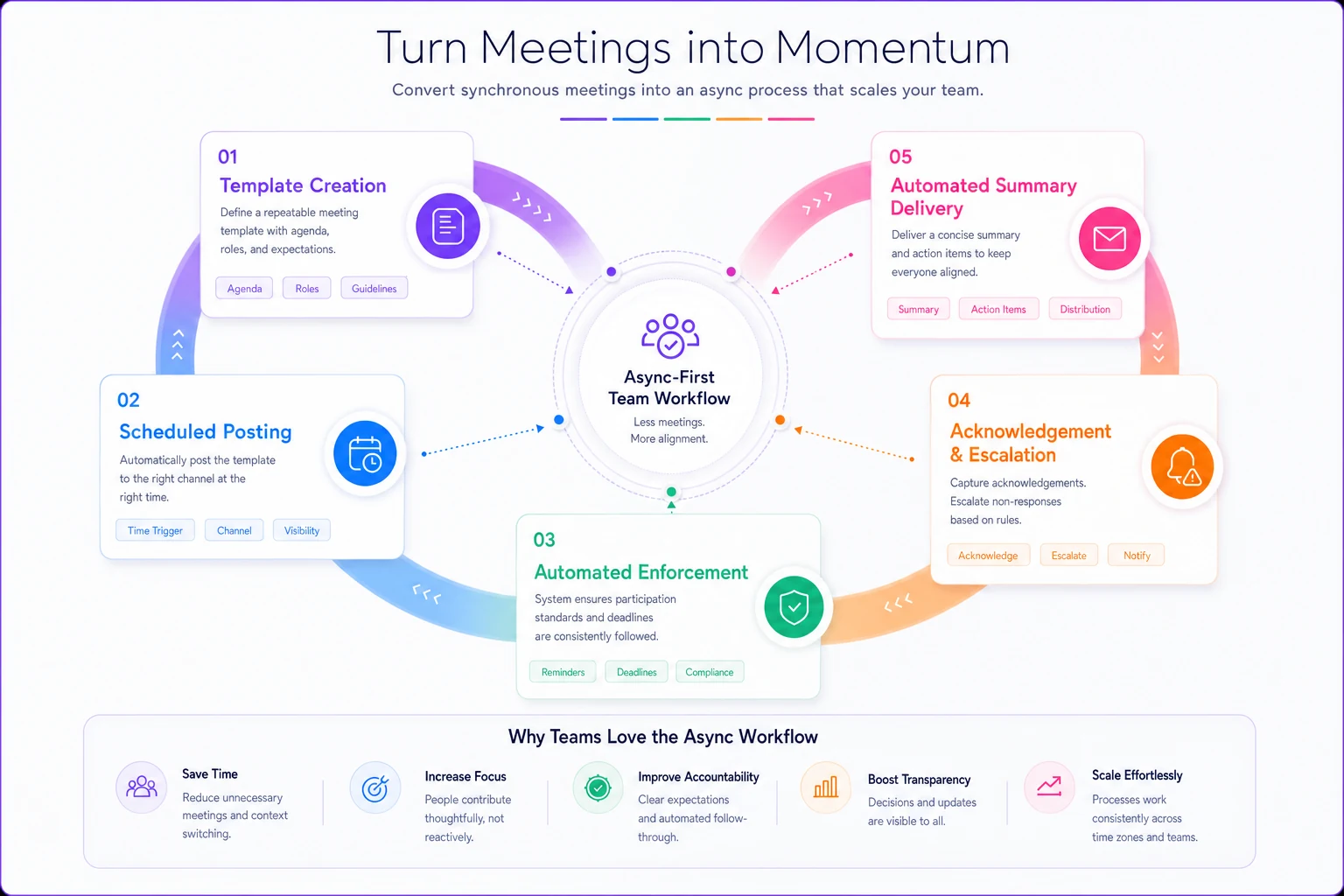
A simple visual helps teams adopt the steps and share the playbook.
Why AI automation makes async enforceable at scale
The problem with async rules is enforcement. Someone needs to police them. That someone usually gets tired of being the bad cop after three weeks.
Modern operational software with AI automation changes this dynamic. These platforms automatically track who's posting updates, flag missing information, escalate blocked items, and summarize async threads for executives who just need highlights. AI agents handle enforcement so humans don't have to play compliance police.
Construction company implemented async daily reports through their project management platform. The system automatically reminds foremen to submit reports by 3 PM, flags safety concerns for immediate review, and generates consolidated summaries for project managers. Meeting time dropped 8 hours weekly per project. Compliance hit 95% because the system handles the nagging, not humans.
The difference between async that works and async that fails isn't templates or rules. It's systematic enforcement that doesn't rely on human discipline.
Warning signs your async system is breaking
Even with solid templates and enforcement, async systems fail when certain conditions emerge:
The Clarity Decay
Updates get shorter and vaguer over time. "Working on stuff" replaces specific status. This happens when people feel their updates aren't being read or acted upon.
The Shadow Meeting
People start having "quick syncs" outside the official process. Two people grab coffee to discuss what should be in the decision log. This indicates the async process is missing crucial context or relationship elements.
The Compliance Cliff
Participation drops suddenly, not gradually. Usually happens when a senior person skips the process without consequence. Once the CEO skips three async updates, the entire system collapses.
The Escalation Explosion
Everything becomes urgent. Every handoff needs a "quick call." This means async templates aren't capturing enough detail or response time agreements are too slow.
Watch for these patterns. They're easier to fix early than after they become embedded habits.
A realistic conversion timeline
Software development team with 24 people wanted to reduce meetings by 50%. What actually happened:
Week 1-2: Identified meeting types to convert, created templates, announced new process. Enthusiasm high, compliance at 60%. Week 3-4: Enforcement kicks in. Complaining peaks. Three people claim async "doesn't work for their role." Compliance drops to 45%. Week 5-6: Adjusted templates based on feedback. Added automated reminders. Started celebrating good async updates publicly. Compliance rebounds to 70%. Week 7-8: First major win - shipped a feature two days early because developers had more focus time. Skeptics start converting. Compliance hits 85%. Week 12: Steady state achieved. Team running 11 fewer hours of meetings weekly. Async updates taking 5 minutes daily per person. Actual deep work blocks appearing on calendars.
Total time savings: 264 hours monthly across the team. That's $22,440 in recovered productivity at their rates. But three meetings needed to stay synchronous: architecture decisions, customer escalations, and quarterly planning.
The meetings you should never make async
Some managers try converting everything and wonder why their team falls apart:
| Meeting Type | Why It Needs Sync | Alternative |
|---|---|---|
| Brainstorming and Ideation | Creative work needs rapid iteration and building on ideas | Keep sync, but limit to core participants |
| Conflict Resolution | Interpersonal issues get worse in writing, tone gets misread | Face-to-face when possible |
| Major Cross-Department Decisions | Five departments agreeing on something affecting everyone | One focused meeting beats three weeks of comment threads |
| Culture Building | Team bonding doesn't happen through status updates | Keep monthly team lunch, quarterly celebrations |
Some managers try converting everything and wonder why their team falls apart:
Start with your most painful recurring meeting
Don't convert everything at once. Pick the one meeting everyone secretly hates. Usually a status meeting that could be an email but takes an hour.
Create the template. Set the enforcement rule. Give it six weeks. Measure time saved and work delivered.
Head of operations at logistics company started with their daily dispatch meeting. Fifteen people spending forty-five minutes sharing route updates. Converted it to structured async report taking three minutes to complete. Dispatchers got an extra 42 minutes of productive time daily. Routes started getting optimized instead of just reported.
Once people experience getting that time back, they'll push to convert other meetings themselves. The culture shift from "meetings are how we work" to "meetings are the exception" happens naturally when people taste the productivity gain.
Your calendar shouldn't be a graveyard of recurring meetings that exist because nobody questioned them. Start questioning. Start converting. Start enforcing.
The real question isn't whether you can go async. It's whether you can afford not to when your competition is already reclaiming those hours for actual work.
Ready to elevate your team's performance?
Join 2,000+ teams using Temsly to streamline workflows, boost productivity, and deliver projects on time.