

Most teams don't fall apart because a specialist quits. They fall apart in the fourteen days between "she's out unexpectedly" and "we finally figured out how she did that thing." That gap is where deadlines slip, half-finished work sits untouched, and someone eventually opens a file nobody knows how to read.
A specialist absence continuity plan isn't about replacing the person. You can't replace fifteen years of pattern recognition in a weekend. It's about keeping deliveries moving for the two or three weeks it takes to either bring them back, hand things off cleanly, or hire. That's a much smaller, more solvable problem — and the teams that solve it ahead of time barely feel the hit.
This is a kit, not a philosophy. Concrete artifacts, a temporary ownership map, triage rules, and a few decision aids you can put together in an afternoon and actually use when your DevOps person is in the hospital or your only Salesforce admin ghosts you mid-migration.
Why the gap is worse than people expect
The damage from a sudden specialist absence isn't linear. It compounds, and it compounds fastest in the first 72 hours because nobody knows what's actually on fire versus what just looks scary.
Here's the pattern. A single specialist — say, the person who owns your payment reconciliation pipeline — is out. Day one, everyone assumes it's fine because nothing's due yet. Day three, a scheduled job fails and there's no runbook. Day five, three separate people have each spent an hour poking at the same undocumented script. By day eight you've burned more collective hours flailing around than the specialist would have spent doing the work in the first place.
What makes this expensive isn't the missing skill. It's the missing context: where things live, what's safe to touch, what's currently mid-flight, and who's allowed to make the call when something breaks. A specialist carries all of that in their head, and none of it is transferable in a panic.
A realistic example: a 40-person agency had one senior developer who owned the client billing integration. He took two weeks of unplanned medical leave. The team had his code but not his mental model. They burned roughly 30–35 hours across four people trying to understand a reconciliation edge case, delayed two client invoices, and one of those delays turned into an awkward "why are you billing me now" conversation that put a renewal at risk. The skill wasn't the bottleneck. The context was.
What actually needs to survive: the cross-train artifacts
You don't cross-train people. That's the mistake. Full cross-training a specialist takes months and you'll never keep it current. What you cross-train is the work — and only the slice of it that has to keep moving during a short absence.
Eliminate team chaos and missed deadlines.
Temsly helps you assign, track & complete projects efficiently with full visibility.
- Centralized task management
- Real-time team communication
- Resource and deadline tracking
No credit card required
For each critical specialist, you need a small set of artifacts. Keep them boring and short. A 40-page wiki nobody updates is worse than a one-page doc someone actually maintains.
-
The "keep the lights on" list — the 3 to 6 recurring things that break or stall if this person disappears. Not everything they do. Just what can't wait two weeks.
-
Runbooks for those specific things — step-by-step, written for someone competent but unfamiliar. Screenshots where a wrong click is costly.
-
The access map — what systems, credentials, and permissions are needed, and how a temporary owner gets them fast without a three-day IT ticket.
-
The "do not touch" list — the things that look urgent but should just wait for the specialist to return. This one prevents more damage than anything else.
-
Mid-flight state — a lightweight note on what's currently in progress. This is the piece that's almost always missing.
That last one matters more than teams realize. When the payment pipeline person is out, the question isn't just "how does this run" — it's "what did she change last Tuesday that hasn't finished deploying." The mid-flight state is the difference between a smooth pickup and someone deploying on top of half-finished work.
Test it while the specialist is still around — have someone else run it live, with the specialist watching silently and only noting where the doc failed.
One practical rule: an artifact only counts if a peer can execute it without asking the absent specialist a single question. If the runbook still requires a phone call, it's not done. Test it while the specialist is still around — have someone else run it live, with the specialist watching silently and only noting where the doc failed.
Temporary owner mapping: name the human before you need them
The most common failure isn't a missing document. It's ambiguity about who decides. When the specialist is out and something breaks, three people each assume someone else is handling it, and the thing that needed a decision in an hour sits for a day and a half.
Temporary ownership fixes this by pre-assigning a named backup for each critical area — not a team, a person. "Engineering will cover it" means nobody covers it. "Marcus owns the billing integration while Dana is out" means Marcus knows, his manager knows, and everyone routing questions knows where to send them.
A temporary owner doesn't need to be able to do everything the specialist does. Their job is narrower:
-
Execute the runbooks for keep-the-lights-on work.
-
Triage what comes in — decide what waits, what escalates, and what they can handle.
-
Hold the mid-flight state so nothing gets duplicated or deployed twice.
-
Be the single routing point so the rest of the team stops guessing.
Here's a simple mapping table for a small ops or engineering team:
| Critical area | Primary specialist | Temporary owner | Decision scope | Escalate to |
|---|---|---|---|---|
| Payment reconciliation | Dana | Marcus | Run jobs, hold minor fixes | Eng lead for schema changes |
| Salesforce admin | Priya | Alex | User/permission changes only | Ops director for data migrations |
| CI/CD pipeline | Sam | Jordan | Restart/rollback deploys | Sam's manager for infra changes |
| Client onboarding automation | Lea | Noah | Run standard flows, pause exceptions | Account lead for scope changes |
Notice the decision scope column. That's the part most teams skip, and it's the part that actually prevents chaos. Marcus can run the reconciliation jobs, but he's explicitly not authorized to change the schema — that waits or escalates. Without that boundary, a well-meaning temporary owner makes a "small fix" that becomes next month's incident.
One more thing: the temporary owner should know they're the temporary owner before the absence, not find out via a frantic Slack message. A quiet fifteen-minute walkthrough when things are calm is worth ten hours of scrambling later.
A simple workflow for temporary ownership and escalation looks like this.
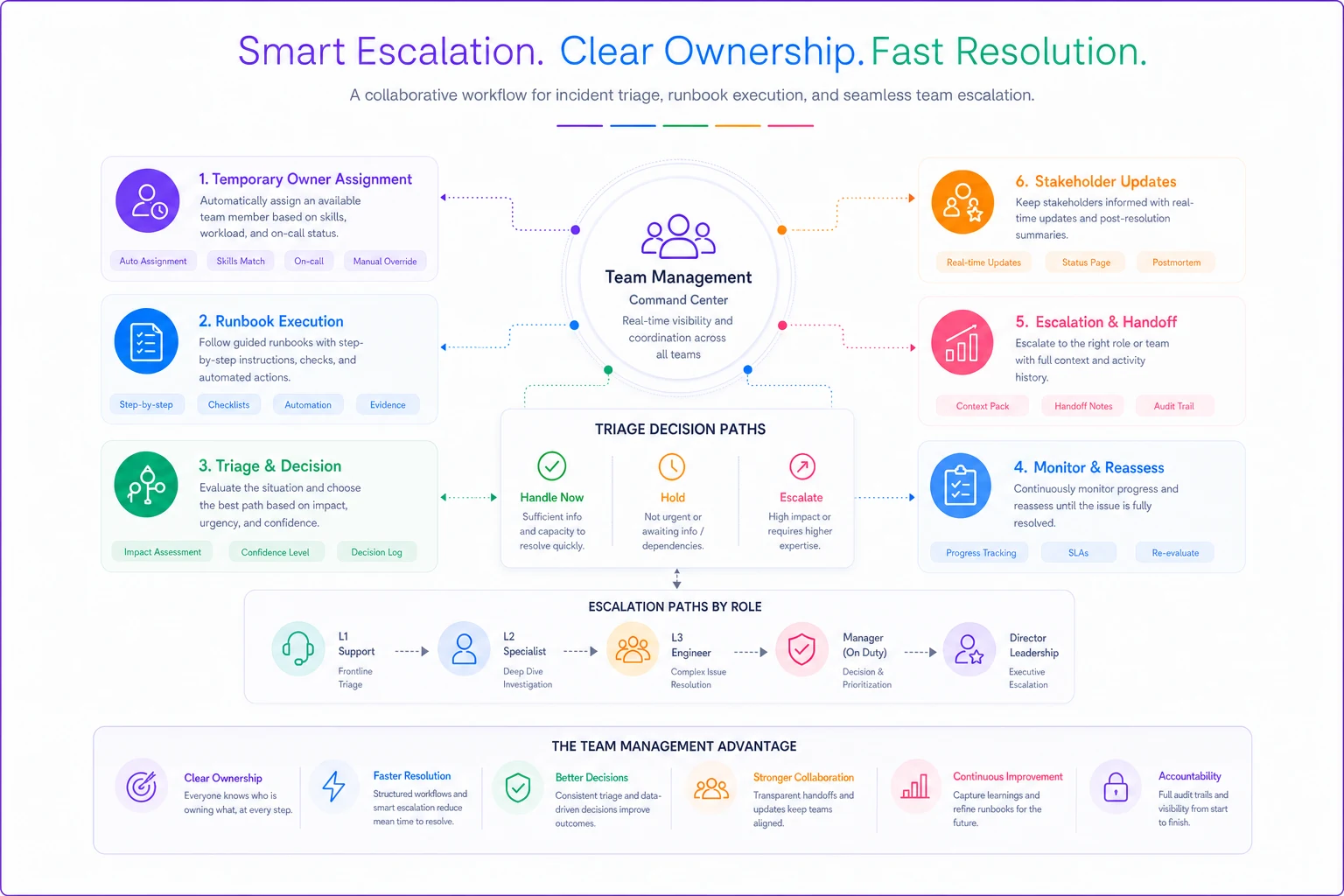
The visual shows assignment of a named temporary owner, the runbook execution path, a triage decision node (handle/hold/escalate), and the escalation routes to managers or specialists.
Triage rules: sorting the two weeks of incoming work
Once a specialist is out, everything they would have handled keeps flowing in — requests, alerts, "quick questions," breakages. Without triage rules, the temporary owner either drowns or freezes. So you write the rules ahead of time, and you keep them simple.
The core triage decision for anything that lands during the absence:
-
Handle now — it's in the runbook, it's within the temporary owner's scope, and it can't wait. Do it.
-
Hold for return — it's real but not urgent, and it's cleaner to let the specialist do it. Log it, tell the requester when, move on.
-
Escalate — it's outside scope, it's genuinely time-sensitive, and doing it wrong is expensive. Kick it up the escalation path immediately.
The trap is treating everything as "handle now" because saying "this waits" feels like dropping the ball. It isn't. A lot of what a specialist does genuinely can wait two weeks, and forcing a temporary owner to attempt deep, unfamiliar work under pressure is how you turn a two-week absence into a two-month cleanup.
A quick decision aid worth writing down for the temporary owner: If doing this wrong would cost more than a two-week delay, escalate it instead of attempting it. That single sentence resolves most of the judgment calls.
This is really an extension of protecting planned work from noise — the same instinct behind a good systematic approach to capacity planning across your portfolio. An absence is just a sudden, involuntary capacity cut, and triage is how you spend the reduced capacity on what matters instead of whatever shouts loudest.
Quick decision aids for the moments that stall everything
Two or three tiny decision aids do more work than a long process doc. People under pressure don't read process docs. They need a rule they can apply in ten seconds.
The "safe to touch" flag. For each system in the continuity kit, mark it green (temporary owner can act freely), yellow (act only per runbook), or red (do not touch — hold or escalate). When someone's staring at a failing job at 6pm, "this is a red system, escalate" is a decision they can make instantly and correctly.
The rollback-first rule. If the temporary owner touches something and it goes sideways, the default is revert, don't debug. Get back to the last known-good state and wait for the specialist. Debugging an unfamiliar system live is where most damage happens.
The 30-minute rule. If the temporary owner has spent 30 minutes on something and isn't making clear progress, they stop and escalate. This kills the silent hours where one person quietly burns an afternoon on something that a two-line message could have unblocked.
These aids exist because the failure mode isn't laziness — it's a competent person trying too hard on unfamiliar ground. The rules give them explicit permission to stop, hold, and escalate without feeling like they failed.
Where handoffs quietly break
A specialist absence is a handoff whether you planned it or not — and unplanned handoffs fail in the same ways planned ones do, just faster. The work leaves one person's head and lands in another's with missing context, unstated assumptions, and no shared definition of "done."
Teams that handle absences well tend to already have handoff discipline elsewhere. If you've built a real definition of ready that keeps handoffs from creating rework, you already understand the muscle: context has to travel with the work, not stay in someone's head. A continuity kit is that same principle applied to an emergency instead of a routine sprint boundary.
The specific thing that breaks during absence handoffs is the unwritten stuff — the "oh, we never touch that on Fridays because the batch job runs" tribal knowledge. You can't document all of it. But the "do not touch" list and the safe-to-touch flags capture the most dangerous 20% of it, which is the part that actually causes incidents.
Keeping the kit alive without it becoming a chore
A continuity kit that's out of date is a trap — it gives false confidence and points the temporary owner at a runbook that no longer matches reality. So the kit needs a light maintenance rhythm, or it rots.
Keep it minimal enough that updating it is a five-minute task, not a project. A practical cadence:
-
Monthly each specialist glances at their keep-the-lights-on list and confirms it still matches reality. Two minutes.
-
After any major change if a runbook step changed, fix it that day while it's fresh.
-
Quarterly fire drill pick one specialist, have them "go dark" for a morning, and let the temporary owner actually run the kit. You'll find the gaps immediately.
That quarterly drill is the single highest-value activity here. Reading a runbook tells you nothing. Watching someone try to execute it while the author sits on their hands tells you everything — which step is ambiguous, which credential doesn't work, which "obvious" thing wasn't obvious at all.
Where operational tooling helps is keeping these artifacts findable and current — a shared workspace where runbooks, the ownership map, and triage rules all live in one place, with reminders that nudge specialists to review their sections before the kit goes stale. The tooling isn't the point, though. A well-maintained shared doc beats a fancy system nobody updates. The discipline is what keeps deliveries moving; the tool just makes the discipline cheaper to maintain.
A real scenario: the three-week absence that barely registered
A mid-sized SaaS company, around 60 people, had a single data engineer who owned all their customer-facing reporting pipelines. He'd been the "just ask Rob" person for years. When he took three weeks off unexpectedly for a family situation, leadership braced for a mess.
It didn't come. Six months earlier they'd built a lightweight continuity kit — a keep-the-lights-on list of five recurring jobs, runbooks for each, a temporary owner (a mid-level analyst named Priya), and a "do not touch" list flagging schema changes as red.
During the three weeks: two scheduled pipeline jobs needed manual restarts, and Priya ran them from the runbook in under twenty minutes each. Four "can you add this metric" requests came in — all held for Rob's return, with requesters told exactly when. One genuine issue — a report showing wrong totals — got escalated same-day because it was flagged red, and the eng lead caught that it was an upstream data problem, not a pipeline one.
Total disruption: roughly a day of Priya's time spread across three weeks, two slightly delayed feature requests, zero incidents. Compare that to the earlier billing example where a similar-length absence burned 30-plus hours and put a client renewal at risk. Same category of problem. Wildly different outcome. The only difference was that someone had spent an afternoon assembling the kit before it was needed.
When this is worth building — and when it isn't
Build it when you have genuine single points of failure — one person who, if they vanished for two weeks, would stall real deliveries or put revenue at risk. Most small teams have two or three of these people, and they usually know exactly who they are.
Skip the heavy version when the work is already well-distributed. If three people can each do the job, you don't need a formal continuity kit — you need to make sure they all keep their access current. Don't build ceremony around a risk that doesn't exist.
Don't do this as a giant documentation initiative. The moment it becomes "let's document everything everyone does," it dies, and you'll have wasted weeks producing a wiki that's stale before it's finished. The whole value is in staying small: only critical specialists, only keep-the-lights-on work, only the two-week window.
The teams that survive a key person going dark aren't the ones with the most documentation. They're the ones who decided ahead of time what has to keep moving, named a human to move it, and gave that human clear rules for when to act, when to wait, and when to ask for help. That's a one-afternoon investment against a two-week fire — and it's one of the few pieces of operational prep that pays for itself the very first time you need it.
Ready to elevate your team's performance?
Join 2,000+ teams using Temsly to streamline workflows, boost productivity, and deliver projects on time.