



You know that feeling when your engineering manager says "yeah, we can squeeze that in" during sprint planning, then three weeks later everyone's working weekends? Or when sales promises a client delivery in Q2, but nobody checked if the design team even exists in Q2 because they're buried under Q1 work that's already late?
This isn't about people being bad at estimates. It's about how capacity planning across portfolio projects becomes exponentially harder as your organization grows. What worked when you had 5 people and 3 projects completely falls apart at 50 people and 30 projects.
The real killer? Most teams try to solve this with better project management tools or more detailed timesheets. But the problem runs deeper – it's about how work flows through your entire system, how hidden dependencies create cascading delays, and why traditional capacity planning misses roughly 40% of actual effort required.
Why portfolio capacity planning breaks at scale
When you're running a small team with a handful of projects, capacity planning feels straightforward. You've got Sarah on Project A for two weeks, Mike can handle Project B, and everyone knows what everyone else is doing because you all sit in the same room.
But something fundamental shifts around the 15-person mark. You start dealing with cross-project dependencies nobody tracks properly. That "simple" API update for Project X requires backend work from the team busy on Project Y. The designer working on Project Z needs assets from the marketing team who's deep in a campaign launch. These dependencies create what I call "capacity ghosts" – work that exists but isn't visible in any single project plan.
The expertise bottleneck problem. You've got one database architect who touches every major project. One senior designer who needs to review all client-facing work. One DevOps person who handles all deployments. Your capacity planning shows 500 available hours across the team, but these three people only have 120 hours each, and suddenly nothing moves because everyone's waiting for them.
Hidden coordination overhead multiplies fast. A five-person team needs maybe 10 communication paths. A 50-person team dealing with 30 projects? That's potentially thousands of coordination points. The actual time spent in "quick syncs" and "alignment meetings" can eat up 25-30% of your theoretical capacity, but most planning systems treat this as zero.
Teams start with simple spreadsheets tracking who's on what project. This works until around 8-10 concurrent projects. Then they move to project management software, which helps until you hit 20+ projects and realize the tool shows individual project health but misses portfolio-level resource conflicts. By the time you're managing 30+ projects across multiple teams, you're essentially flying blind, making commitments based on gut feel rather than actual capacity data.
The compound failure effect
The worst part about broken capacity planning isn't just missed deadlines – it's how failures compound across your entire operation.
Eliminate team chaos and missed deadlines.
Temsly helps you assign, track & complete projects efficiently with full visibility.
- Centralized task management
- Real-time team communication
- Resource and deadline tracking
No credit card required
Your product team commits to launching Feature Set A by end of Q1. Sales, excited about this, promises three enterprise clients they'll have access by April 1st. Marketing plans a major campaign around the launch. Customer Success schedules training sessions.
But your capacity planning missed that your lead engineer is also critical for maintaining the legacy system (eating up 30% of their time), your designer is covering for someone on parental leave (another 40% gone), and that "simple" feature actually requires infrastructure changes that need your already-overloaded DevOps team.
The feature ships three weeks late. Not catastrophic, except sales loses credibility with those enterprise clients, one of whom was worth roughly $400k annually. Marketing's campaign launches pointing to features that don't exist, confusing prospects. Customer Success scrambles to reschedule training, annoying existing clients. The delayed project pushes back everything planned for Q2. Team morale drops because everyone worked overtime and still "failed."
This cascade effect is why seemingly small capacity planning mistakes can crater entire quarters. You're not just missing one deadline – you're triggering operational failures across sales, marketing, support, and product development.
Building systematic capacity intelligence
Real capacity planning across portfolio projects requires understanding three interconnected systems: your actual work inventory, your true team capacity, and the hidden multipliers that affect both.
First, inventory reality. Most teams dramatically undercount their actual work inventory. They track "projects" but miss maintenance work that consumes 20-30% of technical capacity, support escalations that randomly eat senior people's time, "quick favors" for other departments that add up to dozens of hours weekly, rework from unclear requirements or changing priorities, and knowledge transfer when people join or leave projects.
A manufacturing company I worked with discovered they were actually running 47 active initiatives when leadership thought they had 15 projects. The other 32 were "small asks" and "maintenance items" that consumed 35% of their team's capacity.
Second, true capacity calculation. Forget the myth of the 40-hour work week.
Start with 40 hours per week per person. Now subtract 15% for meetings that aren't project-specific, 10% for context switching between projects, 10% for administrative tasks, timesheets, updates, 15% for unplanned work and interruptions, and 10% for learning, research, and professional development.
You're left with roughly 16 productive hours per week per person for actual project work. That's your real capacity baseline. Teams that plan against 40 hours per person consistently overcommit by 150%.
Count maintenance and frequent small asks separately when you first build inventory so they aren't overlooked.
Third, the multiplier effects. Certain factors dramatically affect your true capacity:
Team composition multipliers include new team members (multiply their capacity by 0.5 for first month, 0.7 for second month), cross-functional dependencies (multiply available capacity by 0.8), timezone differences for remote teams (multiply by 0.85), and multiple project assignments (multiply by 0.9 for two projects, 0.75 for three or more).
Project type multipliers involve first time doing this type of work (multiply estimated time by 1.8), similar to previous project (multiply by 1.2), exactly same as previous with same team (multiply by 0.9), and client-facing with external dependencies (multiply by 1.4).
The practical calculation system
Here's exactly how to calculate real capacity for portfolio planning. This isn't theoretical – this is the system that actually works when you're juggling multiple projects with shared resources.
Step 1: Build your capacity baseline
Create a simple table for each team member:
| Person | Theoretical Hours/Week | Reality Adjustments | Actual Project Hours |
|---|---|---|---|
| Designer A | 40 | -24 (60% overhead) | 16 |
| Developer B | 40 | -26 (65% overhead + mentoring) | 14 |
| Developer C (junior) | 40 | -28 (70% overhead + learning) | 12 |
| PM D | 40 | -30 (75% overhead + coordination) | 10 |
Step 2: Map project demand with buffers
For each project, calculate:
-
Base effort estimate (your best guess)
-
Uncertainty buffer (add 40% for new work, 20% for familiar work)
-
Dependency buffer (add 20% if crossing team boundaries)
-
Coordination buffer (add 5% per additional stakeholder beyond 3)
Step 3: Create the collision matrix
This is where most teams fail. You need to see where projects compete for the same people:
Project A needs Designer A for 20 hours in Week 3. Project B needs Designer A for 15 hours in Week 3. Project C needs Designer A for 10 hours in Week 3. Designer A has 16 available hours in Week 3. You're already 29 hours over capacity before the week even starts.
Step 4: Run what-if scenarios
Use scenarios to evaluate tradeoffs.
Here's a visual workflow to run these steps:
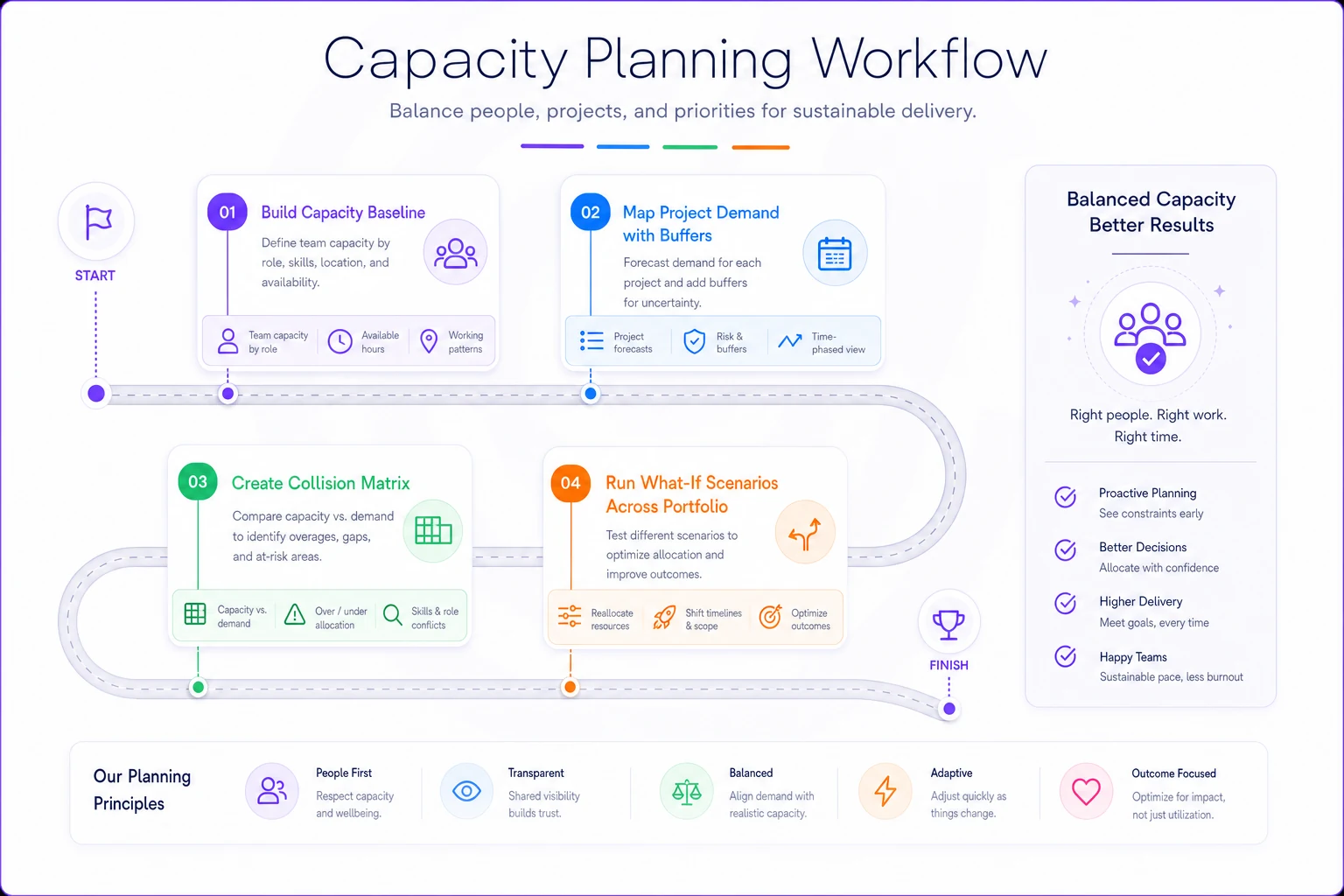
Run example scenarios and document impact, risk, and mitigation for each option.
-
Scenario 1
Push Project C to Week 4 - Impact: Client delivery delays by 1 week - Risk: Client escalation (High) - Mitigation: Early client communication
-
Scenario 2
Add contract designer - Impact: $3,000 additional cost - Risk: Quality/consistency issues (Medium) - Mitigation: Assign Designer A for review (4 hours)
-
Scenario 3
Reduce Project B scope - Impact: Feature set reduced by 25% - Risk: Stakeholder pushback (Medium) - Mitigation: Promise Phase 2 delivery
This systematic approach reveals the actual tradeoffs instead of hiding them until everything explodes.
Communication that prevents meltdowns
The math is only half the battle. The other half is translating capacity reality into language stakeholders actually understand and accept.
Most teams communicate capacity wrong. They say things like "we're at 110% capacity" or "the team is overloaded." This means nothing to executives who hear excuses rather than data. Instead, you need to speak in terms of tangible business impact.
Wrong way: "The development team is overbooked for Q2."
Right way: "Based on current commitments, we can deliver Project A by April 15th OR Project B by April 30th, but not both. Attempting both means missing both deadlines by approximately 3 weeks, risking $200k in penalty clauses with Client X and delaying the product launch that marketing has already scheduled for May 1st."
Create a standard portfolio view that shows what's actually possible with current resources, what would become possible with specific additions, what gets sacrificed with each priority decision, and the cascade impact of delays on other departments.
A simple weekly email format works well:
-
Projects on track
[List]
-
Projects at risk
[List with specific bottlenecks]
-
Critical decisions needed
[Specific tradeoffs requiring executive input]
-
Resource conflicts next 2 weeks
[Specific overlaps]
This forces leadership to confront reality weekly instead of discovering problems at the end of quarters.
The operational software advantage
This is where modern operational platforms make a massive difference. Manual capacity planning across portfolios requires updating dozens of spreadsheets, constantly checking for conflicts, and somehow keeping everyone aligned on priority changes.
AI-powered operational software can automatically track actual hours versus planned, identify resource conflicts before they happen, and run what-if scenarios in seconds instead of hours. More importantly, these platforms can spot patterns humans miss – like how certain types of projects consistently require 40% more design time than estimated, or how specific team combinations deliver 20% faster than others.
The real value isn't in the automation itself, but in how it changes decision-making. When you can instantly see that accepting a new client project will delay three others by two weeks each, you make different choices. When the platform alerts you that your database architect is booked for 200% capacity next month before you commit to deadlines, you avoid the crisis entirely.
These tools also solve the communication problem by creating real-time dashboards that stakeholders can actually understand. Instead of static reports that are outdated the moment they're sent, everyone sees the same live view of capacity, progress, and tradeoffs.
When this approach actually works (and when it doesn't)
This systematic capacity planning works brilliantly for organizations with 10+ people working across multiple projects, shared resources between projects, external stakeholder commitments, and quarterly or longer planning horizons.
It's overkill if you're a 5-person team working on one product. It's also wrong if your work is purely reactive (like a support team) where you can't predict demand patterns.
The approach breaks down when leadership consistently ignores capacity data and overcommits anyway, your estimates are off by more than 100% (indicates deeper problems), team composition changes faster than monthly, or projects are smaller than 40 hours total effort.
The path forward
Getting capacity planning right across your portfolio isn't about perfect predictions – it's about building a system that reveals reality early enough to make intelligent tradeoffs.
Start simple. Track actual versus planned hours for just one month. Not timesheets for billing, but real "how long did this actually take" data. You'll likely discover your estimates are off by 50-80%. That's normal and fixable.
Then build your capacity baseline using the realistic adjustments I outlined above. Yes, it will show you have far less capacity than you thought. That's the point. Better to know now than discover it through failed projects.
Finally, implement weekly portfolio reviews where you explicitly discuss resource conflicts and make conscious tradeoff decisions. Document these decisions and their rationale. When projects inevitably slip, you'll have clear data on why, instead of finger-pointing and blame.
The organizations that get this right share three characteristics: they accept that capacity is finite, they make tradeoffs visible to everyone, and they use actual data rather than optimistic estimates. It's not complicated, but it does require facing uncomfortable truths about what's actually possible versus what we wish were possible.
Your choice is simple: build systematic capacity intelligence now, or keep learning through painful project failures. The math doesn't lie, and neither does the mounting evidence of what happens when we ignore it.
Ready to elevate your team's performance?
Join 2,000+ teams using Temsly to streamline workflows, boost productivity, and deliver projects on time.