



Your engineering team opens Jira Monday morning to find twelve new tickets. Feature descriptions that say "implement customer dashboard." Acceptance criteria that reads "should work properly." No mockups. No edge cases. No database schema considerations. By Wednesday, three engineers are building three different versions of the same feature, and your product manager is in back-to-back meetings trying to explain what they actually meant.
This isn't a communication problem. It's a handoff problem.
Most product to engineering handoff processes fail because they try to document everything or document nothing. The comprehensive ones create 40-page PRDs that nobody reads. The minimal ones leave engineers guessing. Both create rework, delays, and frustrated teams.
Why handoffs break down (and it's not about communication skills)
Product managers think they're being clear when they write "users should be able to filter results." Engineers think they understand until they start building and realize: Filter by what? Multiple filters at once? Do filters persist? What happens with zero results? Should filtering work with pagination? How do filters interact with sorting?
These aren't edge cases. They're core functionality questions that determine whether you build for two days or two weeks.
The breakdown happens because most teams treat handoffs as a single moment instead of a process. Product writes something, tosses it over the wall, engineering catches it (or doesn't). When questions arise, it's already too late—engineers are mid-build, product has moved on to the next initiative, and any clarification means rework.
Teams keep solving it wrong. They add more meetings. They create longer templates. They implement "collaboration tools" that just move the confusion to Slack threads. None of this addresses the core issue: you're missing specific artifacts at specific checkpoints.
The minimal artifact set that actually prevents rework
Forget the 15-section PRD template you downloaded. You need exactly four artifacts before engineering starts building, and they need to exist in this specific order:
Eliminate team chaos and missed deadlines.
Temsly helps you assign, track & complete projects efficiently with full visibility.
- Centralized task management
- Real-time team communication
- Resource and deadline tracking
No credit card required
Feature Brief (300 words max)
Not a novel. Not a user story. A brief that answers: What are we building? Why does it matter to users? What business metric does it move?
Keep feature briefs under 300 words to force focus.
Most feature briefs fail because they're either too abstract ("improve user engagement") or too prescriptive ("add a blue button here"). The right level sits between these: "Users need to track inventory levels across locations because they're currently logging into three systems and manually comparing spreadsheets, causing stockouts that cost roughly $2,000 per incident."
Acceptance Criteria (as testable statements)
-
User can filter products by category, price range, and availability status
-
Applying multiple filters shows results matching ALL selected criteria
-
Clearing filters returns to full product list
-
Filter state persists during pagination
-
Zero results shows specific message
"No products match your filters"
Each line is a test case. If QA can't write a pass/fail test from your criteria, it's not criteria—it's a wish.
Edge Case Inventory
-
What happens with malformed data?
-
What happens when external systems are down?
-
What happens with conflicting user permissions?
-
What happens at scale limits?
You don't need solutions for every edge case before development starts. You need acknowledgment that they exist and a decision on whether to handle them now, later, or never.
Technical Assumptions Document
This is what most handoffs completely miss. Product assumes engineering knows which database to use, which APIs are available, what the performance requirements are, what the deployment environment looks like. Engineering assumes product understands technical constraints.
A single paragraph stating assumptions prevents the week-three discovery that you're building on the wrong stack or that the feature requires infrastructure that doesn't exist.
The pre-development review that takes 15 minutes
Most teams create elaborate review processes with steering committees and approval chains. These become bottlenecks that everyone learns to skip.
Instead, implement a 15-minute review with exactly three checkpoints:
Checkpoint 1: The Artifact Check (2 minutes)
-
Feature brief exists and is under 300 words
-
Acceptance criteria written as testable statements
-
Edge cases listed (not necessarily solved)
-
Technical assumptions documented
This isn't a quality review. It's an existence check. Do these things exist? Yes or no.
Checkpoint 2: The Engineering Sanity Check (8 minutes)
One engineer (rotate who) answers three questions:
-
Can I build this from these artifacts?
-
What's the biggest unknown?
-
What will likely change once we start building?
This isn't about getting perfect answers. It's about surfacing gaps before code gets written. The engineer might say "I can build this but the acceptance criteria conflicts with our current data model" or "This assumes we have user session data we don't actually store."
Checkpoint 3: The Scope Lock (5 minutes)
Product and engineering agree on one thing: what's in and what's out for this iteration. Not forever. Just for this build cycle.
-
In scope
Basic filtering by category and price
-
Out of scope
Saved filter sets, filter analytics, filter sharing
Write it down:
Here's a quick visual of the 15-minute review flow.
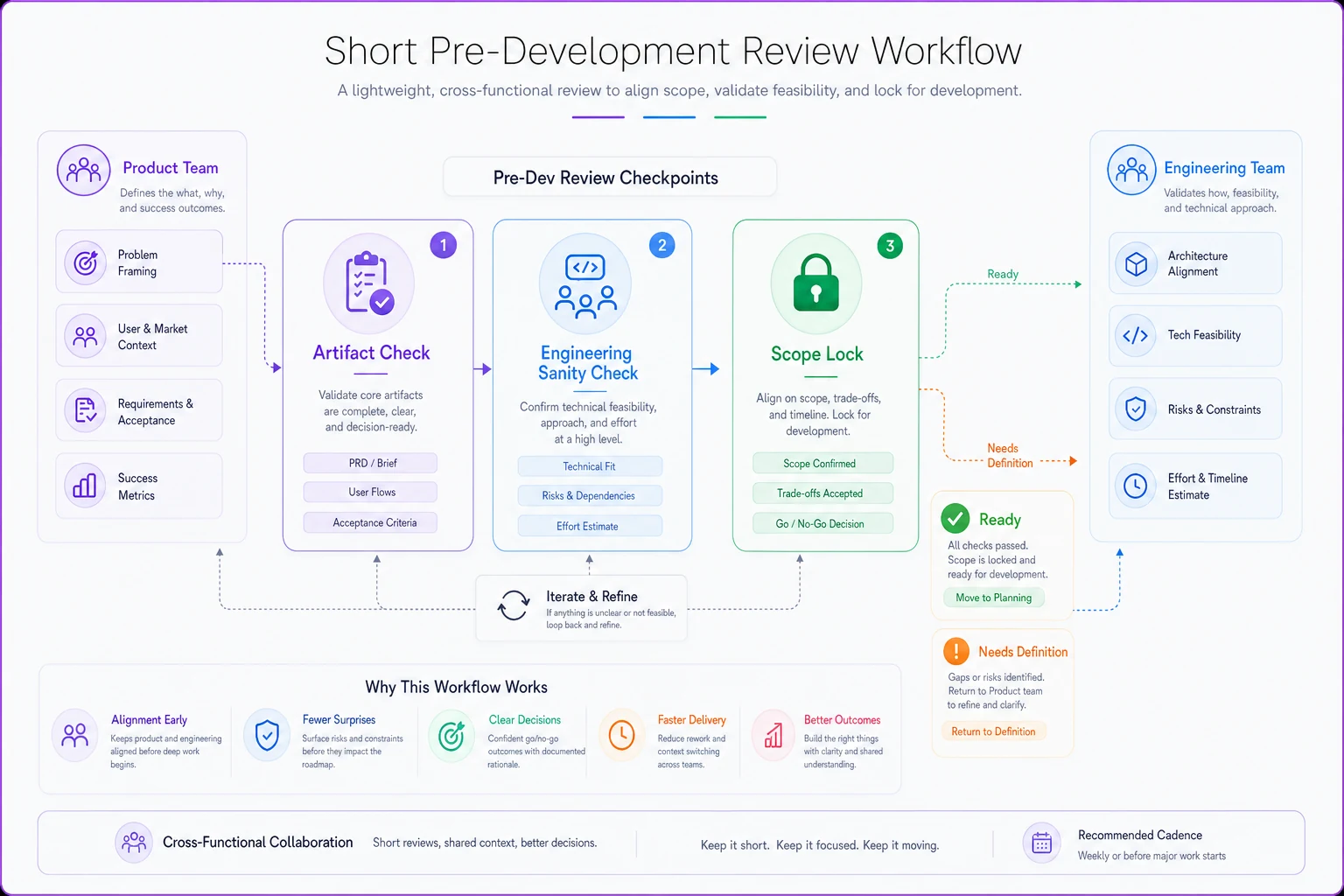
This visual shows how the checkpoints prevent work starting without needed artifacts.
This prevents the inevitable scope creep that happens when someone says "while you're in there, could you also add..."
When to skip the process (and when you absolutely cannot)
Not every feature needs this full process. A copy change doesn't need edge case documentation. A bug fix doesn't need a feature brief.
Skip the full process when:
-
Changes are cosmetic only (CSS, copy, images)
-
Fixing bugs without changing functionality
-
Updates that don't touch user-facing features
-
Emergency patches for production issues
Never skip when:
-
Building new user-facing functionality
-
Modifying data models
-
Integrating third-party services
-
Anything that affects billing or payments
-
Features promised to specific customers
Teams that make exceptions for "simple" features usually regret it. That "simple" filter becomes a two-week rebuild when you discover it needs to work across five microservices nobody mentioned.
The enforcement mechanism that doesn't require process police
Documentation without enforcement is just wishful thinking. But nobody wants to be the process enforcer.
The solution is making the process self-enforcing through your tools. Your ticketing system becomes the gatekeeper, not a person.
-
Feature brief (required field, character limit enforced)
-
Acceptance criteria (must include at least 3 testable statements)
-
Edge cases (minimum 2 required)
-
Technical assumptions (required for features, optional for bugs)
But what actually makes this work: make engineers the ones who reject tickets, not product managers. When an engineer can't start work because artifacts are missing, they move the ticket back to "Needs Definition" status. This creates natural accountability without anyone playing enforcer.
The other enforcement mechanism that works: public scoreboards. Track handoff quality metrics weekly:
-
Tickets returned for missing artifacts
-
Rework hours due to unclear requirements
-
Time from ticket creation to "ready for development"
Post these somewhere visible. Not to shame anyone, but to make the cost of bad handoffs visible. When everyone can see that unclear requirements caused 40 hours of rework last sprint, the motivation to follow the process appears naturally.
Real-world implementation: How a 50-person SaaS company fixed their handoff chaos
A project management software company was hemorrhaging engineering time. Their developers were spending roughly 30% of each sprint in "clarification meetings" and another 20% on rework. Features that should take a week were taking three.
They tried everything wrong first. Longer PRDs that nobody read. Daily standups that became 90-minute requirement discussions. Hiring a technical writer to document everything. Nothing reduced the chaos.
Then they implemented this minimal handoff process. Not all at once—that's another mistake teams make. They started with just the acceptance criteria requirement. Every ticket needed testable statements before moving to development.
First sprint: chaos. Product managers complained about the extra work. Engineers complained about sending tickets back. But by sprint three, something shifted. Engineers were building the right thing the first time. Rework dropped from 20% of sprint time to about 8%.
They added the other artifacts gradually:
-
Sprint 4
Added feature briefs (capped at 300 words)
-
Sprint 6
Required edge case documentation
-
Sprint 8
Added technical assumptions
Six months later:
-
Rework down to less than 5% of engineering time
-
Average feature delivery time cut by 40%
-
Product managers spending less time in clarification meetings
-
Engineers reporting higher job satisfaction
The key wasn't the artifacts themselves. It was that everyone knew exactly what needed to exist before work could start. No guessing, no assumptions, no "we'll figure it out as we build."
Why traditional handoff processes fail at scale
Most handoff processes are designed for perfection, not reality. They assume everyone has unlimited time to write comprehensive documentation, that requirements never change, and that communication is the only problem to solve.
Real product development is messier. Requirements shift. Deadlines loom. People get sick. New information appears mid-build.
-
Documentation debt compounds. The more you require, the further behind teams fall. Eventually, people start skipping the process entirely because catching up becomes impossible.
-
Context switching kills productivity. When product managers spend days writing novels about features, they're not talking to customers or analyzing data. When engineers spend days in requirement meetings, they're not building.
-
Perfect clarity is impossible. No matter how much you document, something unexpected will arise during development. The goal isn't to eliminate all uncertainty—it's to eliminate unnecessary uncertainty.
-
Teams change faster than process. That elaborate 40-field template made sense when you had 10 engineers. Now you have 50, across three time zones, and half your product team is new.
The minimal approach works because it acknowledges these realities. It doesn't try to document everything—just the things that cause the most rework when missing.
Building handoffs into your operational rhythm
Don't treat handoffs as a separate process from your regular operational rhythm. This creates two workflows: the official one nobody follows and the real one that happens in Slack DMs.
Build handoffs into your existing ceremonies:
During Sprint Planning:
Don't just review what goes into the sprint. Review whether it's actually ready. The 15-minute review happens here, in front of everyone. If artifacts are missing, the ticket doesn't make it into the sprint. No exceptions, no "we'll add documentation later."
In Daily Standups:
When someone mentions starting a new ticket, the first question should be "are all artifacts complete?" This creates social accountability. Nobody wants to admit in standup that they started building without requirements.
At Sprint Retrospectives:
Track handoff metrics as part of your regular retro. How many tickets got returned? How much rework happened? What artifacts were most often missing? This keeps the process visible and lets you adjust based on what's actually happening.
In Your Tools:
Your project management tool should make the handoff status visible at a glance. Use labels, custom fields, or separate columns. Everyone should know immediately whether a ticket is "truly ready" or "sort of ready if you squint."
Make product and engineering jointly responsible for handoff quality. This isn't about product serving engineering or engineering making demands of product. It's about both teams owning the efficiency of the overall system.
The hidden costs of bad handoffs you're not tracking
Everyone knows bad handoffs cause rework. But the real costs hide in places you're not measuring:
-
Developer confidence erosion. When engineers constantly have to guess what product wants, they stop making decisions confidently. Every choice becomes a question. Development slows not because of technical complexity but because of decision paralysis.
-
Product manager burnout. They're in constant reaction mode, answering questions about tickets they wrote weeks ago while trying to plan next quarter. The mental switching between past features and future strategy destroys strategic thinking capacity.
-
Quality architects quit. Your best engineers don't want to build the same feature three times because requirements weren't clear. They have options.
-
Customer trust evaporates. When features ship half-baked because requirements were unclear, customers notice. They stop trusting your roadmap promises. They stop expanding their usage.
A marketing automation company learned this the hard way. They had decent velocity metrics—shipping features every sprint. But customer satisfaction kept dropping. Features were shipping incomplete because handoffs didn't include edge cases. Customers would try to use new features, hit undocumented limitations, and assume the product was buggy.
Once they started requiring edge case documentation in handoffs, something interesting happened: they shipped fewer features but customer satisfaction went up. Customers prefer three complete features over six half-broken ones.
Making this work with your existing tools
You don't need new software to implement this process. Every project management tool can handle these requirements with basic configuration:
For Jira users:
Create custom fields for each artifact. Use automation rules to prevent status changes when fields are empty. Set up a dashboard showing tickets missing artifacts.
For Linear users:
Use Linear's templates to pre-populate tickets with artifact sections. Create custom workflows that include a "Definition Review" status before "Ready for Development."
For Asana users:
Create custom fields and use Rules to automatically assign tickets back to product when required fields are empty. Build a portfolio view sorted by handoff completeness.
For Notion users:
Create a database template with required properties for each artifact. Use filtered views to show only tickets with complete handoffs.
| Tool | How to implement |
|---|---|
| For Jira users: | Create custom fields for each artifact. Use automation rules to prevent status changes when fields are empty. Set up a dashboard showing tickets missing artifacts. |
| For Linear users: | Use Linear's templates to pre-populate tickets with artifact sections. Create custom workflows that include a "Definition Review" status before "Ready for Development." |
| For Asana users: | Create custom fields and use Rules to automatically assign tickets back to product when required fields are empty. Build a portfolio view sorted by handoff completeness. |
| For Notion users: | Create a database template with required properties for each artifact. Use filtered views to show only tickets with complete handoffs. |
Don't overengineer your tools. You don't need complex automation or elaborate workflows. You need fields for your four artifacts and a way to see when they're missing.
If you're using AI-powered operational software for project management, this becomes even simpler. Modern platforms can automatically check for missing artifacts, flag incomplete handoffs, and even suggest what's missing based on similar past tickets. The AI doesn't write your requirements—that's still a human job—but it can spot when your acceptance criteria isn't testable or when you've forgotten to document edge cases.
The handoff quality metrics that actually matter
Most teams track the wrong metrics. They measure velocity, story points, cycle time—but these don't tell you if handoffs are working. You can have great velocity while burning 40% of engineering time on rework.
Track these instead:
-
Handoff Return Rate Percentage of tickets sent back for missing artifacts. Target: under 10%.
-
Clarification Time Hours spent in "requirement clarification" meetings per sprint. Should decrease over time as your artifacts get better.
-
First-Build Success Rate Percentage of features that pass QA without major rework. This is your north star metric.
-
Time to Ready How long tickets sit in "needs definition" before becoming "ready for development." Shorter is better, but not at the expense of quality.
-
Scope Creep Incidents How often "small additions" get added after development starts. Each one represents a handoff that wasn't complete.
A financial services startup tracked these metrics for six months. They discovered their handoff return rate was 45%—nearly half of all tickets were missing critical information. But it wasn't distributed evenly. Two product managers had 80% return rates while others were under 20%.
The problem wasn't the process. It was that nobody had shown those two PMs what good artifacts looked like. Once they saw examples from their colleagues, their return rates dropped to normal within a month.
Start Monday, see results by Friday
Don't overthink implementation. Don't form a committee. Don't spend weeks debating the perfect template.
Monday morning: Pick your five most important upcoming features. Write a feature brief for each (remember: 300 words max). Share them with your engineering team.
Tuesday: For those same five features, write acceptance criteria as testable statements. Have one engineer review them for clarity.
Wednesday: Document edge cases. You don't need solutions yet—just acknowledge what could go wrong.
Thursday: Add technical assumptions. One paragraph about what you're assuming about the technical environment.
Friday: Run your first 15-minute review on these five tickets. See what's missing. Fix it. Move them to ready for development.
You've just prevented roughly 20-30 hours of rework next sprint.
Teams that succeed with this don't aim for perfection. They aim for consistency. Better to have basic artifacts for every ticket than perfect documentation for half of them.
The bottom line on handoff processes
Your product to engineering handoff process is probably the highest-leverage improvement you can make to your development workflow. It's not sexy. It won't get you promoted. But it will dramatically reduce the hidden friction that makes every feature take longer than it should.
The process outlined here isn't perfect. It's minimal. That's the point. Perfect processes don't get followed. Minimal processes that prevent the most common problems do.
Start with the four artifacts. Implement the 15-minute review. Track the five metrics that matter. In about six weeks, you'll wonder how you ever operated without this structure.
Don't let perfection stop progress. Your first handoffs using this process will be messy. Your product managers will complain about extra work. Your engineers will find gaps you didn't anticipate. That's normal.
What matters is that you're no longer throwing requirements over the wall and hoping engineering figures it out. You're creating a repeatable, enforceable process that gets better every sprint.
The alternative is what you have now: endless clarification meetings, constant rework, and the nagging feeling that you're building the
Ready to elevate your team's performance?
Join 2,000+ teams using Temsly to streamline workflows, boost productivity, and deliver projects on time.