


Most postmortem advice online is written for infrastructure teams. Blameless culture, root cause trees, incident timelines measured in minutes. Great if a database went down. Useless when your quarterly reporting project shipped three weeks late, the vendor integration silently corrupted 40% of your records, or a marketing campaign went out to the wrong customer segment.
Non-SRE failures are messier. They don't page anyone. They surface in a Slack message like "hey, is this number right?" two days after the damage is done. And the usual response — a 90-minute retro that produces 14 action items nobody owns — solves nothing.
What follows is a tight template built for exactly these situations. Not a framework you adopt across the org. Something a team lead or PM runs once, for one failure, in under a week. Three parts: contain the bleeding in 48–72 hours, commit to three real fixes with names attached, and run a 30-day follow-through so the fixes actually land instead of dying in a doc.
Why non-SRE postmortems usually fail
The failure mode is predictable. Someone calls a meeting. Everyone talks about what happened. The conversation drifts toward who dropped the ball. Someone writes a summary. It gets pasted into a wiki. Nothing changes, and four months later the same category of thing breaks again.
Two specific reasons this keeps happening in project-based teams.
First, there's no containment step. In an incident, containment is obvious — you roll back, you failover, you stop the bleed. In a project failure, people skip straight to analysis because the "bleed" feels abstract. But a botched data migration is still leaking. Wrong numbers are still circulating in decks. A broken onboarding flow is still confusing customers right now. If you don't separate "stop the current damage" from "understand the cause," you spend the first meeting debating root cause while the damage continues.
Second, the action items have no scarcity. When a retro produces a dozen improvements, none of them are real commitments. The whole thing gets diluted. The trick that actually works is forcing a hard cap: exactly three fixes, ranked, each with a single named owner. Constraint creates ownership. A list of 12 creates a shared shrug.
The structure at a glance
Here's the whole thing on one page before we go deep on each part.
Eliminate team chaos and missed deadlines.
Temsly helps you assign, track & complete projects efficiently with full visibility.
- Centralized task management
- Real-time team communication
- Resource and deadline tracking
No credit card required
| Phase | Timeframe | Goal | Output |
|---|---|---|---|
| Containment | 0–72 hours | Stop ongoing damage, protect data and stakeholders | A short list of "we did X to stop the bleed" |
| Triage & fixes | By end of week 1 | Identify and rank the top three fixes | 3 fixes, ranked, one owner each, due dates |
| Follow-through | 30 days | Ensure fixes ship and verify they worked | Weekly check-ins + a day-30 verification |
A quick workflow view:
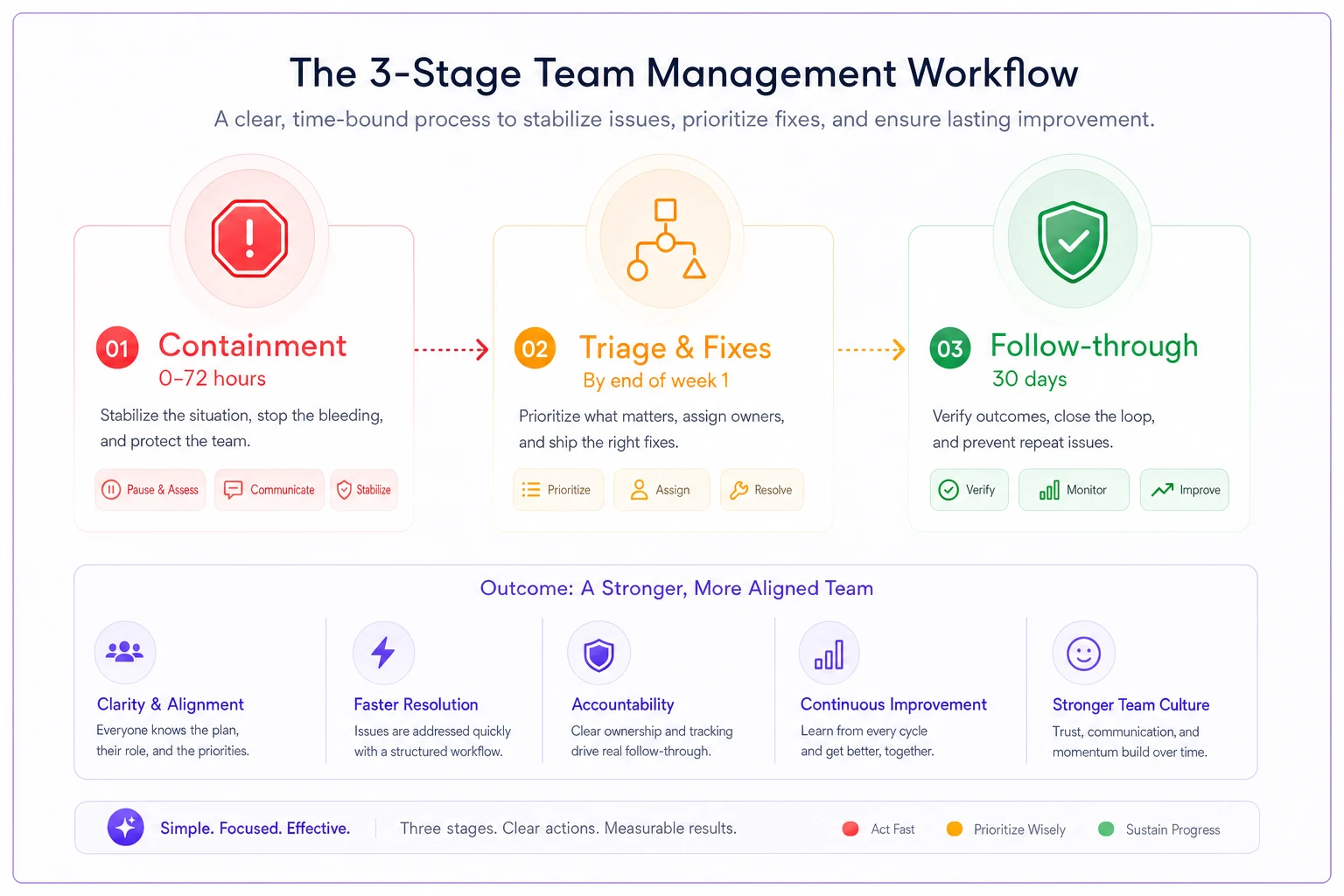
No incident commander role, no five-whys ceremony unless the failure genuinely warrants it. The point is speed and follow-through, not documentation for its own sake.
Phase 1: Containment in the first 48–72 hours
Before anyone asks why it broke, you answer one question: what is still going wrong, and how do we stop it today?
Containment is not the fix. It's the tourniquet. Often ugly and temporary, and that's fine.
A realistic example: a mid-size B2B services company runs a migration to a new CRM over a weekend. Monday morning, sales reps notice deal stages are wrong — closed deals showing as open, some contacts duplicated. The instinct is to convene a big meeting to figure out what happened in the migration script.
Wrong first move. The right first move is containment:
-
Freeze writes to the affected records so reps stop layering new mistakes on top of the corrupted data.
-
Post a pinned message telling the sales team not to trust deal-stage data until further notice, and which fields are still reliable.
-
Snapshot the current broken state before anyone "helpfully" starts fixing rows by hand — manual fixes destroy your ability to trace the cause later.
None of that solves the root problem. All of it stops the situation from getting worse while you figure things out. That's the entire job of the first 72 hours.
The containment checklist
-
Stop the source. Pause the process, script, campaign, or deploy that's producing the bad output.
-
Protect the data. Snapshot or export the current state before anyone edits it manually.
-
Notify the blast radius. Tell the people consuming the broken output — internal or external — what not to trust and what's still fine.
-
Set a "do not touch" boundary. Make it explicit which systems or records are frozen and who's allowed to change them.
-
Assign one containment owner. One person coordinates the tourniquet. Not a committee.
-
Timebox it. Containment gets a hard deadline — end of day, or 72 hours max. If you can't contain in that window, you've got a bigger escalation on your hands.
One pattern worth flagging: the most damaging containment mistakes come from well-meaning people quietly fixing things on their own. A rep who manually corrects ten deal records, an analyst who "cleans up" the export — they mean well, but they contaminate the evidence and sometimes widen the problem. The "do not touch" boundary exists specifically to prevent this.
Phase 2: Three prioritised fixes with owners
Once the bleeding stops, you have breathing room to think. This is where most teams overcorrect and generate a wishlist. Don't.
You are picking three fixes. Ranked. One owner each. If it feels like you're leaving good ideas on the table, good — that means the cap is working. The fourth-through-twelfth ideas can go into a backlog, but they are not part of this postmortem's commitments.
How to actually pick the three
Rank candidate fixes on two axes: how much this reduces the chance of recurrence, and how much effort it takes. You want the fixes that kill recurrence risk cheaply, first.
Here's a realistic prioritisation from the CRM migration example:
| Candidate fix | Recurrence impact | Effort | Verdict |
|---|---|---|---|
| Add a pre-migration validation script that checks record counts and field mappings | High | Medium | Fix #1 |
| Require a staged migration (10% sample) before full cutover | High | Low | Fix #2 |
| Build a rollback runbook so reverting doesn't take a weekend of guessing | Medium | Medium | Fix #3 |
| Rewrite the entire migration tooling in-house | High | Very high | Backlog |
| Add more detailed logging everywhere | Low | High | Skip |
The last two are the trap. Rewriting tooling sounds thorough but it's a quarter of work triggered by a single failure — that's overcorrection. And "more logging everywhere" is the classic filler fix: feels responsible, changes nothing about whether this breaks again.
Owners, not areas
Every fix gets exactly one name. Not "the data team." Not "engineering." A person. That person is accountable for the fix shipping, even if they delegate the actual work.
When a fix is owned by a team, it's owned by no one. Someone assumes someone else has it. The named-owner rule is the single highest-leverage part of this whole template. If you keep only one thing from this article, keep that.
Write each fix in this exact shape:
-
The fix — one sentence, concrete and testable.
-
The owner — one human.
-
The due date — a real date, ideally within the 30-day window.
-
How we'll know it worked — the verification. If you can't state this, the fix is too vague.
That last line matters more than it looks. "Add validation script" is not done when the script exists — it's done when it catches a deliberately broken test migration. Defining "worked" up front is closely related to writing good acceptance criteria before development starts; the same discipline that prevents rework in normal projects prevents your remediation from being fake-complete.
Phase 3: The 30-day follow-through
This is where postmortems go to die. Everyone agrees on fixes in week one, energy fades in week two, and by week four the doc is buried. The follow-through phase exists purely to fight that decay.
Lightweight on purpose:
-
Weekly 15-minute check-in for four weeks. Just the three owners and whoever ran the postmortem. Each owner reports: on track, at risk, or done. That's it.
-
Day 30 verification. For each fix, you run the "how we'll know it worked" test. Not "did we build it" — "did it actually prevent the thing." This is the difference between a closed ticket and a real remediation.
-
A single status line kept visible somewhere the team already looks. Not a new dashboard. A pinned note, a line in the team channel, a row in an existing tracker.
If a fix slips two weeks in a row, that's an escalation trigger — you either re-scope it or pull in help, because a fix that keeps slipping is usually bigger than the postmortem assumed.
On day 30, you verify each fix against its success test and formally close the postmortem. If a fix didn't pass verification, it doesn't get closed — it gets re-owned or re-scoped. Keeping these three commitments visible against everything else your team is running is genuinely hard when the follow-through lives in a separate doc from your actual work. Teams that already have a team operating system for tracking intake and delivery have an easier time here — the remediation fixes just become tracked work items with owners and dates, sitting in the same place as everything else, subject to the same visibility instead of quietly rotting in a wiki.
A short real scenario
A regional accounting firm — around 30 staff — pushed out a new client-facing document portal ahead of tax season. Within two days, clients were uploading sensitive files to the wrong client folders because of a confusing folder-selection dropdown. Support tickets spiked, and a couple of files landed somewhere they absolutely shouldn't have.
They ran this template instead of a traditional retro.
Containment (first 48 hours): disabled client-side folder selection entirely, routing all uploads to a single staff-reviewed inbox. Ugly, manual, but it stopped the misfiling immediately. They notified affected clients and quarantined the misplaced files.
Three fixes:
-
Replace the dropdown with a locked, pre-assigned folder per client (owner
the ops lead, due in 2 weeks).
-
Add a confirmation step showing the client which folder they're uploading to (owner: the developer, due in 3 weeks).
-
Build a weekly audit that flags uploads landing in unexpected folders (owner
the office manager, due in 4 weeks).
Follow-through: four weekly check-ins, day-30 verification where they ran a deliberate wrong-folder test to confirm the confirmation step caught it.
The outcome wasn't dramatic — support tickets related to misfiling dropped to a handful a month from the initial spike, and the manual review inbox got retired once the locked folders shipped. What mattered more was that the fixes actually landed within the month instead of becoming a "we should really fix that portal thing" conversation that drags into summer.
When this template makes sense — and when it doesn't
Use it when the failure is bounded and project-shaped: a botched rollout, a data issue from a migration, a campaign that went wrong, an integration that broke a workflow. Anything where you can name the blast radius and there are three or fewer clear fixes.
Skip it when you're dealing with a genuine security incident, a regulatory breach, or a live outage affecting many customers. Those need real incident response with proper escalation, not a lightweight team postmortem. This template is not built for those.
Be careful using it when the failure is actually a symptom of something systemic — the fourth time this quarter a migration broke, or the third campaign sent to the wrong list. In that case the "three fixes" will keep treating symptoms. You still run the postmortem, but the real fix belongs to a broader process review, not a rapid one.
A note on who should not run this as-is: if your team has no habit of writing down "how we'll know it worked," this template will quietly fail, because every fix will get marked done the moment code ships rather than when it's verified. Build that verification habit first, even if it feels pedantic.
The one thing that separates a useful postmortem from a wasted one
Everything above comes down to a single discipline: containment and cause are two different jobs, and follow-through is a third. Most teams collapse all three into one meeting and wonder why the same failures recur.
Separate them. Stop the bleeding in 72 hours. Commit to exactly three owned fixes by end of week one. Verify — not just ship — those fixes over 30 days. It's less thorough than a full SRE-style analysis, and that's the point. For a late project or a broken rollout, a fast, honest, three-fix postmortem that actually gets followed through beats a beautiful root-cause document that nobody acts on.
Separate them. Stop the bleeding in 72 hours. Commit to exactly three owned fixes by end of week one. Verify — not just ship — those fixes over 30 days. It's less thorough than a full SRE-style analysis, and that's the point. For a late project or a broken rollout, a fast, honest, three-fix postmortem that actually gets followed through beats a beautiful root-cause document that nobody acts on.
Ready to elevate your team's performance?
Join 2,000+ teams using Temsly to streamline workflows, boost productivity, and deliver projects on time.