

Most post-release retros die the same way. Everyone shows up, someone shares their screen with a doc titled "What went well / What didn't," people talk for 45 minutes, three action items get typed into the notes, and then nothing happens. The next release ships with the same rollback risk, the same flaky migration step, the same "oh yeah we forgot to feature-flag that" moment.
The problem isn't that teams don't know what went wrong. They usually nail the diagnosis. The gap is between "we identified 11 things" and "we're actually working on the 3 that matter for stability." Nothing bridges it, so the retro becomes a recurring group therapy session instead of an input to real engineering work.
This is a template for closing that gap — specifically around release stability. A retro structure that outputs a small set of prioritised experiments, maps them to your quarterly improvement OKRs, and hands them off into a tracked backlog where they actually get worked.
Why post-release retros fail to move stability
There's a pattern that shows up in almost every team that runs retros but keeps hitting the same incidents.
The retro generates observations, not commitments. "Deploys are stressful" is an observation. "We spent 40 minutes manually verifying the payment flow because we have no smoke test" is closer — but still vague. Neither one has an owner, a size, or a deadline. So when sprint planning rolls around two days later, the retro output has no standing. It's a Google Doc. Feature work has Jira tickets, estimates, and a PM defending it. Guess which one wins.
The second issue is scope creep inside the retro itself. A release retro should be about that release and stability. Without a tight structure it drifts into "our roadmap is unrealistic" and "design hands off too late" and "the on-call rotation is unfair." All real problems, none of them fixable in a stability-focused retro. The signal drowns.
The third one is sneakier: teams treat every retro output as equal weight. Eleven items go in the notes, and because there's no forcing function to rank them, either all eleven get "assigned" (meaning none get done) or the loudest person's pet issue wins. There's no relationship between what the team actually fixes and what the org cares about for the quarter.
The core structure: five phases, 45 minutes, three outputs
The retro doesn't need to be long. It needs a fixed shape that ends with prioritised, sized, owned items — not a discussion that trails off when the calendar block ends.
Eliminate team chaos and missed deadlines.
Temsly helps you assign, track & complete projects efficiently with full visibility.
- Centralized task management
- Real-time team communication
- Resource and deadline tracking
No credit card required
-
Signal collection (10 min) — Everyone drops stability-relevant events from the release. Not opinions. Events. "Rollback at 2:14pm," "migration took 22 minutes and blocked deploys," "three support tickets about slow login in the first hour."
-
Cluster and pick (8 min) — Group the events into themes. You'll usually land on 3–5 clusters. Vote on the top 2–3 that carry the most stability risk going forward.
-
Root-cause the top clusters (12 min) — For each chosen cluster, go one or two levels deeper. Not a full incident postmortem — that's a different ritual — just enough to know what a fix would actually target.
-
Convert to experiments (10 min) — Turn each cluster into a testable improvement with a hypothesis and a success signal. This is the step everyone skips, and it's the whole point.
-
Handoff (5 min) — Assign owner, size, target OKR, and push into the tracked backlog before anyone leaves the call.
Phase 4 matters more than most teams realise. A fix framed as a task ("add a smoke test") gets deprioritised because there's no way to argue its value later. A fix framed as an experiment ("if we add a payment smoke test to the deploy pipeline, we expect to cut manual pre-release verification from ~40 min to under 10, and catch checkout regressions before customers do") is defensible. It has a before, a hypothesis, and a measurable after. That's what survives sprint planning.
A simple visual of this five-phase flow helps keep the meeting on track.
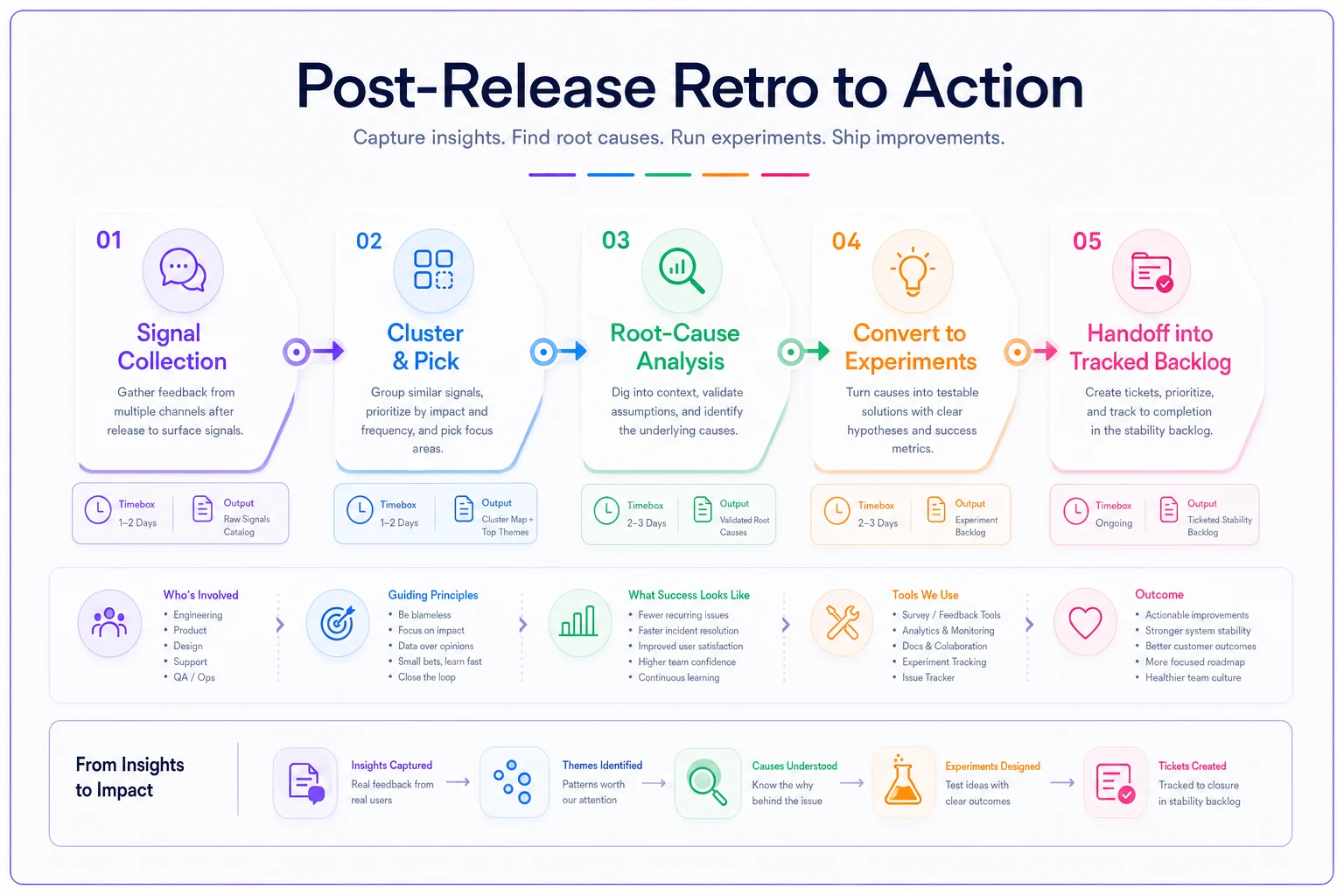
Phase 4 is where you turn things into measurable experiments that can be defended in planning and tracked in the backlog.
Writing the experiment card
Each stability item that leaves the retro should fit on a small card. If it doesn't fit, it's too big and needs to be split.
-
Observation what actually happened, with the event data
-
Hypothesis if we do X, we expect Y to improve
-
Success signal the specific metric or event that tells us it worked
-
Size rough t-shirt size (S/M/L) — not story points yet
-
Owner one name, not a team
-
Mapped OKR which quarterly stability objective this ladders up to
The "mapped OKR" field is the quiet enforcer. If your quarter has an objective like "reduce release rollbacks from ~1 in 4 deploys to under 1 in 10," then every experiment card either maps to that or it doesn't. The ones that don't map to anything aren't necessarily bad — they go to a parking lot, not the priority backlog. This single field kills the "everything is equally important" problem, because the org's stated priorities do the sorting for you. If you want the deeper mechanics of that mapping, the Continuous Improvement Operating Model walks through how retrospectives feed quarterly improvement OKRs without turning into a bureaucracy.
Prioritising when you have more than three good fixes
You'll frequently leave a retro with five or six legitimate stability experiments and capacity for maybe two. This is where teams stall, because everything feels urgent right after a rough release.
Use a simple two-axis sort: stability impact against effort to ship. You don't need a fancy scoring rubric — the goal is to force a decision in the room, not to build a spreadsheet.
| Experiment | Stability impact | Effort | OKR mapped? | Decision |
|---|---|---|---|---|
| Payment smoke test in pipeline | High | S | Yes | Ship this sprint |
| Automated migration timing check | High | M | Yes | Ship next sprint |
| Better deploy dashboard | Medium | M | Partial | Backlog |
| Rewrite on-call runbook | Medium | L | No | Parking lot |
| Feature-flag audit tooling | High | L | Yes | Split into smaller cards |
The pattern that keeps showing up: the highest-value stability fixes are usually small. The scary big-effort rewrites feel important but rarely move the incident rate as much as a well-placed smoke test or a pre-deploy check. When a high-impact item is also large, the right move isn't to schedule it — it's to split it until at least one piece is shippable next sprint.
The handoff is where most templates fall apart
Everything above is worthless if the experiment cards don't leave the meeting and enter the actual work system.
-
Each committed experiment becomes a real ticket in your tracker — same board your team actually looks at, not a separate "improvement" board nobody opens
-
The ticket carries the full card
observation, hypothesis, success signal, owner, mapped OKR
-
It's tagged so you can filter your entire stability backlog in one query
-
It has a target sprint, even if that's "next quarter"
The tagging matters more than people expect. When stability experiments live scattered across normal feature tickets with no consistent label, nobody can ever answer "how much of our improvement backlog is release stability, and how much have we actually shipped this quarter?" A consistent tag turns that into a saved filter you glance at in standup.
Tag stability tickets consistently so the backlog is easy to filter and report on.
This is also where AI-assisted operational tooling earns its place quietly. The tedious part of the handoff — turning a messy retro doc into structured tickets with the right fields, tags, and OKR mapping — is exactly the kind of low-judgment, high-friction work that gets skipped when everyone's tired at the end of a call. Workflow platforms with AI automation can take the retro notes, draft the tickets, pre-fill the mapped OKR based on your quarterly objectives, and drop them into the tracked backlog with the stability tag already applied. The team still decides what to commit to; the automation just removes the excuse of "we ran out of time to write it up." When the handoff takes ten seconds instead of ten minutes, it actually happens.
A real scenario
A B2B scheduling software company — engineering team of about nine — was shipping every two weeks and rolling back roughly one deploy in three. Their retros were happening. They just weren't producing anything. The notes doc from the previous quarter had around 30 action items and maybe four had been touched.
They switched to this structure. First retro after a bad release, they collected events, clustered into four themes, and picked two: flaky database migrations and no automated check on the checkout path. Two experiment cards, both mapped to their quarterly objective of cutting rollbacks below 1 in 10. Both handed off into tickets before the call ended, tagged stability-exp.
Over the following quarter they ran this after every release. Not every experiment worked — one migration-timing check turned out to be noisy and got scrapped after a few deploys. But the rollback rate drifted from roughly 1 in 3 down to about 1 in 8. The bigger change was cultural: because every card had a mapped OKR and a success signal, the team could see which fixes actually moved the needle instead of guessing. The retro stopped being the meeting people dreaded and became the place stability work originated.
When this makes sense — and when it doesn't
This works well when you're shipping regularly, hitting recurring stability issues, and you have quarterly objectives you can map to. It's built for teams that already run retros but can't convert them into shipped work.
This is a bad idea when you're dealing with a single catastrophic failure that needs deep investigation. A lightweight retro-to-experiment loop is the wrong tool for a major incident — that needs a proper containment and root-cause process. The Rapid Postmortem Template is the right structure for those, and it feeds this backlog once the immediate fire is out.
Who should skip this entirely: very early-stage teams shipping daily with two or three engineers. At that size the overhead of experiment cards and OKR mapping outweighs the benefit — just fix the thing and move on. This template starts paying off around the point where you have enough people that things fall through the cracks and enough release cadence that the same problems keep recurring.
The one habit that makes it stick
End every stability retro with items in the tracker, not in a doc. The doc is where good intentions go to die. The moment an experiment becomes a real ticket with an owner and a mapped OKR, it stops competing with feature work as a second-class citizen and starts getting scheduled like everything else.
The retro isn't the deliverable. The tracked, prioritised, OKR-mapped backlog is. Run the meeting to produce that, protect the handoff step like it's the most important five minutes on the call, and the same release problems stop showing up every two weeks.
The retro isn't the deliverable. The tracked, prioritised, OKR-mapped backlog is. Run the meeting to produce that, protect the handoff step like it's the most important five minutes on the call, and the same release problems stop showing up every two weeks.
Ready to elevate your team's performance?
Join 2,000+ teams using Temsly to streamline workflows, boost productivity, and deliver projects on time.