

I spent last Tuesday watching a product manager run their team's quarterly retrospective. Sticky notes everywhere, good energy, honest feedback about what went wrong. The team identified twelve improvement areas, voted on priorities, assigned owners. Standard stuff.
Then someone asked: "Whatever happened to the action items from last quarter's retro?"
Silence.
This isn't unusual. Most teams treat retrospectives like group therapy — feels productive in the moment, but nothing fundamentally changes. The continuous improvement operating model most organizations claim to follow is really just a series of disconnected meetings where people air the same grievances every few months.
The Retrospective-to-Reality Gap
What typically happens: teams dutifully run their retrospectives, generate lists of improvements, maybe assign owners. But without a systematic way to convert those insights into measurable experiments — and actually track them — you're just building a backlog of good intentions.
This pattern plays out across engineering teams, marketing departments, operations groups. Doesn't matter the function. Retro outputs go into a doc somewhere, the team goes back to their real work, and three months later everyone's surprised nothing improved. The problem isn't retrospectives. It's the absence of an operating model that treats improvement as actual work, not just aspirational ideas wedged between "real" projects.
Why Traditional Improvement Approaches Break Down
Most organizations follow the same loop: run retrospectives → create action items → hope people find time → wonder why nothing changes.
Eliminate team chaos and missed deadlines.
Temsly helps you assign, track & complete projects efficiently with full visibility.
- Centralized task management
- Real-time team communication
- Resource and deadline tracking
No credit card required
It breaks for a few consistent reasons. Improvement work competes with delivery work, and delivery always wins. Engineers aren't going to prioritize "improve code review process" when there's a feature deadline looming. Without success metrics, you can't tell if anything actually improved. And there's no systematic way to capture what worked and replicate it across teams. What's genuinely frustrating is watching teams identify the same problems quarter after quarter. "Deployments take too long." "Too many meetings." "Unclear requirements cause rework." These aren't new observations — they're chronic issues that never get properly addressed because nothing converts the insight into action. Eventually, teams start treating retrospectives as mandatory theater. People show up, go through the motions, knowing nothing will change. Even the retrospectives themselves become something everyone wants to improve but never does.
Building a Continuous Improvement Operating Model That Actually Works
A real continuous improvement operating model treats improvement work like product development — backlogs, experiments, metrics, learning loops. Here's the framework that actually closes the retrospective-to-reality gap.
1. Convert Retrospective Outputs into Experiment Proposals
Every improvement idea becomes a lightweight experiment proposal. Vague improvements need to become testable changes, and the only way to force that is structure. Each proposal should cover:
-
Problem statement (what specific pain are we addressing)
-
Hypothesis (what we believe will happen if we try X)
-
Success metrics (how we'll know if it worked)
-
Time box (how long we'll run the experiment)
-
Effort estimate (rough t-shirt size)
So instead of "improve code review process," you get: "Experiment: Implement review buddies system. Hypothesis: Pairing reviewers will reduce review cycle time by 30%. Metrics: Average PR review time, rework rate. Duration: 4 weeks. Effort: Medium."
2. Maintain an Improvement Backlog with a Scoring Rubric
Not all improvements are worth the same attention. A scoring rubric helps teams evaluate what to actually prioritize:
| Factor | Weight | Scoring Criteria |
|---|---|---|
| Impact Scope | 30% | Single team (1) → Multiple teams (3) → Organization-wide (5) |
| Pain Frequency | 25% | Monthly (1) → Weekly (3) → Daily (5) |
| Effort Required | 20% | Major overhaul (1) → Medium changes (3) → Quick win (5) |
| Risk Level | 15% | High uncertainty (1) → Some risk (3) → Low risk (5) |
| Strategic Alignment | 10% | Nice to have (1) → Supports goals (3) → Critical priority (5) |
Scoring each proposal creates a prioritized backlog. It also removes the dynamic where the loudest voice or the most recent complaint dominates what gets worked on.
3. Quarterly Improvement OKRs with Dedicated Capacity
This is where most improvement efforts die — no protected capacity. Your continuous improvement operating model needs reserved time, same as any strategic initiative.
-
Each quarter, teams commit to 2-3 improvement OKRs
-
OKRs pull from the prioritized experiment backlog
-
Teams allocate roughly 10-15% of capacity specifically for improvement work
-
Progress gets tracked alongside delivery metrics
A real example from a development team:
Q3 Improvement OKRs:
O1: Reduce deployment failures
-
KR1
Run 3 experiments on deployment process (automated checks, staging validation, rollback procedures)
-
KR2
Achieve <5% deployment rollback rate
-
KR3
Document winning approach in team playbook
O2: Improve cross-functional handoffs
-
KR1
Implement definition of ready template with product team
-
KR2
Reduce requirements-related rework by 40%
-
KR3
Standardize handoff process across all project types
Not vague goals. Specific, measurable, and time-bound.
4. Experiment Tracking and Learning Rituals
Running experiments without tracking results is just making random changes. You need a simple system that captures what happened and why. Each experiment card should include:
-
Experiment name and hypothesis
-
Start/end dates
-
Baseline metrics (before state)
-
Weekly metric updates
-
Final results and decision (adopt/adapt/abandon)
-
Lessons learned and next steps
Build a regular cadence to review experiments — not a new meeting, just five minutes inside an existing team sync. One team keeps an "Improvement Experiments Board" next to their project kanban. Green cards for successful experiments now baked into standard practice, yellow for ongoing, red for failed experiments — which they actually celebrate as learning.
Limit experiment updates in team syncs to a two-line status and a quick metric to keep the review brief and actionable.
5. Successful Experiment → Standard Operating Procedure
This is where most continuous improvement operating models fall apart. Teams run a successful experiment, everyone agrees it's better, then six months later half the team has reverted, new members never learned it, and you're back to square one.
When an experiment succeeds, you need a real handoff process:
Week 1 Post-Experiment:
-
Team decision
adopt as-is, adapt with modifications, or abandon
-
If adopting
document the new process in team wiki
-
Assign process owner (not the experiment runner)
Week 2-3:
-
Process owner creates step-by-step guide or checklist, templates if needed, light training materials
-
Run a practice session with the team
Week 4:
-
Official cutover to new process
-
Add to team onboarding checklist
-
Schedule 30-day check-in
Month 2:
-
30-day retrospective
is it sticking? Any adjustments?
-
Update documentation based on actual usage
-
Share learnings with other teams if applicable
Skip this and even your best improvements quietly disappear.
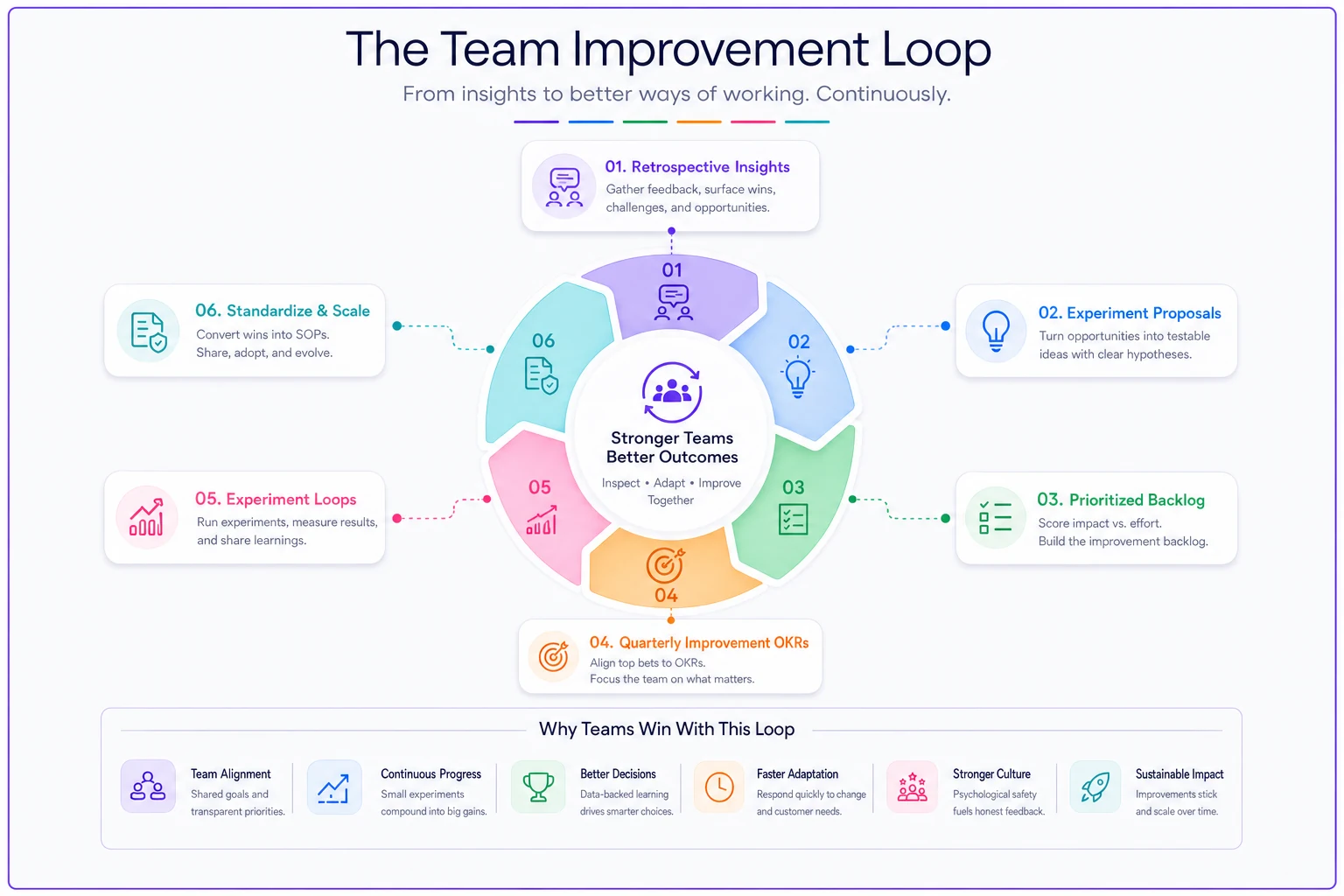
A simple visual of the flow helps teams see the handoffs from ideas to experiments to SOPs.
Common Failure Patterns in Continuous Improvement
A few patterns show up repeatedly:
The "Everything is Priority 1" Trap: Team identifies twenty improvements, tries to tackle all of them, accomplishes none. The operating model has to force prioritization and limit work in progress.
The Metrics Desert: Running experiments without baseline metrics or clear success criteria. You end up debating impressions instead of data. "I think deployments feel faster" isn't an answer.
The Individual Hero Problem: One motivated person drives all improvements. When they burn out or leave, everything stops. Distributed ownership isn't optional.
The Process Police Overcorrection: Team runs one successful experiment, gets excited, creates twelve new mandatory processes. Now the improvement system becomes the bottleneck it was supposed to eliminate.
Real Implementation: Marketing Operations Team
Here's how a 12-person marketing operations team put this operating model into practice.
Starting Point:
-
Retrospectives every two weeks (too frequent, low energy)
-
47-item action list in a shared doc, most items untouched
-
No clear ownership or tracking
-
Same complaints every cycle
campaign handoffs, asset versioning, approval delays
New Operating Model Rollout:
Month 1: Converted existing action items into experiment proposals. Kept only the top 8. Built a simple scoring rubric with the team.
Month 2: First quarterly improvement OKRs:
-
Reduce campaign launch delays (2 experiments)
-
Improve asset request process (1 experiment)
-
Better reporting visibility (1 experiment)
Month 3: First experiments wrapped up. Campaign approval experiment worked (reduced delays by roughly 3 days). Asset request experiment failed — added complexity instead of removing it. Reporting experiment partially worked for certain report types only.
Month 4-6: Refined from learnings. Successful approval process became standard. Modified asset request approach for a second experiment. Reporting solution scoped to specific report types.
Results after 6 months:
-
Campaign launch time down from roughly 12 days to around 7
-
Clear asset request SLA system in place
-
Weekly improvement reviews embedded in team sync (5 minutes)
-
Retrospectives moved to monthly, much more focused
The biggest shift was morale. People saw their feedback producing real change. Retrospectives went from something people dreaded to something they actually engaged with.
Automation and Scale Considerations
As the operating model matures, some parts become natural candidates for automation. Manually tracking experiment metrics works fine for a handful of experiments — it breaks down when you're running a dozen across multiple teams.
Worth setting up automated tracking for:
-
Experiment metric collection (pull from existing tools via APIs)
-
Progress notifications (remind experiment owners of check-ins)
-
Success/failure alerts when metrics cross thresholds
-
Documentation prompts when experiments succeed
Some teams connect their improvement backlog directly to their work management platform, which creates visibility and keeps improvement work from becoming invisible side projects.
The async communication patterns you already use for regular work should extend to experiments too. Weekly check-ins happen via comments on experiment cards, not extra meetings. Decisions get documented in writing rather than just talked through verbally.
Who Should NOT Implement This Model
This operating model isn't right for every situation:
Teams in pure firefighting mode: If you're constantly in crisis, you don't have capacity for systematic improvement. Fix the immediate problems first.
Very small teams (under 4 people): The overhead isn't worth it. Just fix things as you notice them.
Teams with no real autonomy: If changing your own processes requires three levels of approval, this model will just produce frustration.
Temporary or short-duration teams: If the team exists for less than six months, don't bother building improvement infrastructure.
Making It Stick: The First 90 Days
The first quarter determines whether this becomes embedded or abandoned. A straightforward rollout looks like this:
Days 1-30: Foundation
-
Run one final traditional retrospective
-
Convert outputs into first batch of experiment proposals
-
Create scoring rubric with team input
-
Select 2-3 experiments for the first quarter
-
Set up basic tracking (a spreadsheet is fine to start)
Days 31-60: First Experiments
-
Launch your first experiments
-
Establish weekly check-in rhythm
-
Track metrics consistently — even manually
-
Share early wins or interesting failures with the broader team
Days 61-90: Rhythm and Refinement
-
Complete first experiments
-
Run adoption/adaptation decisions
-
Create first SOPs from successful experiments
-
Plan second quarter improvements
-
Celebrate both successful experiments and failed ones that generated useful learning
Start small. Pick a few genuinely painful problems, run rigorous experiments, show measurable improvement. Once people see it working, adoption follows naturally.
The Compound Effect
No single improvement revolutionizes how a team operates. That's not the point. A team that consistently improves three things per quarter — even small things — looks completely different after a year. Deployments 30% faster. Code review turnaround cut in half. Meeting load down by a fifth. Rework from unclear requirements dropped significantly.
Stack those across four quarters and you have a team operating at a different level. More importantly, you've built the habit of continuous improvement. The operating model stops feeling like a system and just becomes how the team works. Teams that stick with this for a full year tend to report something similar: they stop dreading problems. When something breaks or frustrates them, the reaction shifts from complaining to "that's an experiment for next quarter."
Operating Model as Competitive Advantage
Most teams accept their operational friction as permanent. "That's just how deployments work here." "Marketing briefs are always unclear." They complain about it, maybe discuss it in retros, but never systematically address it.
Teams with a real continuous improvement operating model gradually eliminate those frictions. While others lose hours to preventable inefficiency, they've already tested and optimized their way past those problems. While other teams repeat the same mistakes, they've captured lessons and built prevention into how they work.
Without a model like this, you're just having really good conversations about change. With it, you're systematically building a better operation, one experiment at a time.
Ready to elevate your team's performance?
Join 2,000+ teams using Temsly to streamline workflows, boost productivity, and deliver projects on time.