


Shared specialists are the people everyone wants and nobody owns. Your security engineer, your database performance person, your accessibility expert, the one designer who actually understands motion, the ML infra person who's the only one who's touched the feature store since it was built. In a small or mid-sized org, you can't afford one of these per team. So they float. And the moment they float, the fights begin.
The core problem with a shared services operating model for engineering isn't that specialists are overloaded — though they usually are. It's that there's no agreed system for who gets them, when, for how long, and who pays. Without that system, allocation happens through whoever escalates loudest, has the best relationship with the specialist, or catches them on Slack first. That's not an operating model. That's a popularity contest with a P0 label slapped on top.
This post walks through how it actually breaks, then covers the pieces that make it work: funding lanes, booking windows, capacity allocation rules, SLAs, and the governance rituals that keep the whole thing honest. There are two fillable templates at the end — a service charter and a booking policy — that you can lift and adapt.
Start with the failure, because it's more instructive than the fix
Picture a platform team with three shared specialists serving eight product squads. No formal allocation model. Here's what happens, almost every time:
Specialists spend the first hour each morning triaging DMs. By 10am they've context-switched across four codebases. The squads that get help are the ones whose managers have standing 1:1s with the platform lead. The squads that don't learn to route around the specialists entirely — they ship the risky migration themselves, badly, and the cleanup lands back on the specialist three sprints later as an incident. Meanwhile leadership sees a specialist who's "always busy" and concludes they need to hire another one. So they do. The new hire absorbs the same unstructured demand, and within a quarter both specialists are underwater again. You didn't fix a capacity problem. You doubled an allocation problem.
That's the thing worth sitting with: most shared specialist pain is misdiagnosed as a headcount problem when it's actually an intake and prioritization problem. Hiring is the expensive way to avoid building a system.
The four failure modes at scale
Once you're past roughly five or six teams sharing a specialist pool, four distinct failure modes show up. Each has a different fix.
Eliminate team chaos and missed deadlines.
Temsly helps you assign, track & complete projects efficiently with full visibility.
- Centralized task management
- Real-time team communication
- Resource and deadline tracking
No credit card required
| Failure mode | What it looks like | Root cause | What it costs you |
|---|---|---|---|
| Invisible queue | Requests live in DMs and hallway asks; no one can see total demand | No single intake point | Duplicate work, no capacity signal, panic hiring |
| Loudest-wins | Priority set by escalation volume, not business value | No funding or scoring lane | Strategic work starved by noisy small asks |
| Perpetual interrupt | Specialist context-switches all day, ships nothing deep | No booking windows or focus blocks | 30–40% effective capacity lost to switching |
| Ownership fog | "Who's accountable for this system?" gets a shrug | No service charter | Reliability decay, on-call resentment |
These compound. An invisible queue guarantees loudest-wins, because if you can't see relative value you default to volume. Loudest-wins guarantees perpetual interrupt, because urgent-flagged small asks jump the line. And all of it accelerates ownership fog — a specialist who's constantly firefighting never has time to document or hand off, so they become the single point of failure for three systems nobody else understands.
Funding and prioritization lanes
The concept that changes the whole conversation: specialist capacity should be funded before it's requested, not allocated after.
-
- Committed / roadmap lane (≈50%) — Capacity pre-allocated to specific squads or initiatives for the quarter. Funded through planning. Booked in advance and protected.
-
- Reactive / shared lane (≈25%) — Pooled capacity for smaller cross-team requests that come in during the quarter. Prioritized by a scoring rubric, not by who asks first.
-
- Reliability / debt lane (≈15%) — Reserved for the specialist's own domain health: paying down risk, improving tooling, documentation, reducing bus-factor. This lane is the first thing teams cut and the first thing that comes back to bite them.
-
- Buffer / true-urgent (≈10%) — Genuine incidents and unplannable emergencies.
The percentages aren't sacred. The discipline is. Once you draw these lanes, arguments stop being about the specialist's time and start being about which lane a request belongs in — which is a far more productive fight. Someone screaming that their request is urgent now has to answer: does this actually qualify for the buffer lane, or are you trying to jump the reactive queue?
A pattern worth watching: teams that skip the reliability lane entirely because it doesn't have an obvious customer. Six months later the specialist's domain has three undocumented systems and a growing incident rate, and everyone's confused about why velocity dropped. The lane you can't attribute to a stakeholder is often the one holding the whole thing together.
If you want to go deeper on sizing these lanes against real availability rather than wishful thinking, the mechanics tie directly into portfolio-level capacity planning across your project portfolio — lanes are only as honest as the capacity math underneath them.
Booking windows and policies
Funding lanes decide how much. Booking windows decide when and how teams actually reserve the time. This is where most models fall apart — they define the lanes and then let people book chaotically inside them.
A few policies that hold up under load:
Booking horizon. Committed-lane work gets booked during quarterly or monthly planning, minimum two weeks out. Reactive work opens a rolling window — you can book into next week, not tomorrow. This one rule alone kills most of the interrupt problem, because it forces requesters to plan instead of pouncing.
Minimum and maximum block sizes. No booking smaller than half a day. Context-switching a specialist for a 45-minute favor is negative ROI. No single continuous booking longer than about a week without a checkpoint, so you don't quietly turn a "shared" specialist into a permanently embedded one.
Embedding decay. If a specialist is embedded with one squad for more than two or three sprints, that should trigger a review. Long embeds aren't wrong, but they should be a decision, not something that happened because nobody was watching the calendar.
Cancellation and no-show policy. Sounds petty until you've watched a squad block a specialist's whole week, then release it Monday morning with the work not ready. A soft rule — release bookings 48 hours out if the input isn't ready, or forfeit to the reactive pool — protects everyone. The Definition of Ready matters here: a booking against a spec that isn't ready is a booking that will bounce.
Booking windows make capacity a shared, visible resource instead of a private negotiation. Once bookings live somewhere everyone can see them, "the specialist is unavailable" becomes a fact instead of an opinion, and the escalation energy has to redirect somewhere useful.
Here's a quick workflow view of how intake turns into scheduled blocks, checkpoints, and buffer handling.
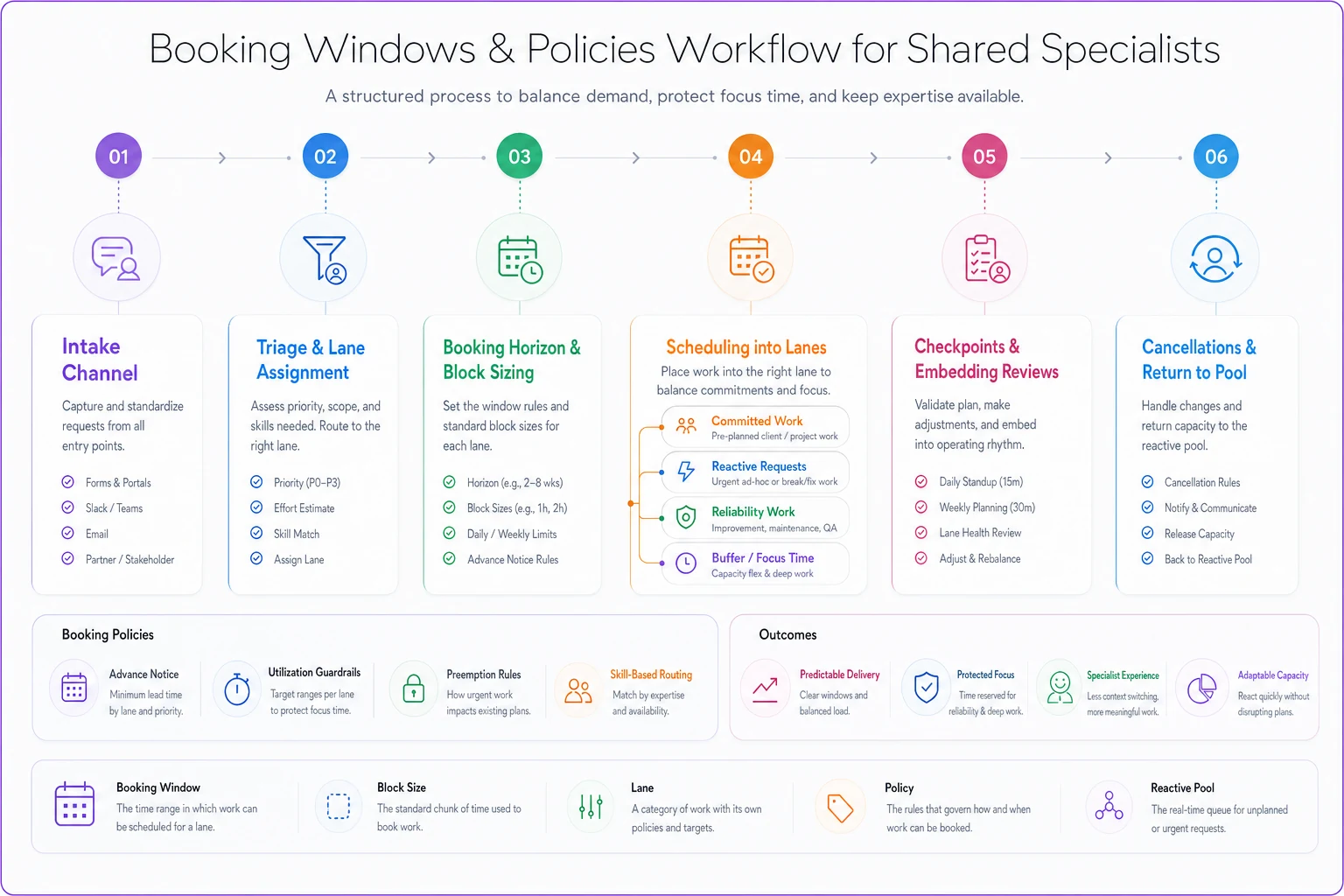
Once bookings live somewhere everyone can see them, "the specialist is unavailable" becomes a fact instead of an opinion, and the escalation energy has to redirect somewhere useful.
Capacity allocation rules
A scoring approach for the reactive lane works better than gut feel, and it doesn't need to be elaborate.
-
Business impact — revenue, risk, or unblock value (1–5)
-
Reversibility — how expensive is it to get this wrong later (1–5)
-
Specialist-only factor — could a generalist do this with light guidance? If yes, it probably shouldn't consume specialist capacity at all
-
Time-sensitivity — is there a real external deadline, or a manufactured one**
The specialist-only factor is the underrated one. A large share of requests that land on shared specialists don't actually require the specialist — they require confidence, and the team is outsourcing that confidence rather than building it. A healthy model deliberately routes some of that back with pairing or a review instead of a full build, so the specialist multiplies rather than absorbs.
A decision rule worth putting in writing:
-
- If a request scores high on impact and genuinely needs specialist skill → reactive lane, booked normally.
-
- If it's high impact but a generalist could do it with review → route to the requesting squad, specialist reviews the design only.
-
- If it's low impact and not specialist-only → declined or deferred, with a clear reason.
-
- If it's a true unplannable emergency → buffer lane, and it gets logged so you can track whether "emergencies" are actually a recurring category you should be funding properly.
That last point matters. When you log buffer-lane usage, patterns emerge fast. If the same "emergency" shows up every third week, it's not an emergency — it's unfunded recurring work, and it belongs in a committed lane.
SLAs that mean something
SLAs for shared specialists should cover response, not just resolution — because the biggest source of frustration isn't slow work, it's silence. A team that knows they're fourth in the queue and will be picked up Thursday is calm. A team that hears nothing invents catastrophes.
| Request type | Acknowledgement SLA | Scheduling SLA | Notes |
|---|---|---|---|
| Buffer / true-urgent | Under 1 hour | Same day | Requires incident label + on-call sign-off |
| Reactive (high score) | Same business day | Within current sprint | Scheduled into next open block |
| Reactive (standard) | 1 business day | Next planning cycle | Booked, not immediate |
| Design review only | 1 business day | Async within 2 days | No live session required |
The critical discipline: acknowledgement is not the same as commitment. "Got it, you're in the reactive queue, expected pickup next week" is a valid, honest response that resolves most of the anxiety without promising work you can't do. Teams that conflate the two either over-promise and breach constantly, or under-communicate and get escalated over.
Governance rituals that keep it honest
A model without maintenance drifts back to loudest-wins within a quarter. Guaranteed. The rituals don't need to be heavy — three of them do the job:
Weekly capacity sync (15 min, async-first). The specialist and the coordinating lead confirm next week's bookings, flag any lane that's overrun, and surface anything sitting in the reactive queue too long. Most of this can be a written update; the meeting only happens if there's a conflict to resolve.
Monthly lane review. Are the lane percentages still right? If the reliability lane got eaten three months running, that's a signal, not an accident. This is also where recurring buffer-lane items get promoted to committed work.
Quarterly charter refresh. Ownership changes, systems get handed off, specialists rotate. The service charter should be a living document reviewed each quarter, not a wiki page that fossilized 18 months ago.
One pattern worth flagging: governance dies when it's someone's extra job. Assign a named coordinator for the specialist pool — not necessarily the specialist, often better if it's not — whose actual role includes running these rituals. Un-owned governance is theater.
Tracking whether the model is actually working matters as much as running it. A few leading indicators — queue age, breach rate, buffer-lane frequency, embedding duration — will tell you the system is drifting long before anyone complains. If you're building that instrumentation, the approach in mapping outcomes to leading indicators and dashboard triggers applies directly to specialist pools.
When this model makes sense — and when it doesn't
It makes sense when: you have four or more teams competing for the same scarce skill, demand clearly exceeds one person's capacity, and allocation is already happening through informal channels. If you're fielding "who gets the security engineer this sprint" arguments, you need this.
It's overkill when: you have one specialist and two teams with predictable, low-volume demand. A shared calendar and a five-minute weekly check is enough. Don't build lanes and SLAs for a problem you don't have — the process overhead will cost more than the chaos it prevents.
Who should NOT do this: teams where the "specialist" is really just a senior generalist everyone likes. If the skill isn't genuinely scarce, formalizing access creates artificial scarcity and resentment. The fix there is spreading the knowledge, not rationing the person.
A realistic before/after
Consider a fintech platform group: three shared specialists — security, data infra, and an SRE-leaning generalist — serving seven squads. Before formalizing anything, they were running on DMs and escalations. The security engineer estimated he spent close to half his week on context-switching and re-explaining, and two squads had quietly stopped asking for help altogether. That showed up later as a pair of avoidable incidents.
They stood up lanes (roughly 50/25/15/10), moved intake into a single booking view, and set acknowledgement SLAs. Within two months, reactive-queue acknowledgements were consistently same-day, the "always busy but shipping nothing" complaint faded because deep work got protected blocks, and the recurring "emergency" around monthly compliance reporting got exposed as unfunded recurring work and moved into a committed lane. No new headcount. The debate over hiring a fourth specialist just quietly stopped.
The number that mattered most wasn't a productivity percentage — it was that both under-served squads started routing through the queue again instead of shipping risky work solo. That's the invisible cost of a broken model: not the hours lost, but the good requests that stop getting made.
Fillable template: Service Charter
Copy this per specialist domain and fill it in.
SERVICE CHARTER — [Specialist Domain, e.g. "Data Infrastructure"] Domain owner: Backup / bus-factor coverage: Coordinator (runs rituals): Last reviewed: | Next review: SCOPE In scope: _ Out of scope: ___ Route elsewhere: CAPACITY LANES (as % of committed capacity) Committed / roadmap: __% Reactive / shared: __% Reliability / debt: __% Buffer / urgent: __% INTAKE Single intake channel: Required fields for a request: Definition of Ready before booking: _ SLAs Urgent acknowledgement: scheduling: Reactive acknowledgement: scheduling: Review-only: _ ESCALATION PATH Level 1: Level 2: Level 3: ___
Fillable template: Booking Policy
BOOKING POLICY — [Specialist Pool]
BOOKING HORIZON Committed lane: booked in planning, min __ weeks ahead Reactive lane: rolling window, min _ business days ahead Buffer lane: same-day, requires _ sign-off
BLOCK SIZES Minimum block: Maximum continuous block without checkpoint: Embedding review triggered after: _ sprints
CANCELLATION / NO-SHOW Release deadline if input not ready: hours prior Consequence of no-show: ____
CONFLICT RESOLUTION When two teams want the same slot:
-
Higher lane priority wins (committed > reactive)
-
Within a lane, higher score wins
-
Tie → coordinator arbitrates at weekly sync
VISIBILITY Where bookings are visible to all teams: ___ Who updates the booking view: ___
The real point
A shared services operating model for engineering isn't about controlling specialists — it's about making their scarcity visible and negotiable instead of hidden and political. The lanes, windows, and SLAs are just the mechanism. What they really do is move the argument out of DMs and into a place where business value, not escalation volume, decides who gets the scarce skill.
The teams that get this right don't necessarily have more specialists. They have specialists whose time is a known, funded, defensible resource — and a coordinator whose job is to keep it that way. Start with the charter and one honest look at where your specialists' hours actually go this week. The gap between where they're going and where they should be going is usually the entire business case.
Start with the charter and one honest look at where your specialists' hours actually go this week. The gap between where they're going and where they should be going is usually the entire business case.
Ready to elevate your team's performance?
Join 2,000+ teams using Temsly to streamline workflows, boost productivity, and deliver projects on time.