

Your product team gets 200+ requests per month. Marketing needs a data export. Sales wants a custom demo environment. Customer Success escalates a bug that's annoying but not critical. The CEO asks for a "quick tweak" to the dashboard.
Without an internal SLA framework, every request becomes equally urgent and equally disruptive. Engineers get pinged directly, context-switch constantly, and somehow still end up blamed for being unresponsive.
The frustrating part? Most teams try to fix this with more meetings, more process, more approvals—request committees and approval chains that slow everything down without actually improving response times.
The Operational Breakdown of Request Chaos
Engineering teams without clear service levels operate in a state of constant negotiation. Every request triggers the same dance: stakeholder submits something, engineer asks for clarification, stakeholder escalates, manager gets pulled in, priority gets debated, work eventually happens, and nobody's happy about how it got there.
A fintech company with 22 engineers tracked their request patterns for a month and found their team was spending roughly 8 hours per week just figuring out what to work on next. Not doing the work—just deciding priorities.
The real damage shows up in three places:
Sprint contamination: Planned work gets constantly interrupted by "urgent" requests that could have waited. Sprint velocity becomes meaningless when half your capacity gets redirected mid-sprint.
Relationship erosion: Stakeholders learn that being loudest gets fastest results. Engineers learn that all deadlines are negotiable. Trust breaks down from both directions.
Hidden queue buildup: Requests pile up across Jira tickets, Slack threads, email chains, and notes from hallway conversations. Some get done twice. Others never get done. Nobody has a clear picture of the actual backlog.
Building Tiers That Reflect Actual Business Impact
Most SLA frameworks fail because they use arbitrary labels like "High/Medium/Low" that mean different things to different people. A marketing manager's "High" is rarely the same as an engineer's "High."
Eliminate team chaos and missed deadlines.
Temsly helps you assign, track & complete projects efficiently with full visibility.
- Centralized task management
- Real-time team communication
- Resource and deadline tracking
No credit card required
Tier 1: Revenue or operations halted
-
Payment systems down
-
Customer-facing outages
-
Data corruption affecting billing
-
Security breaches
Response: 30 minutes | Resolution: 4 hours | Who can declare: On-call engineer, VP+
Tier 2: Revenue or operations degraded
-
Performance issues affecting conversion
-
Bugs blocking sales demos
-
Integration failures with key partners
-
Features broken for major customers
Response: 4 hours | Resolution: 24 hours | Who can declare: Department heads
Tier 3: Business improvement needed
-
Feature requests
-
Non-critical bugs
-
Enhancement ideas
-
Process optimizations
Response: 2 business days | Resolution: Scoped within 5 days | Who can declare: Anyone through proper channels
Tier 4: Information or investigation
-
Data pulls
-
Technical questions
-
Feasibility assessments
-
Architecture reviews
Response: 3 business days | Resolution: Best effort | Who can declare: Anyone through proper channels
Notice the "Who can declare" component. This is what prevents the VP of Sales from classifying every request as Tier 1. It also gives engineers authority to act immediately on genuine emergencies without waiting for sign-off.
The Acknowledgement System That Prevents Follow-Up Pings
Stakeholders chase engineers for one reason: they don't know if their request was received or when they'll hear back. An acknowledgement system fixes this, but most teams get the implementation wrong.
Bad acknowledgement: "We got your request. Ticket #4823 created."
Good acknowledgement: "Request received at 2:14 PM. Classification: Tier 3 (business improvement). You'll receive an initial response by Thursday 10 AM. Assigned to: Platform team queue."
The difference is a specific expectation, not just a receipt.
For Tier 1 and 2 issues, acknowledgement should include who's actively working on it, current diagnosis status, expected next update time, and the escalation path if needed. For Tier 3 and 4 requests, it should include current queue position, estimated start date, any missing information required, and alternative solutions if they exist.
A B2B software company implemented automated acknowledgements with those specific elements and their "where's my request?" follow-ups dropped from around 40 per week to under 5.
Breach Handling That Maintains Trust Instead of Destroying It
SLA breaches happen. Pretending they won't, or burying them when they do, destroys the framework's credibility fast. You need a breach protocol that treats misses as operational data, not personal failures.
The moment a breach occurs—not the next day, not in a report, the actual moment—three things need to happen.
Immediate internal notification: The assigned engineer and their lead get an alert. Not an email they might miss—a Slack message, a text, whatever they'll actually see.
Stakeholder communication within 2 hours: The requestor gets a breach notification that includes acknowledgement of the miss, a realistic new timeline, a reason without excuses, and what's being done to prevent it from happening again.
Pattern analysis within 24 hours: Every breach gets logged with the original tier and SLA, actual response and resolution time, root cause in one sentence, and whether it was preventable.
The pattern analysis matters more than any individual breach. If Tier 3 requests consistently miss because they're actually mini-projects disguised as simple asks, you need to fix either your scoping process or your SLA definitions.
Enforcement Without Becoming the Process Police
The fastest way to kill an internal SLA framework is rigid enforcement. But being too flexible means you don't have SLAs—you have suggestions.
The balance comes from graduated enforcement.
Month 1 — Education mode: Track everything but don't reject anything. When someone submits a Tier 3 as Tier 1, reclassify it and explain why. Build understanding before enforcement.
Month 2 — Soft enforcement: Start pushing back on obviously mis-tiered requests, with detailed explanations each time. Build a "how to tier your request" guide using real examples from Month 1.
Month 3+ — Standard enforcement: Mis-tiered requests get automatically reclassified. Repeat offenders get flagged to their managers. The system becomes self-policing.
One pattern that works well: the "SLA credit system." Each department gets three expedite credits per quarter. They can use these to bump a Tier 3 request to Tier 2 handling, no questions asked. Once they're out, they're out. This gives stakeholders flexibility for genuinely time-sensitive situations while stopping the habit of treating everything as urgent.
The Technical Stack That Makes SLAs Automatic
Manual SLA tracking starts falling apart around 20 requests per week. You need systems that automatically capture, classify, route, acknowledge, and monitor—without someone babysitting the process.
Most teams try to patch this together with existing tools: Jira for ticket tracking, a Slack bot for notifications, Google Sheets for SLA monitoring, Zapier to connect everything. This works early on but becomes a maintenance headache as complexity grows. Every edge case needs a new Zap. Every new tier requires formula updates. Eventually someone's spending half their time just keeping the SLA system running.
-
Single entry point One form, one email address, one Slack channel—pick one and stick with it. Multiple entry points guarantee requests slip through.
-
Auto-classification logic Keywords trigger initial classification. "Customer can't log in" → Tier 2. "Thinking about a feature" → Tier 4. Classification can be challenged, but having a smart default prevents decision fatigue.
-
Timer automation SLA clocks start automatically, pause when waiting on requestor input, and escalate at defined thresholds. Manual timer management always breaks down.
-
Visibility dashboard Both engineers and stakeholders need self-serve access to current queue by tier, average resolution times, individual request status, and SLA performance trends.
Teams that invest in AI-powered operational software for this layer get meaningful leverage here. Platforms that handle intake, auto-classification, acknowledgement, and breach monitoring in one place cut the coordination overhead significantly compared to stitched-together tooling.
Start by automating the most common intake paths first to reduce manual classification work.
Visualizing the automated intake-to-resolution workflow:
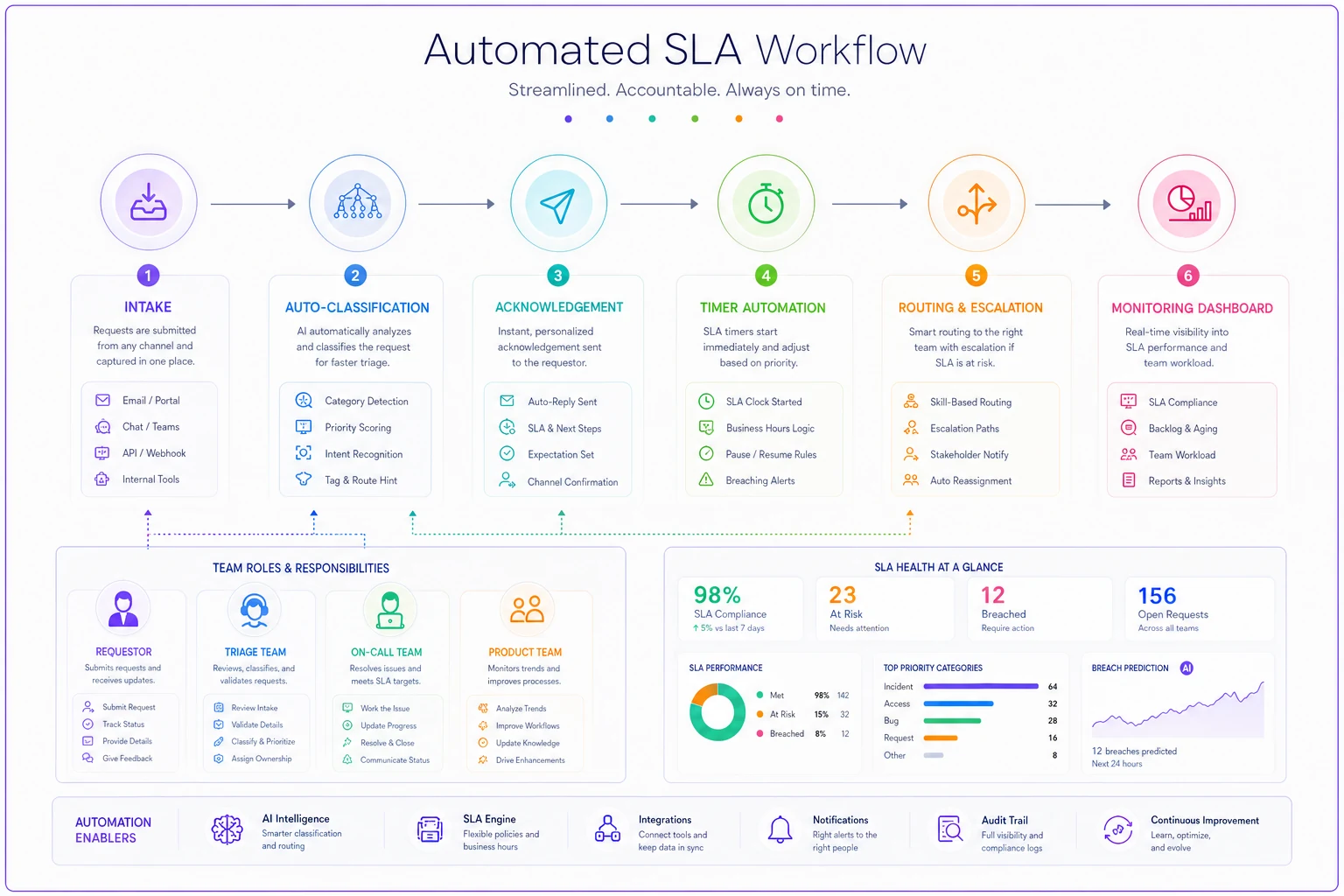
Platforms that handle intake, auto-classification, acknowledgement, and breach monitoring in one place cut the coordination overhead significantly compared to stitched-together tooling.
Real Implementation: A Software Company's 8-Week Journey
A 45-person B2B software company with 18 engineers had reached a breaking point. Engineers complained about constant interruptions. Stakeholders complained about slow turnaround. Everyone was frustrated and nobody agreed on why.
Weeks 1–2: They tracked every request without changing anything. Results: 247 requests ranging from "typo on website" to "major customer threatening to leave." No consistent classification. Response times varied from 10 minutes to 2 weeks.
Weeks 3–4: They drafted their tier system and shared it with stakeholders. Initial pushback was predictable—"Everything we do is important!" They responded by showing the data. Physically impossible to treat all 247 requests as top priority.
Week 5: Technical setup. They used their existing Jira instance but created a new request form with required fields around business impact, then set up automation rules for classification and acknowledgement.
Weeks 6–7: Soft launch with product and engineering only. Refined classifications based on edge cases. Discovered their Tier 2 definition was too broad and split it into 2A (customer-impacting) and 2B (internal-impacting).
Week 8: Full launch to all departments. The first week was rough—lots of mis-tiered requests and confusion. By week two, behavior started shifting.
Results after 3 months:
| Metric | Before | After |
|---|---|---|
| Average first response time | ~18 hours | ~4 hours |
| Engineer interruptions | Baseline | ~60% reduction |
| Sprint completion rate | ~70% | ~85% |
| "Where's my request?" follow-ups | ~40/week | <5/week |
The biggest surprise: engineers reported feeling less stressed even though they were handling the same volume of requests. Predictability reduced anxiety more than any reduction in volume would have.
Common Failure Modes and Their Fixes
The "everything is urgent" problem When stakeholders mark everything as Tier 1, the framework collapses immediately. Require written justification for Tier 1 requests, reviewed weekly. Public visibility helps—nobody wants to be the person who declared "update footer copyright year" as revenue-critical.
The "SLA padding" problem Teams set conservative SLAs they can easily beat, but stakeholders see through it and lose trust. Set realistic SLAs and hit them 90% of the time rather than pessimistic ones you hit 100% of the time. Occasional misses with good communication build more trust than sandbagged commitments.
The "shadow request" problem People bypass the system and go directly to engineers they have a relationship with. Engineers redirect all side-channel requests to the official process—no exceptions, including for executives. Especially executives, since they set the cultural tone.
Beyond Response Times: Using SLA Data for Operational Decisions
SLA metrics reveal patterns that inform bigger decisions.
If 40% of engineering capacity is going to Tier 2 requests, you might need a dedicated support engineer. If certain stakeholders generate three times more requests than others, they might need better tooling or training. If Tier 4 investigations keep turning into Tier 3 projects, your scoping process needs work.
A marketing automation platform discovered through SLA tracking that their customer success team was generating around 35 investigation requests per month—most of them asking for data that already existed in their analytics tool. One training session cut those requests by roughly 80%.
The framework also surfaces imbalances. One company noticed their mobile engineers were hitting 98% SLA achievement while backend was at 67%. The problem wasn't performance—mobile got fewer, simpler requests while backend was absorbing complex investigations disguised as quick questions. They rebalanced team assignments and adjusted SLAs to match reality.
Making the Framework Stick: Cultural Integration
The best internal SLA framework eventually becomes invisible because it's just how you work. Getting there takes deliberate effort.
Start by making SLA performance visible but not punitive. Post weekly metrics somewhere everyone can see them. Celebrate improvements. When breaches happen, focus on fixing the system rather than assigning blame.
Build small rituals around the framework. One team runs "SLA Friday"—a 15-minute standup to review the week's metrics, call out wins, and pick one process improvement for the following week.
Connect SLAs to broader governance patterns your organization already uses. If you have sprint planning, factor in SLA capacity. If you have quarterly planning, use SLA data to inform resource allocation.
Give the framework time to actually stabilize. Behavior change takes 6–8 weeks at minimum. The stakeholder flooding you with Tier 1 requests in week one might become your most vocal advocate by week eight once they see consistent, predictable results.
The Operational Reality After Implementation
Three months into a functioning internal SLA framework, work just feels different. Engineers know that genuine emergencies surface immediately while everything else flows through predictable channels. Stakeholders know when to expect responses and can plan around that.
The constant negotiation disappears. Emergency escalations drop off. Sprint planning becomes meaningful because you know that roughly 25–30% of capacity will go to operational requests and you can account for it.
The biggest shift is trust. When stakeholders trust that requests won't disappear into a black hole, they stop the follow-up pings and hallway check-ins. When engineers trust that urgent requests follow a defined triage matrix, they stop treating every interruption as potentially critical.
An internal SLA framework isn't really about controlling request flow. It's about creating predictability in an environment that defaults to chaos. When both sides know the rules and the rules get consistently applied, the friction disappears and work actually gets done.
Ready to elevate your team's performance?
Join 2,000+ teams using Temsly to streamline workflows, boost productivity, and deliver projects on time.