

Marketing needs the new product feature to launch their campaign. Engineering needs the API specs from the platform team. Customer Success needs training materials from Product. Platform needs a security review from IT. And IT needs requirements from... well, everyone.
Sound familiar?
Most companies try to manage cross-team dependencies through some combination of hope, heroics, and heated Slack threads. Some upgrade to complicated project management tools that nobody actually updates. Others hold marathon planning sessions where everyone nods along, then discovers three weeks later that Team A's timeline completely breaks Team B's deliverables.
The real problem isn't tracking dependencies—it's that most approaches treat symptoms instead of building an actual system. You end up with visibility but no control, awareness but no accountability, and lots of meetings but little actual coordination.
The collision matrix reveals what your planning meetings miss
Here's what typically happens during quarterly planning. Each team presents their roadmap. Everyone takes notes. Someone creates a dependency tracker in a spreadsheet. Then around week three, you discover four teams need the same backend service updated at different times for different reasons.
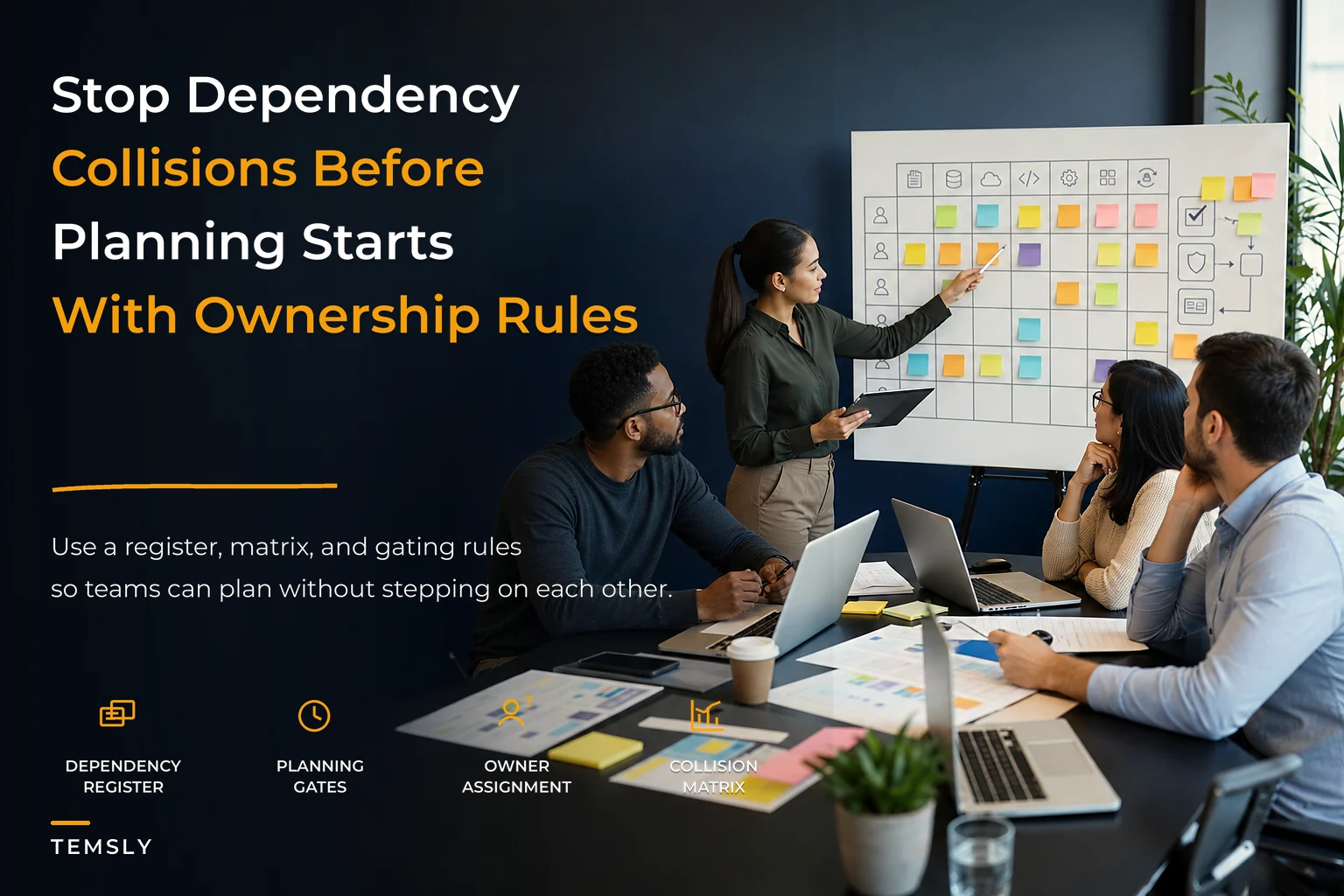
A collision matrix changes this. Instead of just listing who needs what from whom, you map out where work physically collides—same codebase, same data pipeline, same customer segment, same deployment window. The marketing team's database migration for their analytics upgrade suddenly becomes visible as conflicting with the sales team's CRM integration touching the same tables.
One tech company I worked with found through their collision matrix that three separate teams were planning authentication system changes in Q2. Not dependencies exactly—they weren't waiting on each other—but parallel work that would definitely break things. Their previous dependency tracking missed it entirely because each team assumed they were working independently.
The matrix doesn't need to be complicated. Think of it as a heat map:
-
Green zones
teams can work in parallel without issues
-
Yellow zones
coordination needed but manageable
-
Red zones
direct collision requiring synchronization
Here's a quick visual of the collision-to-resolution workflow.
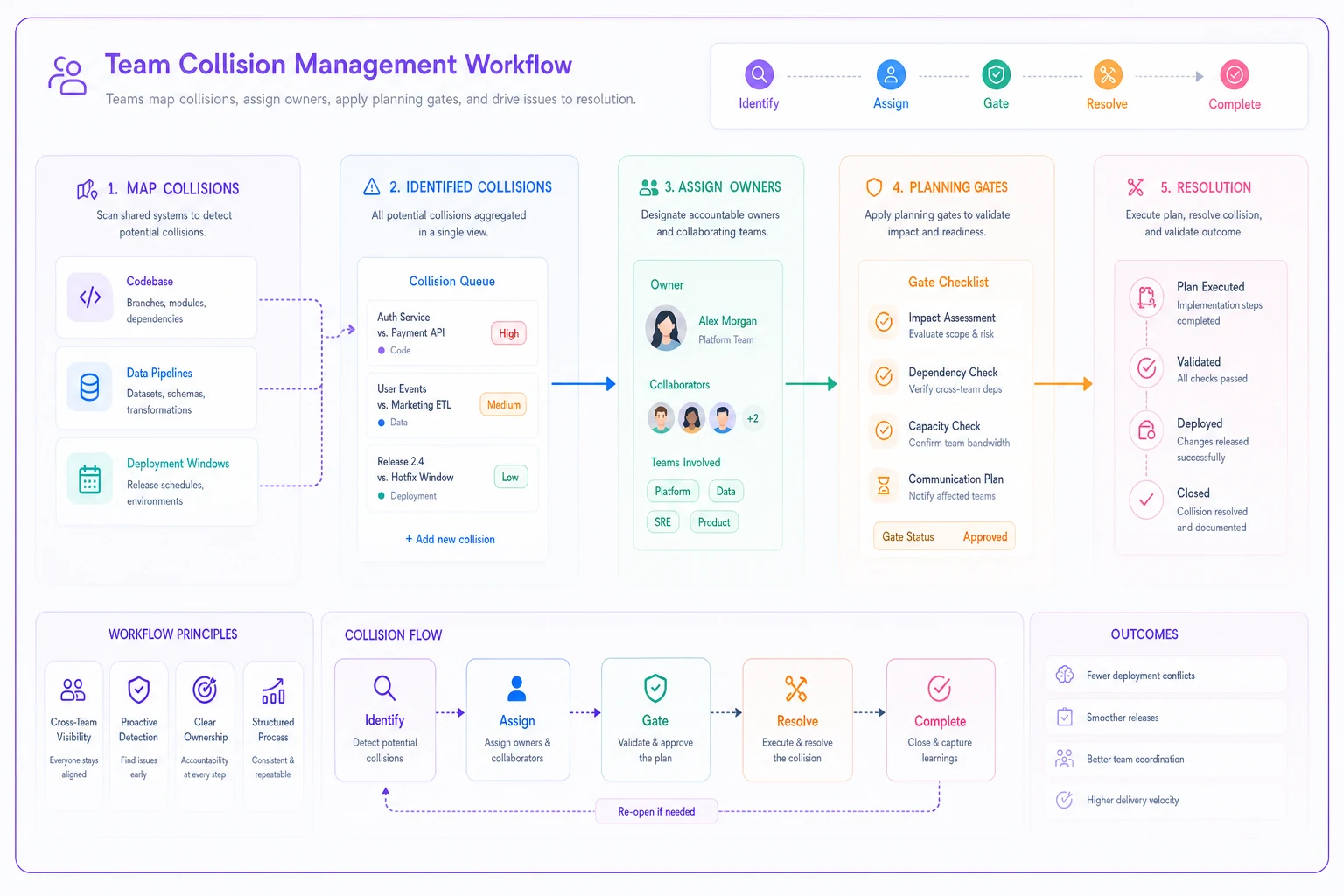
What makes this useful is that it forces conversations about how teams will work, not just when they'll deliver.
Ownership rules that actually stick
Every dependency needs an owner. Not a "stakeholder" or "interested party"—an actual human who loses sleep if it fails. This sounds obvious until you see how many critical dependencies float in organizational limbo.
Eliminate team chaos and missed deadlines.
Temsly helps you assign, track & complete projects efficiently with full visibility.
- Centralized task management
- Real-time team communication
- Resource and deadline tracking
No credit card required
The platform team owns the API... but who owns making sure all consuming teams are ready for the v2 migration? Product owns the feature spec... but who owns ensuring engineering and design are aligned on the interpretation? These gap areas kill more projects than missed deadlines.
The requester owns the requirement. If marketing needs a feature from engineering, marketing owns defining exactly what success looks like. Not "we need better reporting" but "we need daily cohort analysis broken down by acquisition channel with these seven specific metrics."
The provider owns the timeline and approach. Engineering decides how to build it and when they can deliver. They own communicating changes and risks. But they don't get to reinterpret the requirement—that's a conversation, not a unilateral decision.
Both own the handoff. This is where things usually fall apart. The provider thinks they're done when code is deployed. The requester thinks they're starting when the feature is "ready." Clear handoff criteria, agreed upfront, prevents the "but we delivered what you asked for" arguments.
Require owners to be named individuals, not roles, so accountability is clear.
A logistics software company implemented these rules after losing two months on a warehouse integration project. Nobody owned the data mapping between systems—IT thought Operations owned it, Operations thought IT did. After naming owners for requirement, delivery, and handoff on every dependency, their rework dropped by roughly 40%.
Planning gates that prevent downstream disasters
Most teams treat planning as a one-time event. Kick off the quarter, update the tracker weekly, hope nothing explodes. Planning gates flip this—you build specific checkpoints where dependencies get verified before teams can proceed.
Think of it like code review but for operational dependencies. Before the mobile team can start building the new checkout flow, there's a gate: Are the API endpoints specified? Is the design system updated? Has Payment Operations signed off on the reconciliation process?
These gates sound like they'd slow everything down. The opposite tends to happen. Teams stop starting work they can't finish. They stop building on assumptions that turn out wrong. They stop that soul-crushing pattern of getting 80% done and then discovering a blocker that requires starting over.
The gates should be lightweight:
Gate 1: Definition Alignment (before any work starts)
-
Requirements documented and signed off
-
Success criteria explicit
-
Dependencies identified with owners assigned
Gate 2: Ready to Build (before development/execution)
-
Blocking dependencies resolved
-
Resources confirmed available
-
Integration points specified
Gate 3: Ready to Integrate (before connecting systems/teams)
-
Component testing complete
-
Handoff artifacts ready
-
Downstream teams prepared
An e-commerce company running multiple brand sites uses these gates consistently. They went from launching maybe 60% of planned features per quarter to hitting 85-90%. Not because they work faster, but because they stop starting doomed projects.
Templates that make the framework actually work
The best framework dies without decent templates. Not 47-field forms nobody fills out, but focused documents that capture just what matters.
Dependency Registration Template:
-
What we need
[specific deliverable]
-
From whom
[team and owner name]
-
By when
[date with buffer]
-
What breaks if delayed
[actual impact]
-
Fallback plan
[what we do if this fails]
Notice what's missing—no long justifications, no detailed technical specs, no essay about why it's important. Just the operational facts needed to manage the dependency.
Collision Assessment Template:
-
Teams involved
[list]
-
Shared resources/systems
[what overlaps]
-
Conflict type
[timeline/resource/technical]
-
Minimum coordination needed
[specific actions]
-
Owner of coordination
[single name]
Five minutes to fill out, saves weeks of confusion.
Gate Review Checklist:
| Gate Review Checklist |
|---|
| Are all upstream dependencies delivered? Y/N |
| Do we have written confirmation from downstream teams? Y/N |
| Have we tested integration points? Y/N |
| Is there a rollback plan? Y/N |
If any answer is no, you don't pass the gate. Period.
Decision heuristics for when things go sideways
Even with solid planning, dependencies fail. The vendor delays the API release. A key engineer leaves. An acquisition reshuffles all priorities. You need clear heuristics for making fast decisions without convening a committee every time.
Heuristic 1: Customer impact trumps internal convenience If customers feel it, that dependency gets priority. A delayed internal reporting tool is annoying. A delayed checkout fix is unacceptable.
Heuristic 2: Unblock the most teams When multiple dependencies collide, fix the one blocking the most downstream work first. Better to fully unblock three teams than partially help five.
Heuristic 3: Preserve option value Choose solutions that keep future options open. A quick workaround requiring massive rework later is worse than a slightly slower fix that scales.
Heuristic 4: Time-box the decision Dependency conflicts can trigger endless debate. Set a timer—if you can't decide in 30 minutes, escalate. The cost of delay usually exceeds the cost of an imperfect decision.
A SaaS company uses these heuristics to resolve dependency conflicts in under 24 hours. Before, they'd spend days in meetings hunting for the "perfect" solution. Now the rule is simple: apply the heuristics, make the call, move forward. They can always adjust later.
The operational reality of making this work
Week one, everyone complains about more process. Week two, they grudgingly fill out the templates. Week three, the first collision gets caught before it becomes a crisis. By week six, teams start self-organizing around the framework because they see it working.
The marketing team at a financial services firm said their favorite part wasn't avoiding disasters—it was being able to push back on random requests with actual data. "Sorry, that would create a red-zone collision with three other teams in March. Here's what we'd need to deprioritize." Suddenly stakeholders understood tradeoffs instead of just demanding everything simultaneously.
The biggest resistance usually comes from teams that have operated independently. They see dependency management as losing autonomy. The reality is the opposite—clear dependencies give you more autonomy within your boundaries. You know exactly what you own, what you don't, and where coordination is actually required. The governance patterns we've covered before reinforce this same principle: structure enables speed.
Some teams worry this adds overhead to planning. It does—around 2-3 hours per team per quarter. Compare that to the dozens of hours lost to dependency conflicts, rework, and emergency replanning. One operations director calculated they saved roughly 20 hours per month just in reduced emergency alignment meetings.
Building this into your planning rhythm
The framework only works if it's built into your actual planning cadence, not bolted on as an afterthought.
Start quarterly planning two weeks earlier than usual, but use that time for dependency discovery, not roadmap building. Each team drafts their ideal roadmap independently. Then you run the collision matrix. The conflicts that surface inform the actual roadmap. This prevents that painful dance where teams present beautiful plans already doomed by hidden dependencies.
During sprint planning, check dependencies at gates. Not a new meeting—a five-minute addition to existing ceremonies. "Before we commit to this sprint, let's verify our Gate 2 dependencies are clear." Takes minutes but prevents weeks of blocked work.
The weekly operational sync becomes about dependency health, not status updates. Instead of green/yellow/red for projects, you track clear/at-risk/blocked for dependencies. This shifts focus from trailing indicators (is the project on time?) to leading indicators (will we hit a dependency wall next week?).
Monthly, run a dependency retrospective. Not a blame session—a pattern analysis. Are the same teams always blocking others? Are certain dependency types consistently underestimated? Do specific collision zones keep causing problems? Fix the system, not just the instance.
When this framework makes sense (and when it doesn't)
This level of dependency management makes sense when you have:
-
4+ teams with interconnected deliverables
-
Quarterly or longer planning cycles
-
Critical dependencies that can't fail
-
A history of dependency-related delays
It's overkill if you're:
-
Under 20 people total
-
Running purely independent team missions
-
In pure exploration or research mode
-
Changing direction weekly
A startup with 15 people tried implementing the full framework and abandoned it within a month. Too much structure for their reality. They switched to a simple weekly dependency check-in and that solved their actual needs. Don't implement a framework for framework's sake.
On the flip side, a 200-person product organization thought they were "too agile" for this structure. After two quarters of missed dependencies torpedoing launches, they implemented it. Their deployment frequency actually increased because teams stopped getting blocked mid-sprint.
The tools question (and why it matters less than you think)
Everyone asks about tools. Jira? Monday? Asana? A custom database? The answer is whatever your teams will actually update. The best dependency system running in Excel beats the perfect one nobody uses.
That said, certain capabilities matter:
-
Visual mapping (for the collision matrix)
-
Automated notifications (for gate reviews)
-
Historical tracking (for pattern analysis)
-
Integration with existing tools (so people don't need another login)
Modern AI-assisted platforms can automatically flag potential collisions based on project descriptions, suggest ownership based on past patterns, and predict which dependencies are highest risk based on historical data. But these only help if the fundamental framework exists. Better tooling can't fix unclear ownership or missing gates—it just makes unclear things faster.
The prioritization framework we discussed earlier connects here too. When dependency conflicts arise, you need clear criteria for what takes priority. A scoring rubric prevents every dependency from defaulting to "critical."
Real scenario: How an enterprise software company fixed their dependency chaos
A B2B software company with eight product teams was missing roughly half their quarterly commitments. Not because teams weren't executing, but because of dependency collisions. The mobile team would finish their feature, but the API wasn't ready. The API team delivered on time, but the authentication service had changed. The platform team updated authentication, but nobody told the mobile team.
They implemented this framework over one quarter:
-
Month 1 Built the collision matrix, identified 14 red zones
-
Month 2 Assigned dependency owners, established gates
-
Month 3 Ran first gated planning cycle
Results after two quarters:
-
Quarterly commitment delivery went from around 50% to 80%
-
Rework dropped by approximately 35%
-
Emergency alignment meetings went from 12 per month to 3
-
Team satisfaction scores increased (turns out people like finishing what they start)
The biggest win wasn't the metrics. It was that teams stopped playing defense. Instead of constantly reacting to surprise dependencies, they could actually plan and execute. The product team lead put it simply: "We went from feeling like we were juggling chainsaws to actually building software again."
Moving from reactive to systematic
Most organizations manage dependencies through heroics. Someone notices a conflict about to explode, raises the alarm, everyone scrambles. Heroes get rewarded, fires get fought, and the cycle repeats.
This framework breaks that cycle—not through more meetings or complex tools, but through simple, repeatable structures that make dependencies visible and manageable before they become emergencies. The collision matrix shows you where problems will arise. Ownership rules clarify who drives resolution. Gates prevent downstream disasters. Templates keep everything consistent. Heuristics enable fast decisions when things go sideways anyway.
The shift from reactive to systematic takes probably 2-3 months to fully embed. But once it clicks, teams wonder how they ever operated without it. The constant fire-fighting stops. The surprise blockers disappear.
More importantly, you build organizational muscle memory for handling complexity. As the company grows and dependencies multiply, the framework scales with it. The same structures that help five teams coordinate will help fifty—just with more zones in the collision matrix and more gates in the process.
None of this is about adding bureaucracy. It's about removing surprise. When every team knows exactly what they need, from whom, by when, and what happens if things change, you can focus on building instead of constantly coordinating. That's when real velocity happens.
Ready to elevate your team's performance?
Join 2,000+ teams using Temsly to streamline workflows, boost productivity, and deliver projects on time.