

The most expensive meeting in most companies isn't the all-hands or the quarterly planning session. It's the recurring cross-functional review — the security review, the architecture council, the launch readiness gate, the compliance signoff. The one where product, engineering, legal, security, data, and someone from finance all have to weigh in before something ships.
You know the type. It's on the calendar for 90 minutes. Eleven people are invited. Six of them are only there for the 8 minutes that concern their function, and the other 82 minutes they're half-listening while clearing Slack. The decision that was supposed to get made gets punted because "we still need input from data privacy, and Priya's out today." So it rolls to next week. And the thing you were trying to ship just sits there.
This is the meeting worth killing. Not with a vague "let's do this async" declaration that collapses in three weeks — but with a real system that has teeth. That's what this piece is about: a meeting to async conversion kit built specifically for the big, messy, cross-functional review, where the failure mode isn't lack of a document, it's lack of enforcement.
Why async conversions usually fail for big reviews
Most teams have already tried to move reviews to a doc. It rarely sticks. And the reason it doesn't stick is almost always the same: nobody is obligated to do anything by a specific time.
The pattern goes like this. Someone writes a thoughtful pre-read and drops it in a channel with "please review by EOD Thursday." Thursday comes. Two people commented. The other nine either didn't open it or opened it and said nothing — which is somehow worse, because you can't tell if silence means "approved" or "haven't looked." So the organizer, out of anxiety, schedules the meeting anyway "just to be safe." Now you have a document and a meeting. You've added work, not removed it.
The problem isn't the document. Async status updates and coordination can absolutely replace live meetings — we've covered the general case for why enforceable async rules cut meeting load. But cross-functional reviews are a harder animal because they involve people who don't report to the person running the review. A product lead can't tell the security architect "you must respond by Wednesday." There's no reporting line. So without a governance structure behind it, the async version has no enforcement and quietly rots.
The fix is to stop treating the review as an event and start treating it as a process with SLAs, named owners, and actual consequences for silence.
The four parts that make it actually work
An enforceable async review has four moving parts. Skip any one and it degrades back into a meeting.
Eliminate team chaos and missed deadlines.
Temsly helps you assign, track & complete projects efficiently with full visibility.
- Centralized task management
- Real-time team communication
- Resource and deadline tracking
No credit card required
-
A pre-read template that forces the requester to do the thinking before anyone else spends time.
-
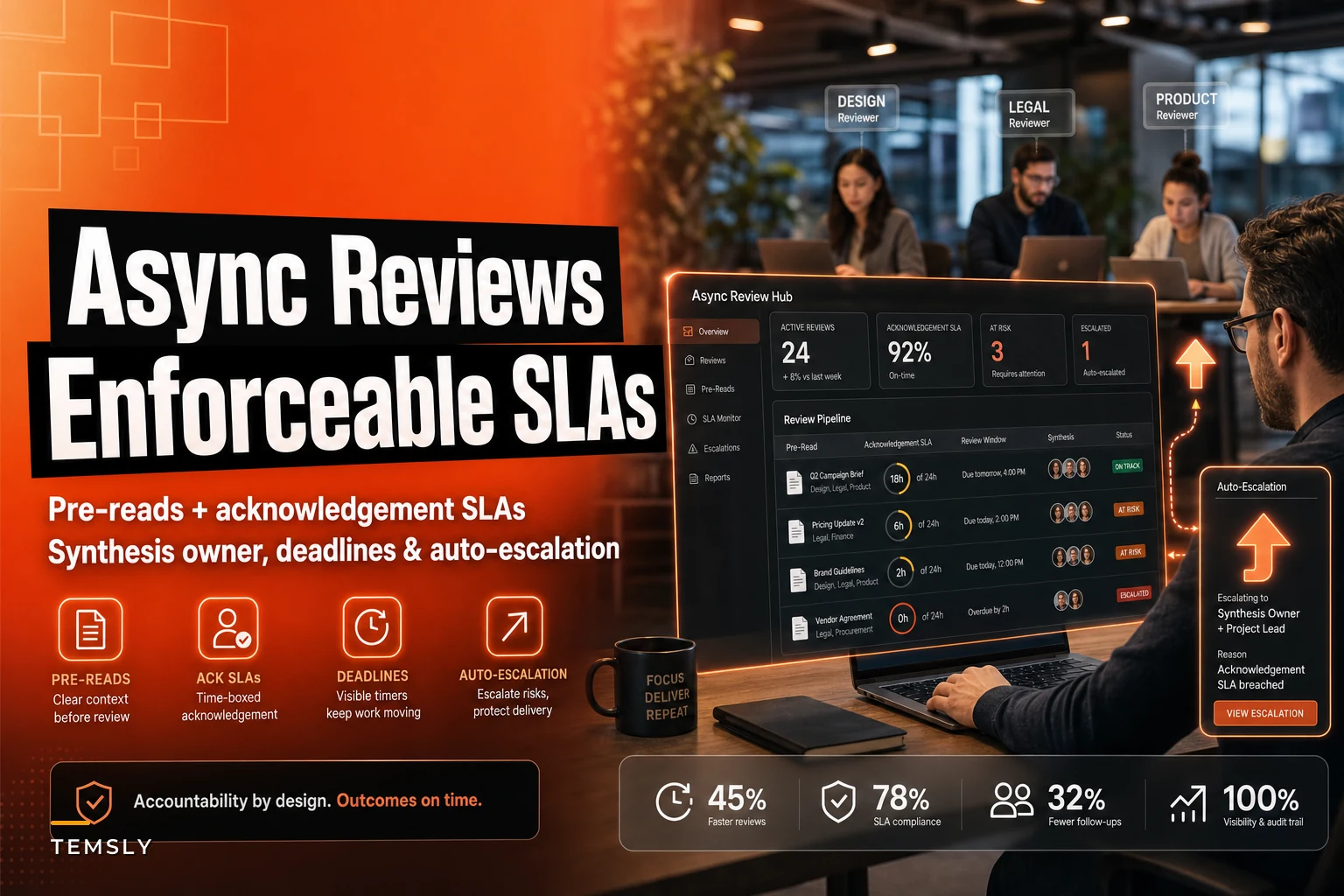
Acknowledgement SLAs — each stakeholder has a defined window to respond, and the response format is constrained so silence can't hide.
-
A synthesis owner — one person whose job is to collapse all the input into a recommendation, not just collect comments.
-
Forced-decision deadlines with auto-escalation — a hard date by which the decision is made, and a rule for what happens if it isn't.
The pre-read template: make the requester earn the review
Half of bad reviews are bad because the requester showed up with a vague ask. "We want to change the auth flow, thoughts?" is not a reviewable artifact. It's an invitation for eleven people to freelance opinions.
For a cross-functional review, that's roughly:
-
The decision being requested (one sentence, phrased as a yes/no or a pick-one)
-
What changes and what doesn't — scope boundaries, explicitly
-
The options considered and why the recommended one won
-
Known risks per function — a line for security, one for legal, one for data, etc.
-
What you need from each reviewer — not "your thoughts" but "confirm the data retention approach is acceptable"
-
The decision deadline and what ships if we hit it
That last line — what you need from each reviewer — is the one people skip, and it's the most important. When you tell the finance reviewer exactly what you need them to confirm, they can answer in four minutes instead of reading the whole thing and commenting on an API design they know nothing about.
Worth noting: teams that adopt a strict pre-read template often find the number of reviewers who actually need to respond drops, because the template surfaces that half the invitees don't have a real stake in the specific decision. You were inviting them out of habit.
Make the "what you need from each reviewer" line a single explicit ask (e.g., confirm data retention approach) so responses only take minutes.
Acknowledgement SLAs: kill the ambiguity of silence
This is the part that separates a real system from a hopeful one. Every named stakeholder gets a response window and a constrained response format. They don't get to just leave a comment or say nothing. They pick one of:
-
Approve — no concerns, proceed
-
Approve with notes — proceed, but here's a non-blocking observation
-
Block — I have a concern that must be resolved before this ships, and here it is
-
Need more info — I can't decide until you answer X
The critical rule: a Block is only valid if it names the specific concern and what would resolve it. "I don't love this" is not a Block. That one rule prevents the most common review pathology, where a senior person vaguely gestures at discomfort and stalls everything without owning a real objection.
Here's how the SLA tiers tend to shake out in practice:
| Review type | Ack SLA per stakeholder | Synthesis window | Forced-decision deadline |
|---|---|---|---|
| Standard change (reversible) | 24 business hours | +4 hours | 48 business hours |
| Significant change (costly to reverse) | 48 business hours | +1 day | 5 business days |
| High-risk (security/compliance/legal) | 3 business days | +1 day | 7–8 business days |
The tiers matter because a one-size SLA either rushes the risky reviews or drowns the trivial ones in ceremony. Match the clock to the reversibility of the decision. Reversible decisions should move fast; the ones that are expensive to undo earn a longer window. This is the same reversibility logic that makes governance patterns produce predictable cross-functional delivery rather than just adding bureaucracy.
The synthesis owner: the role everyone forgets
Collecting eleven comments is not synthesis. Someone has to read all the input, resolve the conflicts, and produce a single recommendation: "Given the security Block on token storage and legal's approve-with-notes, here's the revised proposal, and here's what still needs a yes from security."
Without this role, async reviews turn into a comment thread nobody owns, where two reviewers are arguing in the margins and the requester is refreshing the page hoping it resolves itself. It doesn't.
The synthesis owner is usually the requester's manager or a designated review coordinator — not the requester themselves. That's deliberate. The requester is too close to it; they'll unconsciously downweight the objections they find inconvenient. A neutral synthesis owner is the difference between a review that converges and one that just accumulates opinions.
Once you name a synthesis owner, reviews that used to take three meetings often close in one round of async, because there's finally someone accountable for driving to a conclusion instead of facilitating a discussion that goes nowhere.
Forced-decision deadlines and what auto-escalation actually means
Every review has a forced-decision deadline. When it hits, one of two things is true: either all required stakeholders have responded and the synthesis owner issues the decision, or someone hasn't responded — and then the escalation rule fires.
The escalation rule needs to be written down before you need it, because in the moment nobody wants to be the one who "went over someone's head." Pre-agreeing the rule removes the interpersonal awkwardness. A workable default:
If a required stakeholder misses their acknowledgement SLA, their approval is presumed for reversible decisions, and their manager is auto-notified for irreversible ones.
Here's how it plays out. A launch readiness review goes out Monday morning with a Thursday 5pm decision deadline. Nine of ten reviewers respond by Wednesday. The tenth — the data governance reviewer — has said nothing. Wednesday evening, an automatic reminder goes to them and CCs the synthesis owner. Thursday morning, still nothing. Because this is a high-risk review, the escalation ladder kicks in: the reviewer's manager gets notified that a decision is blocked on their team, with the specific ask and the deadline. Now someone with authority is accountable for either responding or explicitly delegating. The decision doesn't die because one person is on PTO and didn't set up coverage.
The key thing most teams miss: the escalation isn't a punishment, it's a routing mechanism. You're not shaming the reviewer. You're routing the decision to whoever can make it when the assigned person can't. That framing is what makes people accept the system instead of resenting it.
The workflow, start to finish
-
Requester fills the pre-read template and names required reviewers per function
-
System (or coordinator) sends it with per-stakeholder SLAs and the forced-decision deadline attached
-
Each reviewer responds in the constrained format — Approve / Approve with notes / Block / Need more info — within their window
-
Reminders auto-fire at the halfway point and again 24 hours before the deadline for anyone who's silent
-
Synthesis owner collects, resolves Blocks with the requester, and either issues the decision or triggers one more short round
-
At the forced-decision deadline
decision is issued, or escalation fires for missing required responses
-
Decision, rationale, and any conditions get logged where the next reviewer can find them
Here's a simple visual of that workflow.
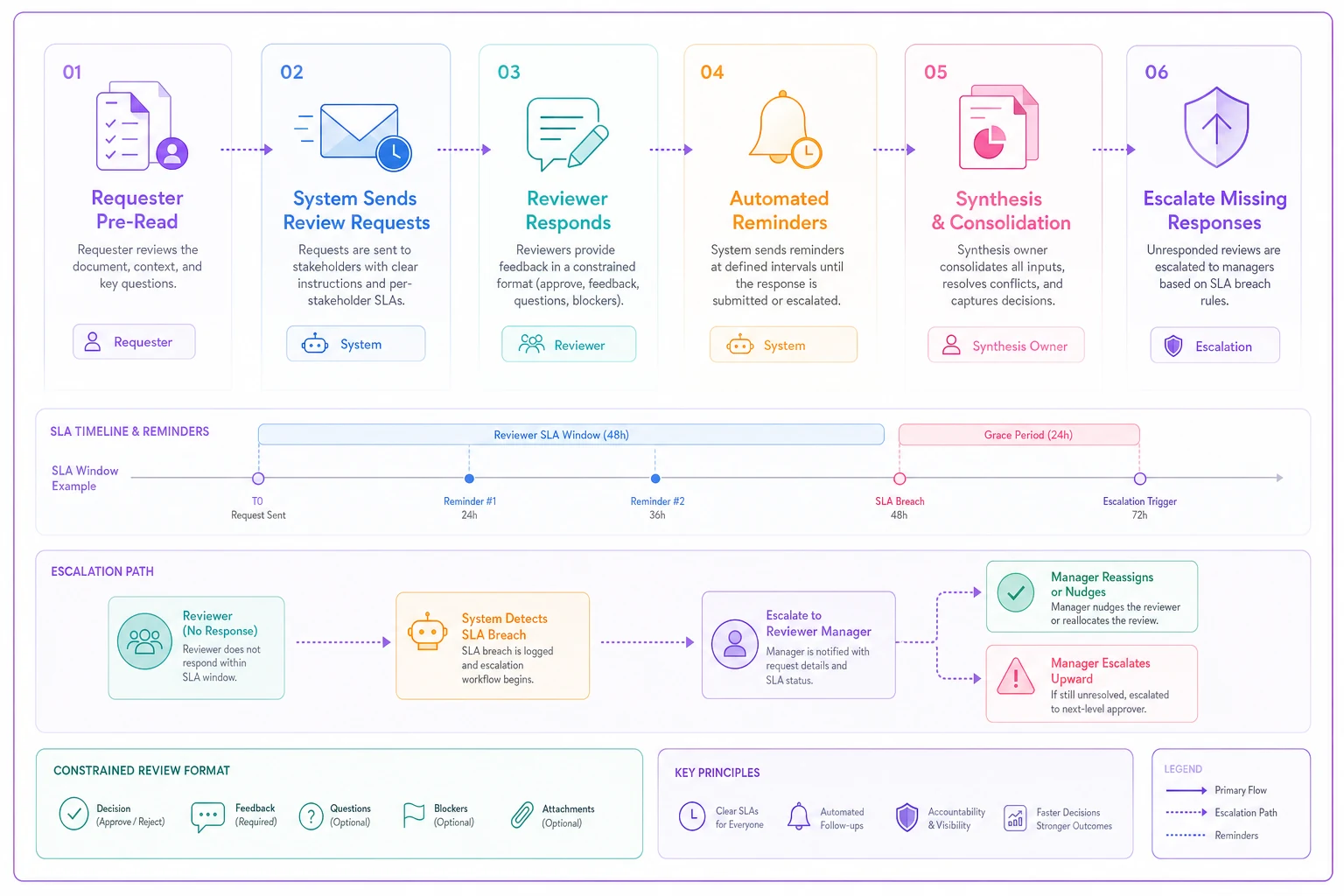
That reminder-and-escalation cadence is genuinely tedious to run by hand across a dozen concurrent reviews. This is the one place where lightweight workflow automation earns its keep — not for the thinking, but for the chasing. Tracking who's acknowledged, firing reminders at the right intervals, and auto-notifying the escalation contact when an SLA breaches is mechanical work that someone will inevitably drop when they get busy. Letting a system own the clock is what keeps the SLAs from quietly becoming suggestions.
A real scenario
A mid-sized fintech — around 120 engineers — ran a weekly architecture review council. Ten to twelve attendees, 90 minutes, one recurring slot. On a typical week they'd get through two or three proposals, and anything that needed input from a missing person rolled to the following week.
The measurable problem was the roll-over. Proposals were waiting an average of about two and a half weeks from submission to decision, mostly dead time between weekly slots. A handful of proposals each quarter waited over a month because they kept missing quorum.
They converted it. Pre-read template became mandatory — no template, no review slot. Each proposal named its required reviewers (usually four to six, not the whole council) with 48-hour acknowledgement SLAs and a five-business-day forced-decision deadline. A rotating synthesis owner drove each one. Missing responses escalated to the reviewer's lead on day four.
Over the next quarter: median time-to-decision dropped to somewhere around four to five days. The weekly council meeting shrank to a 30-minute optional session for genuinely contentious proposals — maybe one in five needed it. Proposals stuck over a month dropped to roughly zero, because escalation caught the stalls that used to just silently roll. Engineers stopped padding their timelines to account for two-plus weeks of architecture review limbo.
The interesting part wasn't the time savings. It was that decision quality held steady or improved, because reviewers were responding to a structured pre-read with a specific ask instead of reacting live to slides someone was clicking through in real time.
When this makes sense — and when it doesn't
This works well when:
-
The review recurs and involves the same functions repeatedly
-
Most proposals only actually need a subset of reviewers
-
Decisions are being delayed by scheduling and quorum problems, not genuine hard disagreement
-
You have someone who can own synthesis credibly
This is a bad idea when:
-
The decision is genuinely contested and needs real-time debate to surface tradeoffs. Some architecture forks should be argued live. Don't async a fundamental "we're betting the roadmap on this" call.
-
Trust between functions is low. Async amplifies existing dysfunction — if people already suspect each other of railroading decisions, presumed-approval-on-silence will feel like a trap and blow up. Fix the trust first.
-
The review is really a relationship-building or alignment ritual in disguise. Some "reviews" exist so people feel included. Killing the meeting kills the inclusion, and you'll pay for it politically. Be honest about which meetings are actually decision forums.
Who should not run this: teams without the authority to enforce escalation. If a stakeholder can ignore the SLA, ignore the reminder, ignore the manager notification, and there's no consequence — you don't have a broken process, you have a broken authority structure, and no async kit fixes that. Sort out who actually owns these decisions first.
The thing that actually determines whether this sticks
The templates and SLAs are the easy part. The hard part is holding the first few reviews to the rules when someone important blows their SLA and expects the old behavior — the meeting scheduled "just to be safe," the vague Block that stalls everything, the reviewer who wants to relitigate in the room what they ignored in the doc.
Cave those first few times and the system dies. Everyone quietly learns the "deadlines" aren't real. Hold the line — issue the decision at the deadline, let escalation fire, treat silence as the response it was defined to be — and people adjust within a couple of cycles. They start responding on time because they've learned the train leaves without them.
Cross-functional reviews don't drag because people are lazy or because you lack a document. They drag because nothing bad happens when someone doesn't respond. Put a real clock on it, name who resolves conflicts, and make silence route the decision somewhere else instead of freezing it — and the 90-minute meeting with eleven half-present attendees quietly stops being necessary.
Ready to elevate your team's performance?
Join 2,000+ teams using Temsly to streamline workflows, boost productivity, and deliver projects on time.