



Most contractor onboarding fails in a very specific way: the person is technically "onboarded" by end of week one — laptop provisioned, Slack access granted, repo cloned — but they haven't produced anything anyone can look at and judge. They're busy. They're reading docs. They're sitting in meetings. And three weeks in, someone finally asks "so what has the contractor actually delivered?" and the honest answer is nothing you could point to.
That gap is expensive. A contractor billing somewhere between $90 and $160 an hour who spends their first two weeks "getting up to speed" is roughly $6k–$12k of spend before anyone knows whether they can do the job. Short-term contributors are the worst people to onboard slowly — you might only have them for eight or twelve weeks. Losing two of those to ambiguity means you've burned 20–25% of the engagement before the work even starts.
So this is a tight, day-by-day ramp built specifically for short-term product and engineering contractors. Not a 90-day plan. Not culture immersion. A seven-day sequence with defined deliverables and acceptance criteria, so by Friday you actually know whether this person is going to work out.
Why the standard onboarding playbook actively hurts contractors
Full-time onboarding is designed around a long time horizon. You invest heavily up front because you'll recoup it over two or three years. Slow ramps, relationship building, absorbing context — all correct for employees.
-
The contractor waits for permission on everything because nobody defined what they're allowed to own.
-
Nobody assigned a single point of contact, so questions get routed to whoever's least busy that day, which means answers are inconsistent.
-
The first real ticket doesn't get assigned until week two because someone has to find one and scope it.
What you see across a lot of engineering teams is that the contractor's productivity in week one is almost entirely a function of how much prep the hiring team did before day one — not the contractor's skill. A senior contractor dropped into an unprepared team looks mediocre for two weeks. A mid-level contractor dropped into a prepared team ships something useful by day three.
What has to exist before day one
If you're scrambling Monday morning, you've already lost the week. Here's the pre-work checklist that determines whether the seven days go well:
Eliminate team chaos and missed deadlines.
Temsly helps you assign, track & complete projects efficiently with full visibility.
- Centralized task management
- Real-time team communication
- Resource and deadline tracking
No credit card required
-
[ ] Access requested and confirmed working (repo, staging, ticketing, Slack/Teams) — verified by you, not assumed
-
[ ] A named mentor assigned, with explicit time blocked on their calendar
-
[ ] Three pre-scoped starter tickets sitting in a queue, ranked by dependency risk
-
[ ] A one-page scope doc
what this contractor owns, what they explicitly do not touch
-
[ ] The definition of "done" for their area written down (tests? review? deploy? docs?)
-
[ ] A single acceptance owner named for each early deliverable
The most common miss on this list is access. It sounds trivial. It is not. A contractor who can't push to the repo until Wednesday because of a security ticket has lost 40% of the week to something entirely preventable. Verify access with a throwaway test before they start, using the account they'll actually use.
Verify access with a throwaway test before they start, using the account they'll actually use.
The second miss is the pre-scoped tickets. If your definition of ready is fuzzy, the contractor spends day one asking clarifying questions instead of shipping. This is exactly the handoff problem — work that arrives underspecified generates rework and delay. If you haven't tightened your intake yet, the thinking in a minimal product-to-engineering definition of ready applies directly to the tickets you hand a contractor on day one.
The mentor model that actually works for short engagements
Full-time hire buddy systems are mostly social. For contractors, the mentor role is operational and specific. This person is not there to be friendly — they're there to unblock.
One mentor, not a committee. That mentor commits to:
-
Two guaranteed sync windows a day in week one — usually 15 minutes at start of day, 15 at end. Predictable, so the contractor batches questions instead of interrupting constantly.
-
A same-day answer SLA on anything blocking. Blocking questions don't wait for the sync window.
-
First-reviewer status on the contractor's early PRs, so review isn't bouncing around the team.
The thing people get wrong here is picking the wrong mentor. The instinct is to assign your most senior engineer. That's usually a mistake — they're the busiest and most likely to go dark on the contractor for a day. The right mentor is someone with deep context on the specific area and enough calendar slack to actually respond. A mid-level engineer who knows the codebase cold and has bandwidth beats a distracted staff engineer every time.
One pattern worth stealing: have the mentor write a two-paragraph "here's how work flows here" note before day one. Not general onboarding docs. Specifically: how a change goes from ticket to production in this codebase, including the annoying steps nobody documents — which flag to toggle, who has to approve the deploy, where the flaky test lives.
The 7-day ramp, day by day
The principle behind the sequence: each day produces something visible, and the deliverables escalate in scope and independence. By Friday the contractor should be operating without hand-holding on a real, shippable change.
| Day | Deliverable | Acceptance criteria | Mentor involvement |
|---|---|---|---|
| 1 | Local env running + trivial change deployed to staging | Change visible on staging; PR opened correctly | High — walk through the flow together |
| 2 | First real starter ticket (small, low-risk) merged | Passes review + tests; follows team conventions | High — first-reviewer, fast turnaround |
| 3 | Second ticket, slightly larger scope | Merged with minimal review comments | Medium |
| 4 | Contractor scopes a ticket themselves from a rough request | Scope doc matches definition of ready | Medium — reviews the scope, not just the code |
| 5 | Ships the ticket they scoped | Merged; contractor explains the change in standup | Low — spot check only |
| 6-7 | Owns a small end-to-end slice of the real work | Deployed; acceptance owner signs off | Low — available but not driving |
Day one's trivial change is not busywork. It's a full dry run of your entire pipeline — clone, branch, commit, PR, review, staging deploy — using a change so small it can't fail on logic. This surfaces every environment and access problem while the stakes are zero. If the trivial change takes until Wednesday, you've just learned your onboarding docs are broken. And you learned it cheaply.
Day four is the pivot. Everything before it is the contractor executing pre-scoped work. Day four is where they demonstrate they can scope work themselves — take a fuzzy request and turn it into a defined ticket. This is the single best predictor of whether a contractor will be low-maintenance for the rest of the engagement. Clean scope on day four means the rest of the engagement is easy. Vague scope means you've caught it early and can adjust.
Acceptance criteria: the part everyone skips
"Onboarded" is not a deliverable. "Merged a change that passes CI and follows our test conventions" is. The difference is whether you can objectively answer did this happen or not by end of day.
For each early deliverable, write the acceptance criteria as a checklist the contractor can self-verify against before flagging it done. Compare:
-
Weak "Fix the export bug."
-
Strong "CSV export includes all columns from the UI table; handles empty result set without erroring; existing export test still passes; new test covers the empty case."
The strong version tells the contractor exactly when they're finished. It tells the acceptance owner exactly what to check. Nobody argues about whether it's "done enough."
The operational habit that makes this work: name a single acceptance owner per deliverable, and make sure that person is available the day the deliverable lands. The failure mode is a contractor finishing a change Thursday afternoon and the only person who can accept it being out until Monday. Now your seven-day ramp has a three-day dead spot in it.
If your team already runs structured acceptance criteria across normal delivery, contractor onboarding just inherits it. If you don't, onboarding a contractor is a surprisingly good forcing function to build it — because the ambiguity that employees quietly absorb, contractors bill you for.
A realistic scenario
A roughly 30-person product company brought on a front-end contractor for a ten-week engagement to help ship a billing UI overhaul. First time they tried it, no ramp plan: access wasn't fully working until day three, the "starter ticket" got assigned in week two, and the first genuinely useful PR landed on day nine. About a week and a half of a ten-week engagement gone — call it $5k–$7k of billed time producing nothing shippable.
Second contractor, same team, they ran a version of the day-by-day ramp above. Access verified the Friday before. Three tickets pre-scoped. A mid-level engineer assigned as mentor with two daily windows blocked. The trivial staging change went out day one. First real merge landed day two. By Friday the contractor had shipped four changes and scoped one themselves.
The delta wasn't the contractor's skill — both were competent. It was that the second engagement front-loaded the prep, so the contractor spent week one doing the job instead of hunting for the job. Over ten weeks that early momentum compounded: the second contractor was trusted with independent work by week two instead of week four.
When this tight ramp makes sense — and when it doesn't
This aggressive seven-day sequence fits when:
-
The engagement is short (roughly 6–16 weeks) and every week counts
-
The scope is reasonably narrow and can be pre-defined
-
You have a mentor with genuine bandwidth to commit
When it's a bad idea: if the work is genuinely exploratory — a research contract, a deep architecture investigation with no clear tickets — forcing day-two merges is theater. You can't pre-scope work that's inherently about figuring out what the work is. In that case, keep the mentor model and the daily syncs, but replace the deliverable ladder with a "shared understanding" checkpoint instead.
Who should not run this: teams whose own definition of ready is already a mess. If your full-time engineers regularly get handed vague tickets and half your sprint is clarification, dropping a contractor into that environment won't work — they don't have the tenure to fight through the ambiguity. Fix the intake discipline first. That's a broader operating-model question, and if you're building the surrounding system, designing a team operating system that turns intake into predictable delivery is the foundation the ramp sits on top of.
Where lightweight tooling helps
None of this requires special software — a scope doc, a mentor, and a queue of ready tickets are the core. But two things are worth automating so they don't quietly rot.
The first is the pre-day-one checklist. Access provisioning, mentor assignment, and ticket pre-scoping tend to fall through the cracks because they're someone's side responsibility. A simple workflow that triggers the checklist the moment a contract is signed — and won't mark onboarding "ready" until access is actually verified — removes the most common failure point. In an operational workflow platform, this is just a templated checklist with owners and due dates; the value is that it fires automatically instead of depending on someone remembering.
The second is acceptance visibility. When each early deliverable has a named acceptance owner and a self-verify checklist, tracking that centrally means nobody has to ask "did the contractor's day-two ticket get accepted?" — the status is just there. Automated nudges to the acceptance owner the day a deliverable lands prevent the dead-spot problem where finished work sits unreviewed.
The point isn't the tooling. The ramp's weakest links are forgetting to prep and deliverables stalling in acceptance — both boring, both preventable, both worth a small amount of automation so a human doesn't have to babysit them.
Here's a simple visual of the workflow you can automate to prevent the common failures.
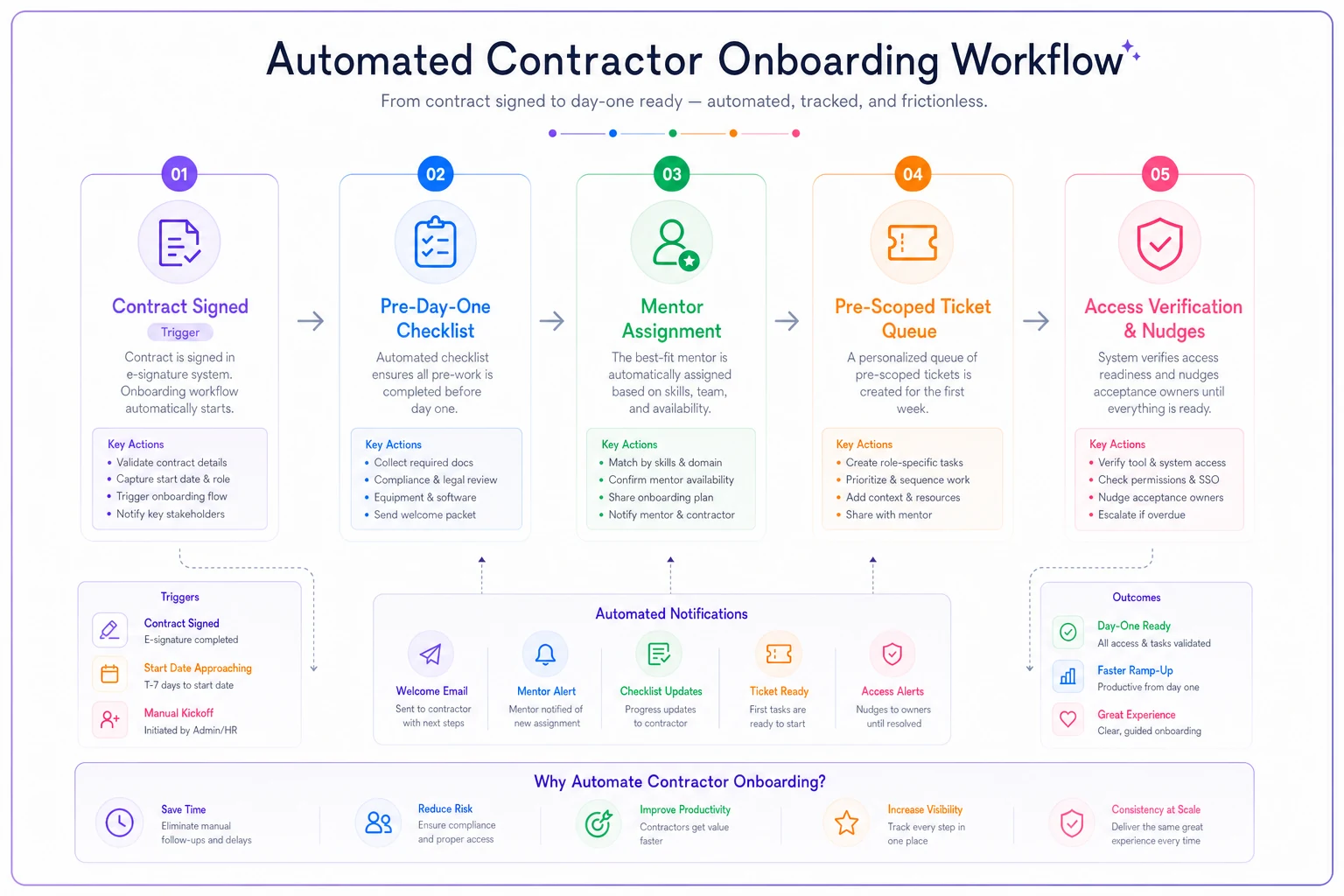
Automating the checklist and acceptance nudges keeps the ramp reliable without extra coordination.
The bottom line
Contractor onboarding fails when it borrows the employee playbook and lets week one dissolve into reading and meetings. For a short-term product or engineering contributor, that's not a slow start — it's a meaningful chunk of the whole engagement gone. The fix is unglamorous: do the prep before day one, name one mentor with real bandwidth, stack the deliverables so each day produces something visible, and write acceptance criteria specific enough that "done" isn't an argument. Get those four things right and you'll know by Friday whether the contractor is going to work out — which, when you're paying by the hour on a fixed timeline, is exactly what you need to know.
Ready to elevate your team's performance?
Join 2,000+ teams using Temsly to streamline workflows, boost productivity, and deliver projects on time.