

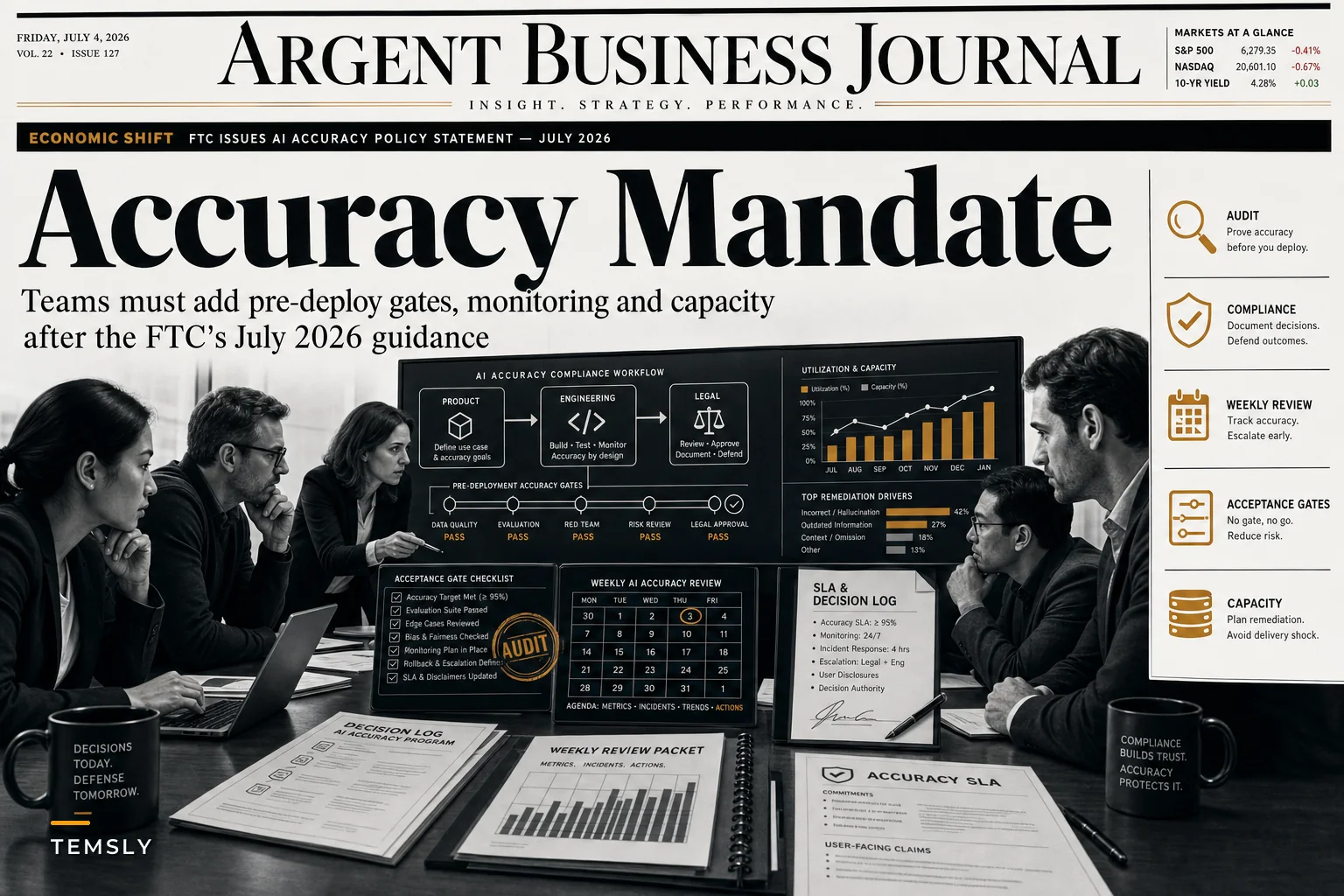

Last week felt different. I watched three separate product teams pull emergency meetings after the FTC announced they're seeking public comment on their proposed AI accuracy policy statement. One team lead texted me at 11pm asking how to audit every AI-powered feature they'd shipped in the last eighteen months. Another called because their legal department suddenly wanted documentation proving their recommendation engine wasn't "suppressing" certain results.
The comment period runs through July 31, but the operational impact hit immediately. Teams using AI for customer-facing features—chatbots, recommendation engines, automated decisioning—suddenly need to prove their outputs are accurate, transparent, and legally defensible. Not next quarter. Now.
The immediate compliance crunch most teams aren't ready for
What makes this FTC guidance particularly painful is how directly it targets the AI capabilities teams have been racing to ship. Reuters reports that even well-intentioned bias safeguards could violate consumer law if they're not implemented transparently. That recommendation algorithm your team spent six months building—the one that personalizes product suggestions based on user behavior—now needs documented accuracy metrics, clear disclosure language, and an audit trail showing it doesn't unfairly suppress certain options.
The operational burden lands hardest on mid-sized teams. Enterprise companies have compliance departments. Startups can pivot fast. But if you're running a 15-person product team at a growing company, you're probably realizing your current processes weren't designed for this kind of scrutiny. Teams are struggling with basic questions they can't answer quickly:
-
Which features use AI for decision-making versus just data processing?
-
What accuracy claims did marketing make about these features?
-
How do we prove our AI isn't suppressing certain results unfairly?
-
Who owns the documentation for AI model updates?
The answers usually live across multiple teams, tools, and timezones. Product knows the features. Engineering knows the models. Legal knows the risks. Marketing knows the claims. Customer Success knows the complaints. Nobody has the complete picture.
Why standard project governance breaks down under AI accuracy compliance
Traditional governance assumes predictable outputs. You plan sprints, estimate capacity, set deadlines. AI accuracy compliance doesn't work like that—it's retrospective, investigative, and cuts across every layer of your operation.
Eliminate team chaos and missed deadlines.
Temsly helps you assign, track & complete projects efficiently with full visibility.
- Centralized task management
- Real-time team communication
- Resource and deadline tracking
No credit card required
Take a typical e-commerce team using AI for product recommendations. Pre-FTC guidance, their governance was probably simple: product defines requirements, engineering builds, QA tests functionality, marketing promotes the personalization benefits. Now that same feature needs accuracy benchmarking, bias testing, suppression analysis, disclosure updates, and ongoing monitoring—each step requiring different expertise and creating new dependencies.
The capacity crunch gets real fast. A team lead managing four engineers told me last week: "We allocated 20% of our sprint for maintenance and bugs. Now legal wants 40% for compliance documentation and accuracy testing. But our roadmap commitments didn't change."
This is exactly where established governance patterns like escalation ladders and review gates become essential. You need clear decision rights about what gets deprioritized when compliance work spikes. You need documented processes for when accuracy issues surface. Predictable checkpoints where legal, product, and engineering align on acceptable risk levels.
Building an AI accuracy compliance framework that actually works
After watching multiple teams scramble through their first AI accuracy audits, some clear patterns emerge about what works versus what creates more chaos.
Start with an AI feature inventory, not policy documents Most teams instinctively start by reading FTC guidance and writing policies. This backward approach produces lengthy documents nobody follows. Map your actual AI touchpoints first:
| Feature Type | AI Component | Accuracy Claims | Current Documentation | Risk Level |
|---|---|---|---|---|
| Search results | Ranking algorithm | "Most relevant" | Technical specs only | High - directly affects what users see |
| Chat support | Response generation | "Instant answers" | Training data logs | Medium - has human fallback |
| Price suggestions | Prediction model | "Market-optimized" | None | High - affects revenue |
| Content moderation | Classification | "99% accurate" | Accuracy metrics | Critical - explicit claim |
This inventory becomes your compliance roadmap. High-risk features with explicit accuracy claims need immediate attention. Lower-risk features with human oversight can wait.
Create tiered SLAs for accuracy issues Not every AI accuracy concern warrants the same response time. A pricing algorithm showing bias is a different situation than a chatbot occasionally misunderstanding a question.
-
Tier 1 (Critical - 4 hour response)
- Discriminatory outputs affecting protected classes - Accuracy degradation in revenue-critical features - Suppression of legally required information
-
Tier 2 (High - 24 hour response)
- Accuracy below marketed thresholds - Consistent user complaints about AI behavior - Unexplained recommendation patterns
-
Tier 3 (Standard - 72 hour response)
- Minor accuracy variations within acceptable ranges - Feature improvement requests - Documentation updates
Each tier needs clear ownership. Critical issues escalate to product leadership and legal. High priority goes to engineering leads. Standard flows through normal sprint planning.
The hidden capacity costs nobody's planning for
AI accuracy compliance isn't a one-time audit. It's ongoing operational overhead that compounds with each new AI feature you ship.
A fintech team discovered their loan approval algorithm needed weekly accuracy reports after deploying to production. Not because anything broke, but because their legal team required proof the model wasn't drifting toward discriminatory patterns. That's roughly four hours of data analysis, report generation, and review meetings every week—for one feature.
Multiply that across every AI-powered capability and capacity planning gets impossible with traditional methods. You need new allocation models that account for:
Baseline compliance tax: Every AI feature now carries somewhere between 15-25% ongoing overhead for monitoring, documentation, and accuracy validation. This isn't sprint work—it's permanent operational cost.
Spike capacity for investigations: When a high-profile article drops about AI bias in your industry, executives want immediate audits. Reserve around 10% of team capacity for these unplanned compliance sprints.
Rework estimates: A significant portion of AI features will need meaningful adjustments after accuracy reviews. Sometimes it's updating disclosure language. Sometimes it's retraining models. Sometimes it's pulling the AI component entirely.
Cross-team coordination overhead: Legal reviews. Stakeholder approvals. Documentation updates. Each AI feature now involves far more stakeholders than a traditional feature would.
Practical governance adjustments for AI-enhanced workflows
Teams successfully managing AI accuracy compliance share common governance patterns. They've moved past ad-hoc responses to systematic processes.
Implement pre-deployment accuracy gates Before any AI feature ships, it passes through three checkpoints:
-
1. Technical accuracy validation (engineering owns) - Baseline accuracy metrics established - Bias testing completed - Suppression analysis documented
-
2. Claims alignment review (product + legal own) - Marketing messages match actual capabilities - Disclosure language approved - User expectations properly set
-
3. Operational readiness check (operations owns) - Monitoring dashboards configured - Escalation paths documented - Accuracy degradation alerts enabled
These gates add roughly two weeks to deployment timelines but prevent months of rework when compliance issues surface after launch.
Establish an AI accuracy review board Weekly 30-minute standing meetings with fixed membership:
-
Product lead (decision authority)
-
Engineering representative (technical expertise)
-
Legal advisor (compliance guidance)
-
Customer success lead (user impact perspective)
This board reviews accuracy metrics, approves model updates, and makes quick calls on emerging issues. The standing meeting prevents the calendar chaos when something actually breaks.
Document decision logic, not just outcomes Traditional documentation captures what the AI does. Compliance documentation needs to capture why it makes specific decisions. That means maintaining:
-
Training data sources and selection criteria
-
Feature importance rankings
-
Decision threshold justifications
-
Alternative approaches considered and rejected
An insurance team learned this the hard way when regulators asked why their claim assessment AI weighted certain factors heavily. They could show the weights but couldn't explain the reasoning. Six weeks of forensic analysis could have been avoided with better upfront documentation.
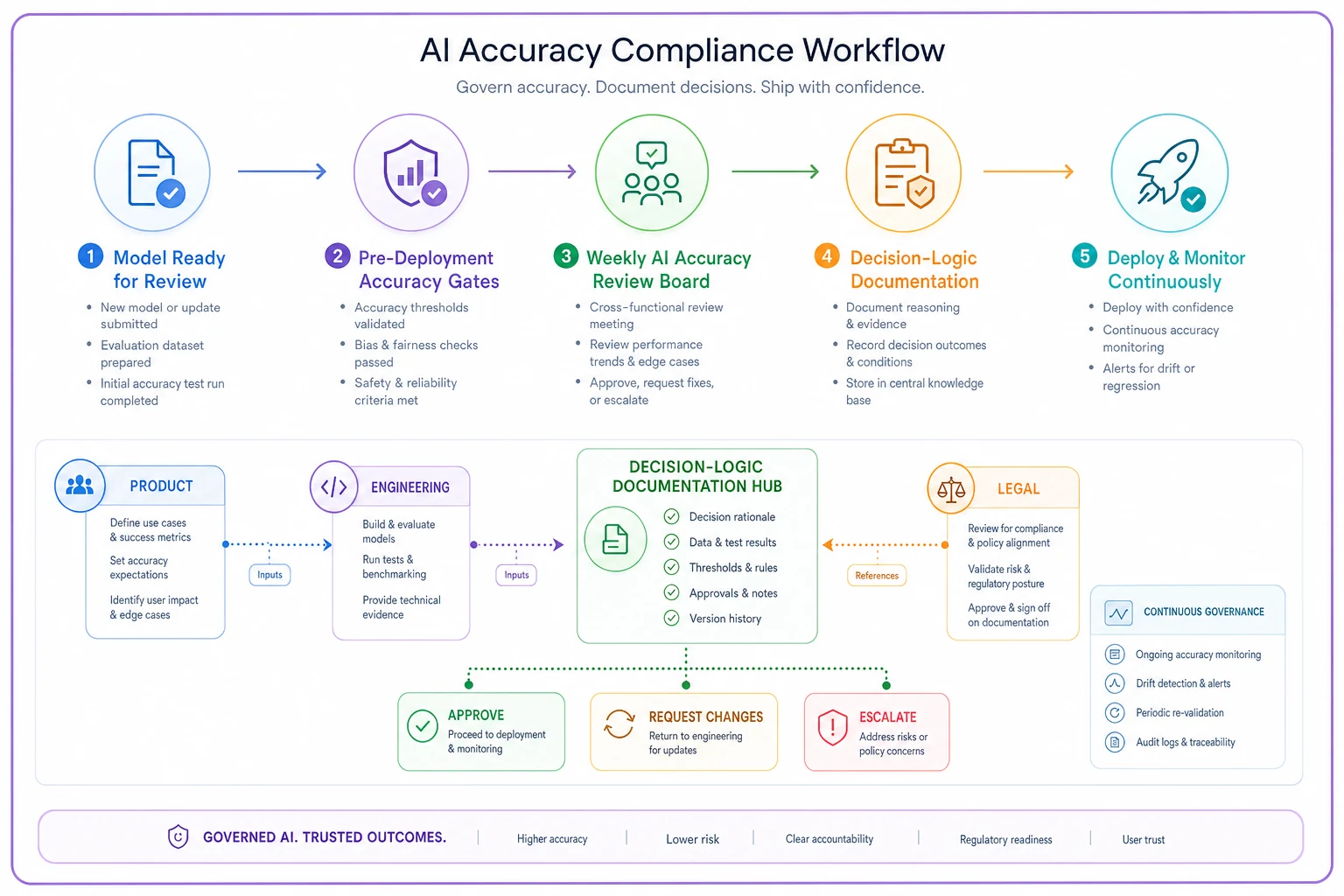
Here's a simple visualization of how gates, the review board, and documentation handoffs connect in practice.
When to add automation to your compliance workflows
Manual compliance processes work initially but don't scale. Once you're managing more than five or ten AI features, automation becomes necessary for sustainable operations.
Start with automated accuracy monitoring. Instead of manually pulling metrics every week, configure dashboards that track:
-
Prediction accuracy trends
-
Output distribution shifts
-
User feedback sentiment
-
Response time patterns
Next, automate compliance documentation. Rather than maintaining spreadsheets, implement systems that automatically capture:
-
Model version histories
-
Accuracy benchmarks at deployment
-
Configuration changes
-
Stakeholder approvals
Finally, automate alerting and escalation. When accuracy drops below thresholds or unusual patterns emerge, the right people need to know immediately. A retail team avoided a discrimination lawsuit because their automated monitoring caught their recommendation engine suddenly stopping to show certain product categories to specific demographic segments.
Start automating read-only audit exports first so you can validate data flows and reports before introducing change-tracking.
AI-powered operational software can centralize these compliance workflows, cutting down the manual coordination burden while keeping audit trails intact. But start with clear processes before adding technology. Automation amplifies good governance—it doesn't create it.
Moving forward without the panic
The FTC's AI accuracy guidance feels overwhelming because it exposes how unprepared most teams are for systematic AI governance. Teams that build proper operational foundations—clear ownership, documented processes, reserved capacity—will turn compliance from a scramble into something resembling a competitive advantage.
Start with the basics. Map your AI features. Assign ownership. Create accuracy baselines. Build monitoring dashboards. Reserve capacity for compliance work. None of this is revolutionary, but it's the difference between reactive panic and proactive management.
The comment period ends July 31, but the operational changes you make now determine whether future regulatory updates derail your roadmap or barely register as routine adjustments. Teams with strong governance patterns and proper capacity planning will adapt without much disruption. Teams without them will find that AI accuracy compliance becomes an endless source of unplanned work, missed deadlines, and organizational friction.
Invest in operational foundations now or pay multiples more in rework, delays, and potential regulatory penalties later. Teams that establish AI governance frameworks quickly will have real advantages as competitors struggle with compliance overhead they never planned for.
Invest in operational foundations now or pay multiples more in rework, delays, and potential regulatory penalties later. Teams that establish AI governance frameworks quickly will have real advantages as competitors struggle with compliance overhead they never planned for.
Ready to elevate your team's performance?
Join 2,000+ teams using Temsly to streamline workflows, boost productivity, and deliver projects on time.