
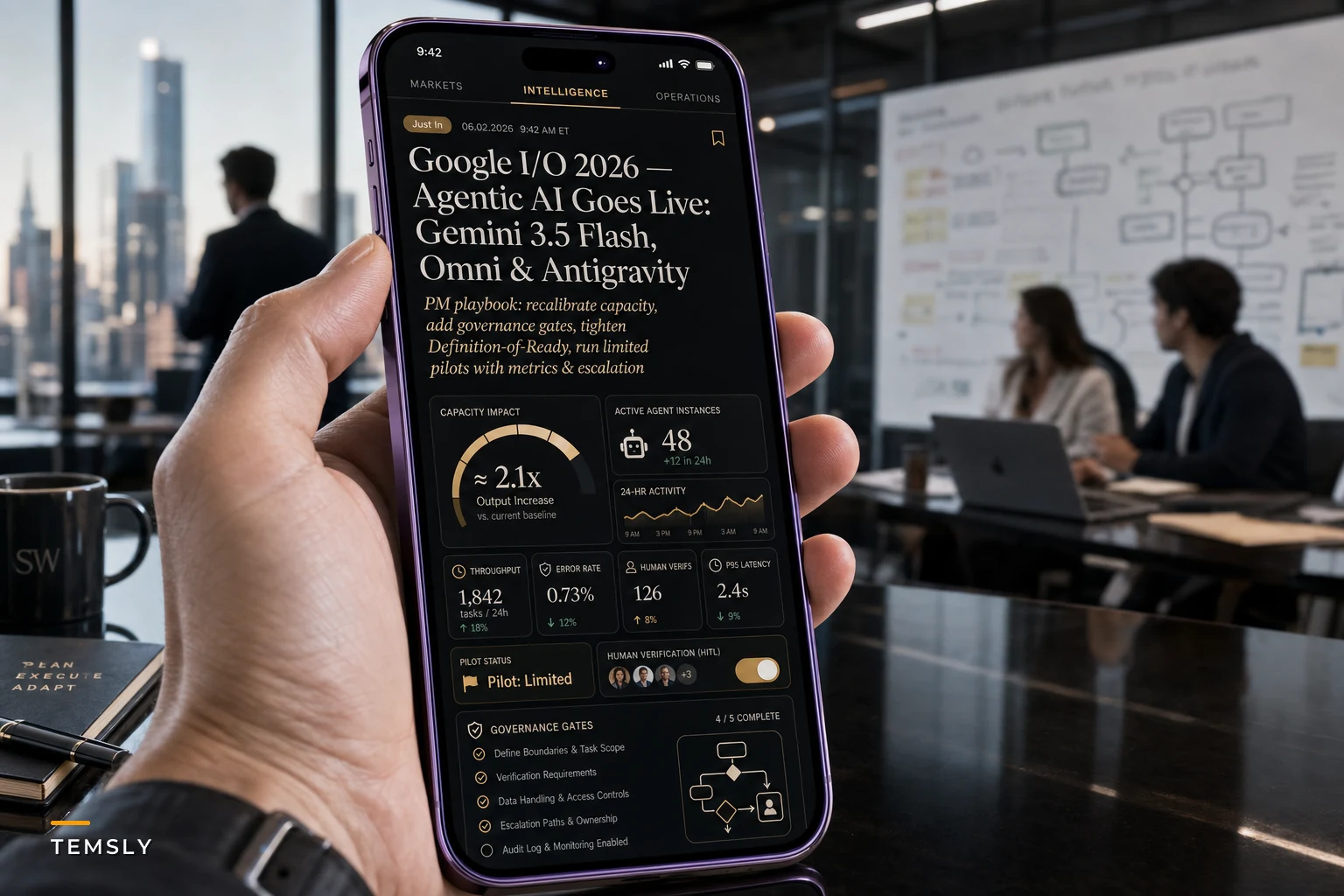

Google just dropped something at I/O that's going to mess with how you run projects. Not in six months. Not next quarter. Right now.
Google's announcement of Gemini 3.5 Flash and their Antigravity platform means your stakeholders are already watching demos of AI doing background tasks, generating entire UIs on the fly, and running 24/7 information monitoring. By next Monday's planning meeting, someone's going to ask why your team isn't using this stuff yet.
Agentic AI project management isn't just adding another tool to your stack. It fundamentally changes how you plan sprints, assign ownership, and measure capacity. These systems don't wait for permission. They don't follow your RACI matrix. They definitely don't respect your carefully planned handoff processes.
Teams that succeed with AI automation aren't the ones who move fastest. They're the ones who update their planning and governance first. The teams that crash? They let stakeholder excitement drive commitments before figuring out how AI agents actually fit into their delivery pipeline.
Why Traditional Planning Breaks When AI Agents Enter Your Workflow
Your current planning probably looks like this: estimate effort, assign to humans, track progress through standups, adjust when things slip. Simple enough.
Agentic AI breaks every assumption in that model. When an AI agent handles document generation, it might produce 50 drafts in the time your writer creates one. Sounds great until you realize your review process now has 50x the volume to handle. Or when your AI monitoring agent flags 200 "urgent" issues overnight that all need human verification.
These agents don't have consistent output quality or timing. One day your AI agent perfectly summarizes customer feedback. The next day it misinterprets sarcasm and creates a report showing customers love a feature they actually hate. Your team ends up committing to deliverables based on AI output they can't fully predict or control.
A product team I worked with recently learned this the hard way. They told leadership their new AI agent could handle all user research synthesis — cutting analysis time from two weeks to two days. Technically true. What they didn't account for: the three days needed to verify the AI hadn't misunderstood context, the rework when it grouped unrelated feedback together, and the emergency scramble when it confidently reported patterns that didn't exist.
The Capacity Planning Trap Nobody's Talking About
Most organizations see AI demos, get excited about 10x productivity gains, and immediately adjust next quarter's roadmap to reflect this new capacity. Your team suddenly owns deliverables that assume perfect AI performance.
Eliminate team chaos and missed deadlines.
Temsly helps you assign, track & complete projects efficiently with full visibility.
- Centralized task management
- Real-time team communication
- Resource and deadline tracking
No credit card required
AI agents don't add capacity the way hiring a contractor does. They reshape it completely. Tasks that took eight hours might take 30 minutes — but require two hours of setup, an hour of verification, and create four new downstream tasks that didn't exist before.
A marketing team started using AI agents to generate campaign variations. Their content production went from 5 campaigns monthly to 50. Amazing, right? Except their approval process still required human review. Their design team couldn't keep up with asset requests. Their analytics setup wasn't built for tracking 50 simultaneous campaigns. They ended up shipping broken campaigns because nobody updated their capacity planning model to account for these bottlenecks.
AI accelerates one part of your workflow, creating massive backlogs in areas you never considered constraints before. Your QA process. Your compliance reviews. Your deployment pipeline. Even simple things like how many Slack threads your team can meaningfully track.
Building Your Pre-Flight Checklist for Agentic AI
Before you let anyone add "AI-powered" to any deliverable in your project plan, you need answers to these questions:
Boundary Definition
-
What specific tasks will the AI agent own completely?
-
What requires human oversight, and who provides it?
-
What happens when the agent produces unexpected output?
-
How do you prevent scope creep into adjacent tasks?
Verification Requirements
-
Who validates AI output before it moves downstream?
-
What's your sampling rate for quality checks?
-
How do you track accuracy trends over time?
-
What triggers full human takeover?
The checklist flows like this:
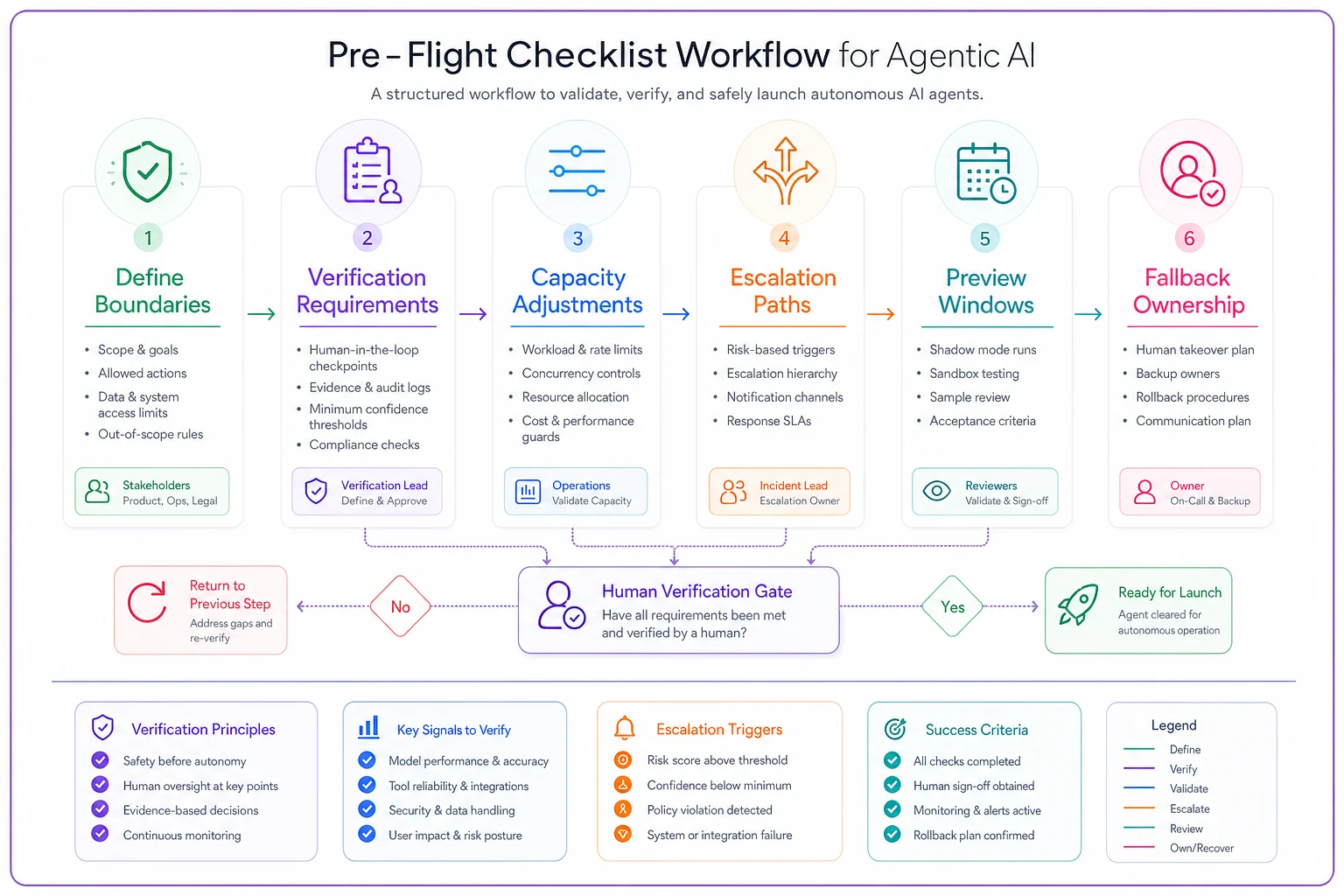
Use this to map responsibilities and handoffs before you let AI-generated outputs enter the pipeline.
Capacity Adjustments
-
Which downstream processes will see increased volume?
-
What new bottlenecks will emerge?
-
How much human time gets added for oversight?
-
What's your backup plan when the AI fails?
Escalation Paths
-
Who decides when AI output isn't acceptable?
-
How quickly can you switch to manual processes?
-
What's the communication plan for AI-related delays?
-
Who owns the relationship with AI vendors?
Most teams skip this checklist and jump straight to implementation. Then they wonder why their sprints keep failing even though the AI is technically working.
The New Handoff Protocol You Need Tomorrow
Traditional handoffs assume predictable inputs and outputs. Design hands off mockups to engineering. Engineering hands off code to QA. Each team knows what they're getting and when.
AI agents blow up this model because they create variable outputs that don't fit neatly into your existing categories. Your AI might generate 20 design variations when you expected 3. It might produce code that works but doesn't follow your architectural patterns. It might create test cases that are technically correct but miss your business context.
Start with output contracts. Before any AI agent joins your workflow, define exactly what constitutes acceptable output. Not just format — include quality thresholds, context requirements, and edge case handling. Make these contracts as specific as your API documentation.
Establish preview windows. AI output needs human review before it becomes someone else's input. Build buffer time into your timeline for this preview. Usually 20-30% of the time the AI saved you ends up here.
Create fallback ownership. Every AI-assisted handoff needs a human owner who can step in when things go sideways. This person doesn't do the work daily but maintains enough context to take over quickly.
Treat output contracts like API docs — make them specific and versioned.
Document variance patterns. Track how often AI output requires rework, which types of tasks produce unexpected results, and what triggers quality issues. This data becomes your early warning system for future planning.
Practical Governance Without Committee Hell
You need governance for agentic AI, but not the kind that requires six approval meetings to change a prompt. The governance that actually works focuses on boundaries and escalation, not process theater.
Set up threshold-based triggers instead of approval gates. For example: AI can generate up to 10 customer responses daily without review, but response #11 triggers human oversight. Or: AI can modify existing documentation but creating new pages requires approval. These thresholds let work flow while maintaining control.
Create audit trails that actually matter. Not every AI decision needs documentation, but you need to track: prompts that generate customer-facing content, decisions that affect system architecture, and any output that touches compliance requirements. Skip the rest — nobody's reading those logs anyway.
Establish kill switches at the task level. When AI agents mess up, you need to stop them from making things worse without shutting down everything. Each AI-powered task needs an independent off switch that reverts to manual process. This isn't paranoia — it's operational insurance you'll definitely need.
Your governance framework should create safety without slowing down the work that matters. Most teams get this backwards and end up with elaborate approval processes that protect against risks that barely exist while missing the actual failure modes.
Your Monday Morning Action Plan
Stop reading and start doing.
-
Map your commitment exposure. List every deliverable your team owns for the next sprint. Mark which ones stakeholders might expect to accelerate with AI. These are your risk zones — where overcommitment will hurt most.
-
Pick one low-risk workflow for AI testing. Not your critical path. Something like internal documentation, test data generation, or meeting summaries. You need real experience with how AI agents behave in your specific environment before making bigger bets.
-
Update your capacity model. Add new categories for AI oversight time, verification work, and rework from failed AI attempts. Yes, this means your capacity might temporarily decrease as you learn. Better to acknowledge this now than explain blown deadlines later.
-
Draft your first output contract. Pick the workflow from step two and write down exactly what acceptable AI output looks like. Share this with your team. They'll immediately spot gaps you missed.
-
Schedule a pre-mortem for your first AI sprint. Assume it fails. Work backwards to identify what went wrong. Usually it's: unclear ownership, missing verification steps, or downstream bottlenecks. Fix these before they happen.
Implement this before stakeholders start making promises based on The Verge's coverage of Google's AI announcements:
Real Patterns from Teams Already Through This
A logistics operations team tried to use AI agents for route optimization. The AI consistently found shorter routes — technically a win. But it didn't account for driver preferences, customer delivery windows, or vehicle capacity constraints that weren't in the training data. They spent three weeks untangling customer complaints before rolling back.
What worked for them afterwards: running AI suggestions parallel to human decisions for a full month. No automation, just comparison. They discovered the AI was good at finding alternative routes but terrible at weighing trade-offs. Now they use it for option generation only, with humans making final calls.
A customer success team used AI for ticket categorization and initial responses. Worked great for two weeks. Then the AI learned from edge cases and started categorizing everything as "urgent - executive escalation." Their executive team got flooded with routine password reset requests.
The fix wasn't better training data. It was adding a simple governance rule: AI can suggest categories but can't assign anything above "normal" priority without human confirmation. Tiny change, massive difference in operational stability.
The Integration Roadmap That Actually Works
Forget big-bang AI transformations. Here's the integration sequence that keeps you from overpromising:
| Phase | Tasks | Risk Level | Success Metrics |
|---|---|---|---|
| Phase 1 | Internal docs, meeting notes, test scenarios | Low | Accuracy rate, time savings |
| Phase 2 | Draft generation with human review | Medium | Review time, quality scores |
| Phase 3 | Customer-adjacent work with buffers | Medium-High | Customer satisfaction, error rates |
| Phase 4 | Critical path optimization | High | Delivery consistency, business impact |
Start with internal-facing, reversible tasks. Things like draft generation for internal docs, meeting transcription, or test scenario creation. If the AI screws up, you annoy your team, not your customers.
Move to customer-adjacent but buffered tasks. AI can draft customer communications that humans review. Generate report templates that analysts complete. Create initial project plans that managers adjust. You're accelerating work without giving AI the keys to customer relationships.
Only then touch customer-facing or critical-path work. By this point, you understand your AI's failure modes, your team knows the verification requirements, and your capacity planning reflects reality instead of vendor promises.
Throughout this progression, maintain shadow mode for at least one sprint before going live. Run AI parallel to existing processes. Compare outputs. Measure time savings AND quality issues. This data becomes your business case for expanded use — or your justification for pulling back.
Why Most Teams Will Screw This Up (And How You Won't)
The teams that fail at agentic AI project management make the same three mistakes:
They promise before they pilot. Stakeholder excitement drives commitments before anyone understands operational reality. You avoid this by running shadow mode and sharing data, not demos.
They automate their constraints instead of removing them. If approval is your bottleneck, AI-generating more stuff to approve makes things worse. You avoid this by mapping your full workflow and finding where AI actually reduces bottlenecks, not just speeds up individual tasks.
They govern through policy instead of process. Writing rules about AI use doesn't work. Building verification steps into your actual workflow does. You avoid this by making governance part of how work flows, not a separate approval layer.
Building Your Competitive Advantage
While your competitors scramble to implement AI agents without updating their planning and governance, you can build a sustainable advantage by getting the operational foundation right first.
This isn't about moving slowly. It's about moving deliberately. Every team that successfully integrates AI agents into their project workflow follows roughly the same pattern: small tests, careful measurement, gradual expansion, constant adjustment.
The teams still struggling six months later? They bought into vendor promises, made big commitments, and now spend most of their time firefighting AI-generated problems instead of delivering value.
Your operational discipline becomes your competitive advantage. While others deal with rework and blown deadlines, you'll consistently deliver AI-enhanced value without the chaos.
Start with the checklist. Update your capacity planning. Build those output contracts. Do this before Monday's planning meeting, and you'll be the voice of reason when everyone else is making promises based on demo videos.
The age of agentic AI project management isn't coming — it's here. The question isn't whether you'll adapt, but whether you'll do it thoughtfully enough to maintain operational excellence while everyone else is putting out fires.
Ready to elevate your team's performance?
Join 2,000+ teams using Temsly to streamline workflows, boost productivity, and deliver projects on time.