

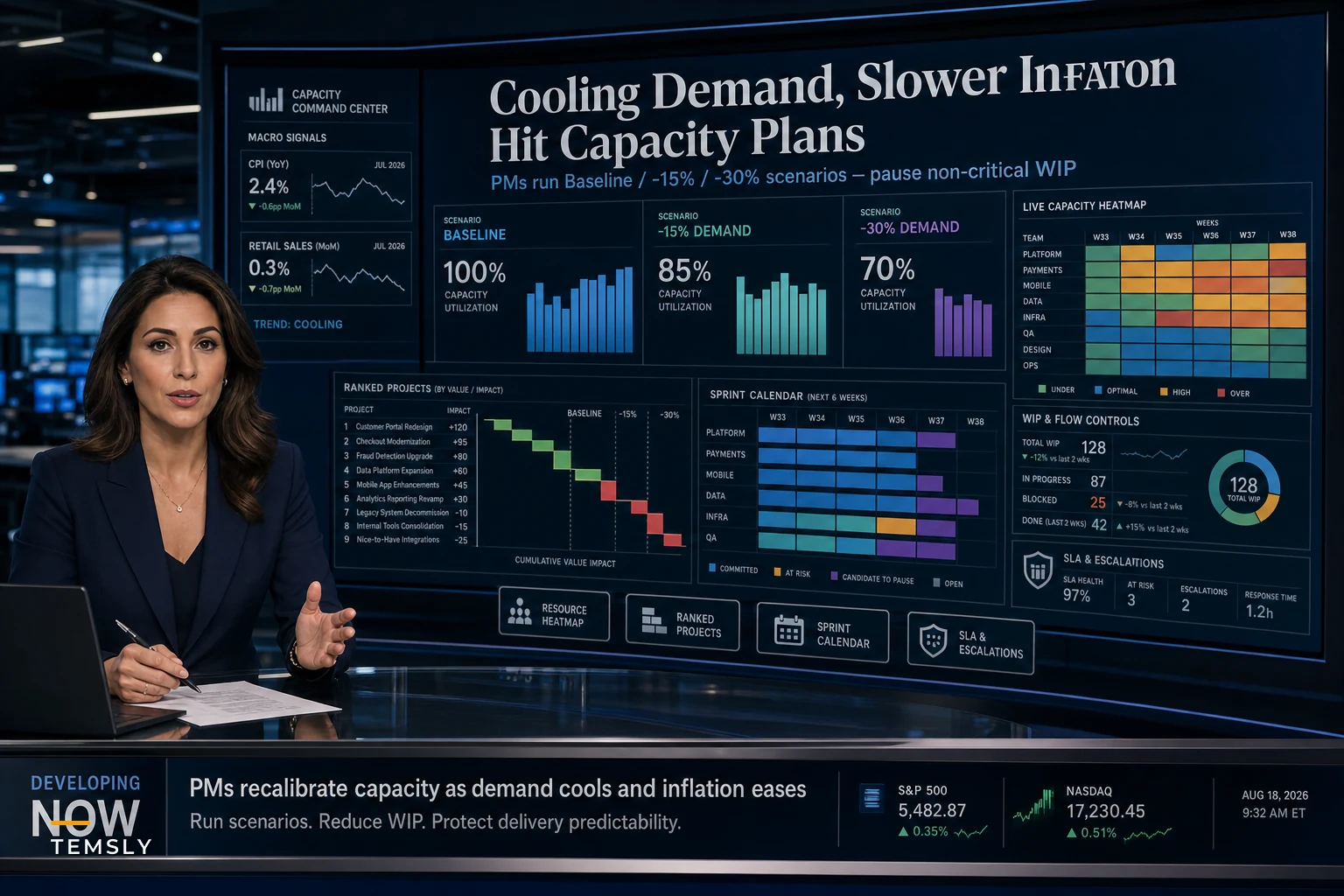

The July 2026 data landed quietly. Consumer prices barely moved—up 0.1% for the month, 3.4% year over year—and then two days later, retail sales did something they hadn't done in nine months: they fell. Down 0.6%, according to Reuters, against expectations of a modest gain.
For most team leaders, this is background noise until it isn't. The moment finance reads the same headlines, the tone of the next planning cycle shifts. Revenue forecasts get trimmed. Hiring gets "paused pending review." And suddenly the roadmap you committed to in Q2 is sitting on capacity assumptions that no longer hold.
This post isn't about the macro picture. It's about what happens two or three weeks later, inside your team, when the demand softening finally reaches your backlog—and why most teams handle it badly.
The lag nobody plans for
Cooling demand doesn't hit your team on the day the CPI report drops. It hits on a delay, and unevenly.
Sales sees it first—longer deal cycles, more "let's revisit next quarter." Then it reaches the roadmap, because projects justified by aggressive growth targets start looking speculative. By the time it reaches your team as an actual capacity change, you've usually already staffed and kicked off three or four initiatives built on the old assumptions.
The mistake isn't reacting slowly. It's reacting all at once, in a panic, when finance finally sends the "we need to find 15%" email. At that point you're making cuts under pressure, which is the worst possible condition for portfolio decisions. The projects with the loudest owners get protected, and the quiet high-value work gets sacrificed because nobody's defending it in the room.
What softer demand really exposes is a problem that was already there: most teams don't have a live picture of what their committed capacity is actually buying them. They have a list of projects and a vague sense that everyone's busy.
Run the what-if before you're forced to
Teams that handle a demand slowdown well aren't smarter. They just did the scenario work while things were calm, so when the budget conversation arrives they're negotiating from a position rather than scrambling to one.
Eliminate team chaos and missed deadlines.
Temsly helps you assign, track & complete projects efficiently with full visibility.
- Centralized task management
- Real-time team communication
- Resource and deadline tracking
No credit card required
A useful what-if isn't a spreadsheet exercise. It's three concrete versions of your portfolio:
-
Baseline — what you're committed to right now, with current headcount and assumptions.
-
Minus 15% — you lose roughly one in seven units of capacity (a contractor rolls off, a hire gets frozen, someone gets pulled to a revenue-critical account). What survives?
-
Minus 30% — the ugly version. Deep freeze. Only work that protects existing revenue or prevents a real operational failure stays funded.
Below is a simple workflow to run the three-scenario exercise.
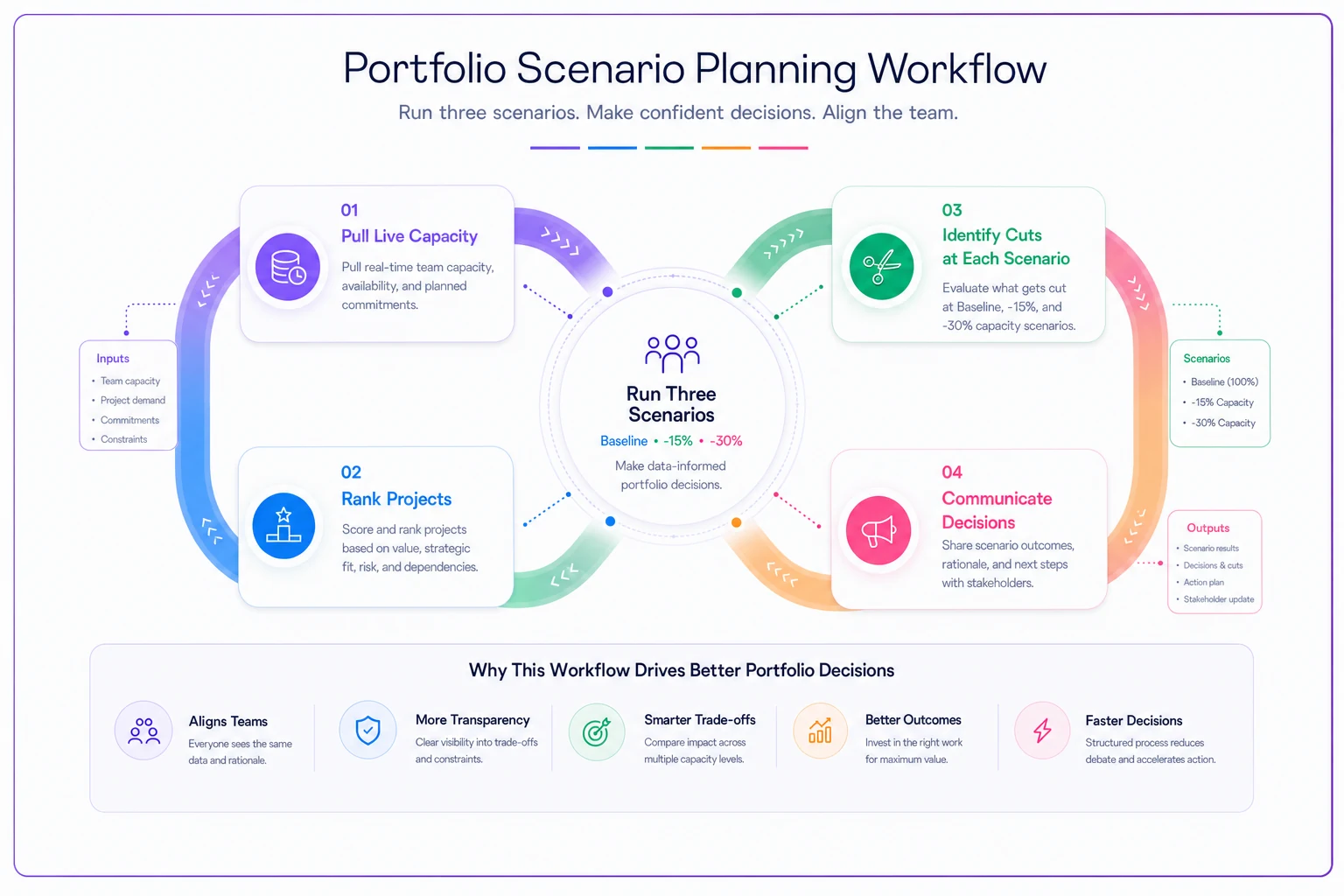
Focus the -15% scenario on fragile dependencies and single points of failure.
The point isn't predicting which scenario happens. It's forcing yourself to rank the portfolio before the pressure is on, so you already know which projects fall off at each threshold. When you've done this, the finance conversation stops being "what can you cut?" and becomes "which scenario are we in?"—a far more useful starting point.
The -15% scenario is where the real learning tends to happen. The -30% version is almost straightforward—everyone agrees the strategic bets get paused. The middle scenario is harder, because that's where two projects both feel important and you actually have to choose.
Where the value hides when demand cools
Softer consumer demand changes what "high value" even means. During growth, value skews toward acquisition and expansion—new features, new markets, new segments. When demand cools, value shifts toward retention, efficiency, and cost-to-serve.
Most teams get this wrong. They keep the growth projects because those had the most political momentum, and they cut the efficiency work because it feels less exciting. Six weeks later they're bleeding margin on operational waste that a paused project would have fixed.
A rough way to re-score your portfolio when demand softens:
| Project type | Growth environment | Cooling-demand environment |
|---|---|---|
| New-customer acquisition features | High priority | Lower—demand is the constraint, not your product |
| Retention / churn-reduction work | Medium | High—keeping customers is cheaper than replacing them |
| Cost-to-serve / efficiency projects | Often deferred | High—directly protects margin |
| Speculative new markets | High | Freeze unless already near revenue |
| Compliance / risk work | Steady | Steady—doesn't move with the cycle |
When the market stops handing you growth, the value moves to protecting what you already have and doing it for less. Your priority scoring should reflect that shift.
The overcommitment trap gets worse, not better
You'd expect a slower economy to mean less pressure on teams. In practice it tends to go the other way. When demand softens, leadership often responds by piling on more initiatives—"capture share," "get ahead of the recovery"—while simultaneously freezing the headcount that would make those initiatives possible.
More asks, less capacity. That's a reliable recipe for the overcommitment problem that quietly destroys delivery predictability. This is where having a systematic approach to capacity planning across your portfolio stops being a process improvement and becomes the thing that keeps your team from silently drowning.
The failure accumulates gradually: the team keeps saying yes because no single request looks unreasonable. Each new ask is small. But the cumulative load hits 130% of a capacity that just got cut to 85%. Nobody decided this. It just piled up.
The fix isn't heroics. It's making the total load visible against real available capacity so every new "yes" is explicitly a "no" to something already in flight. When capacity is tight, that tradeoff has to be spoken out loud, every time.
A real scenario
A regional distribution company—mid-sized operations team, around 40 people across ops and internal tooling—went into July with nine active internal projects. Their roadmap assumed two new hires and one contractor renewal.
When their own customer orders started softening (they felt it before the retail numbers confirmed the trend), finance pulled all three staffing lines. That's roughly a 20% capacity cut applied to a portfolio already running near full.
Their first instinct was the usual one: keep everything moving, just slower. Within about five weeks, six of the nine projects were behind, and two had quietly stalled because the one person who could unblock them got pulled onto an urgent customer issue. Nothing was formally cancelled. Everything just drifted.
What turned it around wasn't more people. It was a hard reprioritization session where they forced the -20% scenario and cut the active list from nine to four. Two paused projects were growth bets that now looked speculative. One was a "nice dashboard" nobody could connect to a real outcome. The four survivors were all either revenue-protecting or cost-reducing.
The results over the next quarter were uneven but real. The four surviving projects shipped. Delivery predictability went from "everything's late" to roughly on-schedule. And—this is the part people underestimate—the team stopped burning energy context-switching between nine half-alive initiatives. Morale improved once "we're behind on everything" turned into "we're finishing what matters."
The lesson wasn't that cutting is good. It was that slowing everything equally is a decision to fail at everything equally.
The checklist to run this month
If you think the demand signal is real for your business, don't wait for finance to force the conversation:
-
Pull a live capacity picture. Not "everyone's busy"—actual committed hours against actual available hours for the next two quarters.
-
Rank the full portfolio now, while things are calm. You want the ranking to exist before anyone gets emotional about it.
-
Build the three scenarios (baseline, -15%, -30%) and identify which projects fall off at each line.
-
Re-score for a cooling market—shift weight toward retention and efficiency, away from speculative growth.
-
Tighten acceptance criteria on surviving work. Rework is the most expensive thing you can do with reduced capacity; a project that ships twice because the first version was fuzzy costs you double when you have less to spare.
-
Make every new request a visible tradeoff. If something's coming in, something's going out—and that gets said openly.
-
Update stakeholders early. Teams that lose trust are the ones that go quiet and then miss dates. Say what's paused and why, before someone asks.
Update stakeholders early. Teams that lose trust are the ones that go quiet and then miss dates. Say what's paused and why, before someone asks.
When to act—and when to sit tight
Not every soft data point is a signal for your business, and overreacting has its own cost. A hard reprioritization is disruptive; running it every time a report lands mildly below expectations is its own problem.
This makes sense when: your revenue forecast has actually moved, staffing lines have been frozen or cut, or your own leading indicators—pipeline, order volume, renewal rates—are confirming the softening. Two or more of those together is a real signal.
This is probably a mistake when: you're reacting purely to the headline with nothing in your own numbers confirming it, or when you'd be cutting work that's already 80% done. Finishing that is almost always cheaper than pausing and restarting later.
Who should be careful here: teams whose work is counter-cyclical or compliance-driven. If your projects protect the business regardless of demand, a broad slowdown response can do more harm than good. Cut based on what the work protects, not on the mood of the economy.
The mild inflation reading, as CNBC noted, reduces some near-term pressure—genuinely good news for planning. But the retail decline is the number that should shape how you think about the next two quarters of capacity. Slower price growth buys you a little room; softer demand tells you how to spend it.
The real work
Demand cycles come and go. What separates teams that ride them well from teams that get whipsawed isn't forecasting ability—it's whether they can see their own capacity clearly enough to make deliberate cuts instead of panicked ones.
The July numbers are just a prompt. The underlying discipline—knowing what your committed capacity is actually buying, ranking honestly before the pressure hits, refusing to slow everything equally—is what you'll need in the next downturn and the one after that. Build it now, while things are quiet enough to think.
Demand cycles come and go. What separates teams that ride them well from teams that get whipsawed isn't forecasting ability—it's whether they can see their own capacity clearly enough to make deliberate cuts instead of panicked ones.
The July numbers are just a prompt. The underlying discipline—knowing what your committed capacity is actually buying, ranking honestly before the pressure hits, refusing to slow everything equally—is what you'll need in the next downturn and the one after that. Build it now, while things are quiet enough to think.
Ready to elevate your team's performance?
Join 2,000+ teams using Temsly to streamline workflows, boost productivity, and deliver projects on time.