

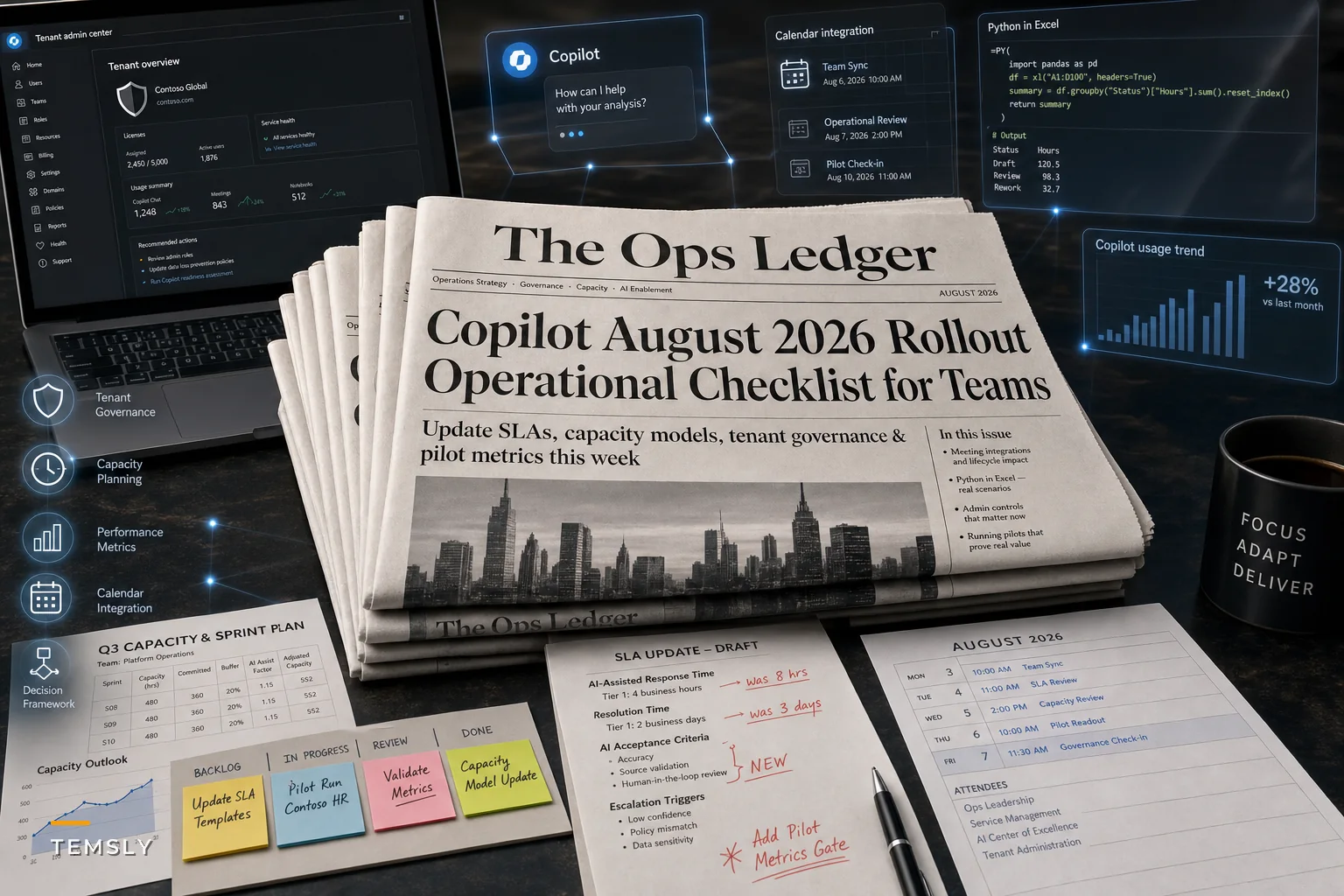

Somewhere between August 11 and 25, a bunch of your people got new buttons inside Teams, Excel, and search without asking for them. Microsoft's staggered August 2026 rollout pushed expanded meeting integrations, Copilot Chat inside search, the reworked Notebooks experience, Python in Excel, Viva Engage grounding, and a fresh batch of tenant and admin controls. Most of it arrives gradually, tenant by tenant, which means half your team may have a feature the other half doesn't — and nobody sent a memo about how it changes the work.
The Microsoft 365 Copilot release notes lay out what's shipping. That part is easy to read. The hard part is what nobody publishes: how these features quietly shift the assumptions baked into your SLAs, your sprint commitments, and your governance gates. That's the actual problem for anyone running delivery.
This isn't a feature review. It's a checklist for the person who has to keep promises to stakeholders while their team's tooling changes underneath them mid-quarter.
Faster drafts don't mean faster delivery
A feature that produces output faster feels like a capacity win. Copilot drafts the spec, generates the Excel model, summarizes the meeting. Leaders see speed and start committing to more.
But speed at the drafting stage doesn't touch the parts of delivery that actually consume your calendar — review, reconciliation, correction, and sign-off. That's where the hidden cost lands. A Copilot-generated first draft that looks 90% done often needs the same review hours as a human draft, sometimes more, because reviewers relax when something looks polished. Confident-looking output gets less scrutiny, not more.
So the estimate that used to read "3 days to draft, 1 day to review" becomes "half a day to draft, 2 days to review because we caught three grounding errors we almost shipped." Your total didn't shrink. It shifted — and if your capacity model only tracked drafting hours, you're now over-committed without knowing it.
This same dynamic played out when generative tools first hit engineering teams, and it's the same underlying mistake we flagged in our breakdown of what project leaders must do to avoid overcommitment and rework as agentic AI arrives. Faster inputs create more work downstream unless you plan for it.
Where the August features actually hit your delivery model
Not every feature matters equally to a delivery lead. Some are convenience. A few change your risk profile. Here's how they sort out operationally:
Eliminate team chaos and missed deadlines.
Temsly helps you assign, track & complete projects efficiently with full visibility.
- Centralized task management
- Real-time team communication
- Resource and deadline tracking
No credit card required
| Feature | Surface-level benefit | What it actually changes for delivery |
|---|---|---|
| Expanded Teams/meeting integrations | Auto-summaries, action item capture | Action items now get auto-generated — someone has to own accuracy or you'll assign phantom tasks |
| Copilot Chat in search | Faster answers from company data | Answer quality depends on permissions and grounding; wrong-but-confident answers spread fast |
| Python in Excel | Advanced analysis without a data team | Non-analysts now ship models nobody reviews; silent calculation errors enter decisions |
| Copilot Notebooks UX | Easier structured workspaces | Knowledge fragments across new surfaces; your "source of truth" multiplies |
| Viva Engage grounding | Responses grounded in internal posts | Stale or informal internal content becomes an authoritative-sounding source |
| Tenant/admin controls | Better governance levers | Only helps if someone actually configures them before the features land |
The pattern across that table: every convenience introduces a new place where an unreviewed output can enter a real decision. That's the governance gap. Your existing gates were designed for human-authored work with a known author. AI-grounded content breaks that assumption — the "author" is a model pulling from sources your reviewers can't easily see.
Your definition of "done" assumes a human made it
Most delivery frameworks quietly assume a person wrote the thing, knows why they wrote it, and can defend it. Acceptance criteria, definitions of ready, sign-off rituals — all of it rests on human accountability being traceable.
Copilot-produced work snaps that thread. When an Excel model built with Python-in-Excel produces a number that drives a roadmap decision, who owns the number? The analyst who prompted it? The reviewer who skimmed it? When a meeting summary auto-assigns a task to the wrong person and they don't notice for a week, whose miss is that?
This is the part teams underestimate. The features are fine. The problem is that your existing accountability model has no slot for "generated, lightly reviewed, and shipped." Until you create that slot explicitly, AI output slides through gates designed for something else.
The checklist: updating SLAs, capacity, and governance before the features bite
Work through these in order. The first three are urgent because features are already rolling out. The rest can happen over the next sprint or two.
-
- [ ] Inventory what your tenant actually has, right now. Rollouts are gradual. Confirm which features are live for which groups before you assume anything about capacity.
-
- [ ] Freeze your capacity assumptions for two sprints. Do not let "Copilot makes us faster" leak into commitments until you have measured review time on real AI-assisted work.
-
- [ ] Assign a named owner for auto-generated meeting action items. Someone verifies them before they become tracked tasks. No owner means no adoption of the feature in official workflows.
-
- [ ] Add an "AI-assisted" flag to your work items. Anything drafted or calculated with Copilot gets tagged. This lets you measure rework rates on AI-assisted vs. human work separately.
-
- [ ] Update acceptance criteria to require source verification for any Copilot-grounded content (search answers, Viva-grounded responses, summaries).
-
- [ ] Add a permissions review gate before Copilot Chat in search goes wide. Grounded answers only surface what a user can access — misconfigured permissions leak or hide the wrong things.
-
- [ ] Require review sign-off for any Python-in-Excel model feeding a decision. Non-analysts producing models is the sneakiest new risk on the list.
-
- [ ] Rewrite your Definition of Ready to distinguish "AI-drafted" from "reviewed and accepted."
-
- [ ] Update onboarding and contractor ramp docs so new people know which outputs need verification and which surfaces are authoritative.
-
- [ ] Set an escalation path for when an AI-produced output causes a downstream miss — so it becomes a tracked pattern, not a one-off blame.
The first three are urgent because features are already rolling out. The rest can happen over the next sprint or two.
Adjusting your capacity model without guessing
Don't recalibrate estimates on vibes. Run a short measured pilot instead:
-
Pick one recurring work type — drafting a requirements doc, building a monthly analysis, something you do often enough to have baseline numbers.
-
Run it the old way for two or three cycles and log actual hours split into draft, review, and rework.
-
Run the same work type with the relevant Copilot feature for the same number of cycles, logging the identical splits.
-
Compare the totals, not the draft phase. You're looking for where hours moved, not whether drafting got faster (it will).
-
Watch the rework column specifically. If AI-assisted rework climbs, your reviewers are trusting polished output too much — a training and gate problem, not a tooling problem.
-
Only then adjust your capacity model, and only for that work type. Resist generalizing one result across everything.
The pilot's real output isn't a new estimate. It's discovering where your review process is weakest, because AI output pressure-tests exactly the gates you were quietly skipping.
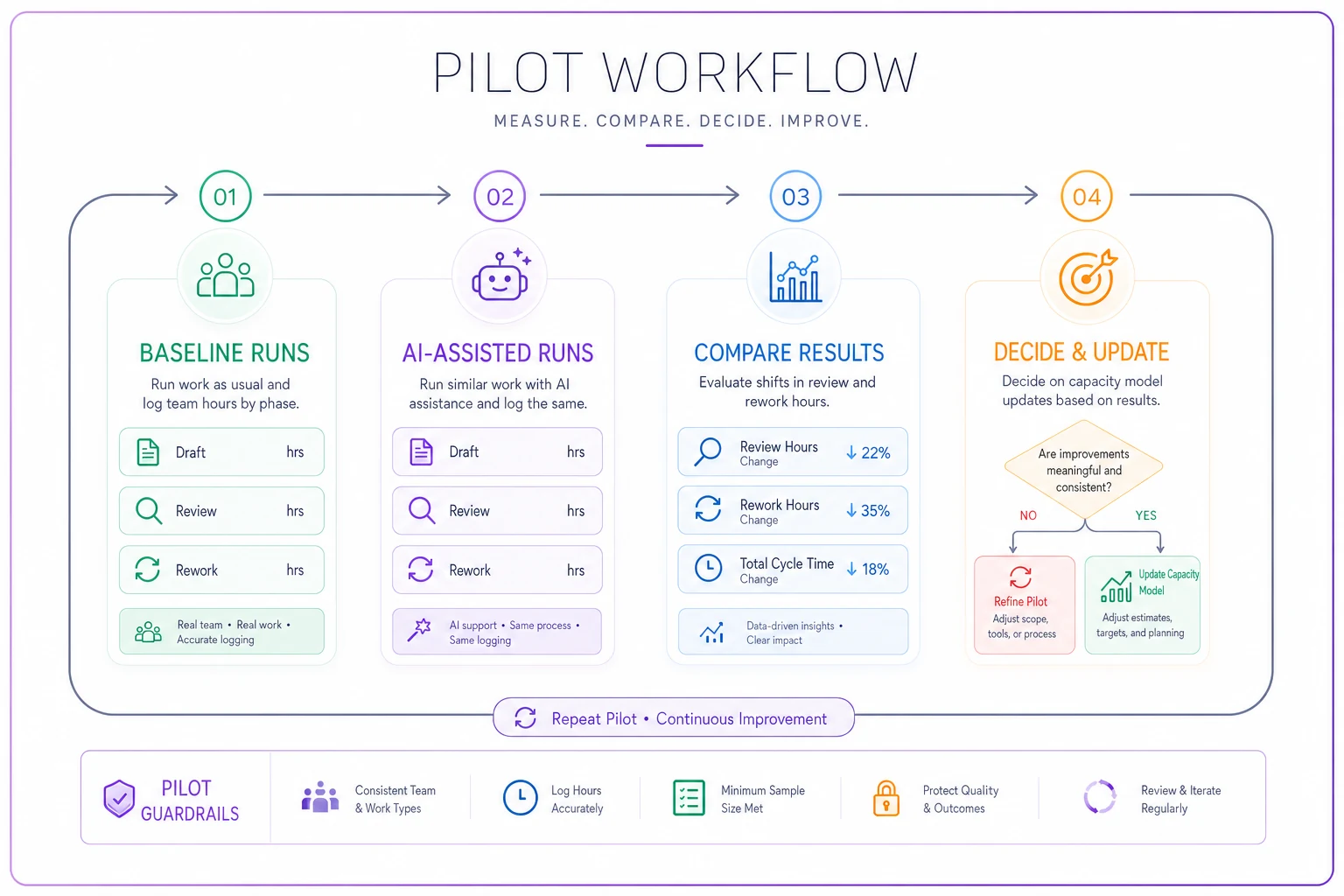
A simple visual of the pilot steps helps teams agree what to log and where to look for shifted hours.
A real scenario: a 40-person operations team, mid-rollout
A regional insurance operations group — around 40 people across underwriting support, reporting, and coordination — got Python-in-Excel and the expanded Teams integrations in the same week. Leadership, understandably excited, told two teams to take on an extra reporting deliverable that quarter because "Copilot handles the heavy Excel work now."
Within about three weeks, two problems surfaced. First, a monthly exposure report built partly with Python-in-Excel carried a filtering error nobody caught — it excluded a category of policies, and the number went into a leadership deck before someone noticed. Not catastrophic, but it burned a couple of days of scramble and cost trust. Second, auto-generated action items from meetings were quietly assigning follow-ups to people who never saw them, and a handful of things slipped for a week or two.
The fix wasn't turning features off. They added a lightweight review gate: any Copilot-built model feeding a report needed a second set of eyes signing off, and one person per recurring meeting owned confirming the auto-captured action items. Rework on the reporting work dropped back to roughly where it had been before, and the extra deliverable got pushed a quarter — because the honest capacity math showed the team was flat, not faster. The speed showed up later, once the gates caught up.
When to lean in — and when to hold back
When adopting fast actually makes sense: low-stakes, high-volume work where errors are cheap and obvious — meeting notes for internal syncs, first-draft summaries, exploratory analysis that a human will rebuild anyway. The speed is real and the downside is small.
When to slow down: anything feeding a decision, a financial number, a customer-facing artifact, or a compliance-adjacent output. The August grounding and Python features are most dangerous exactly where they're most useful — in work that looks authoritative.
Who should hold off entirely for now: teams without a working review culture. If your gates are already loose, AI output will pour through them faster than you can catch it. Fix the review discipline first. The tooling amplifies whatever process you already have, good or bad.
What to actually do this week
The admin side matters more than people realize. Microsoft's August 2026 Partner Center announcements point at the broader skilling and configuration push around these releases, and the tenant controls are only useful if someone owns them before features go wide. Configuring permissions and rollout scope after users have already been surfacing grounded answers is a much worse position than doing it first.
Confirm what's live, freeze your capacity assumptions, assign owners for the two features that create silent tasks (meeting action items, Excel models), and add the "AI-assisted" flag so you can actually measure rework instead of arguing about it. None of this requires a big program. It requires refusing to let new speed rewrite your commitments before you've measured whether the speed is real.
The August rollout isn't the risk. Treating faster drafts as faster delivery is. The teams that stay reliable through this aren't the ones who adopted fastest — they're the ones who updated their gates before the output could sneak past them.
Ready to elevate your team's performance?
Join 2,000+ teams using Temsly to streamline workflows, boost productivity, and deliver projects on time.